

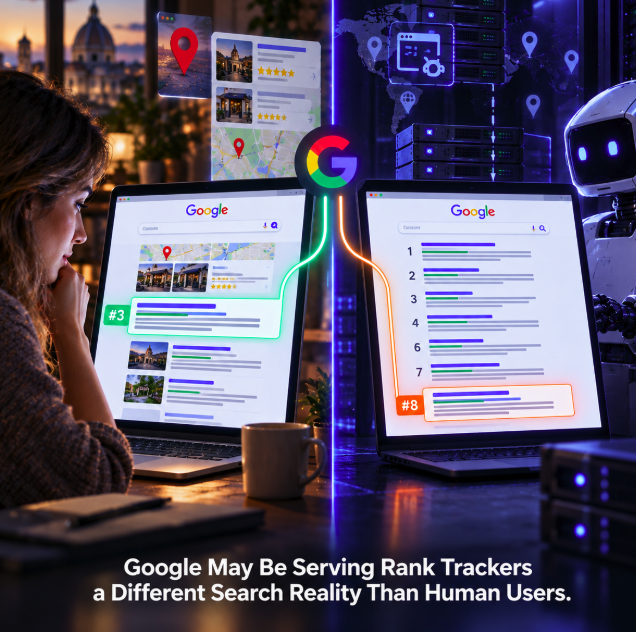

The familiar SEO argument—“my rank tracker says position eight, but I see position three”—may no longer have a single correct answer. Advanced Web Ranking says discrepancies between automated ranking reports and manual Google searches have widened since the May 2026 core update, creating what it calls a “dual-SERP reality” in which tracking systems and human users can receive meaningfully different versions of the same search results.
The analysis, published September 18 by Advanced Web Ranking, argues that the divergence is not a defect unique to AWR. The company says reports of mismatched rankings have appeared across the SEO industry and attributes the widening gap to three overlapping forces: increasingly precise localization, Google’s treatment of suspected automated traffic, and behavioral re-ranking that a clean rank-tracking query cannot reproduce.
AWR’s practical conclusion is more important than any single explanation: SEO teams should stop treating one recorded position as an absolute measurement. Rankings increasingly need to be interpreted as ranges and trends, triangulated with Search Console data and preserved SERP snapshots rather than reported as though every user receives the same ordered list.
The discrepancy intensified after the May 2026 core update
AWR says ranking tools have always differed from manual searches because of timing, location, personalization and ordinary SERP volatility. What changed after the May 2026 core update was the scale and direction of the mismatch. Agencies and in-house teams increasingly reported pages disappearing or falling sharply in trackers while continuing to appear on page one during localized manual checks.
The company places the change within a longer sequence. Google intensified anti-scraping enforcement in early 2025, creating data-collection problems across SEO platforms. It later retired country-code Google domains as separate localized search entry points, making location increasingly dynamic. Then the May 2026 core update, which completed in early June, coincided with a sharp increase in reports that tracked rankings and browser results no longer aligned.
AWR does not claim the core update alone created all three mechanisms. Its argument is that localization, automated-query differentiation and behavioral signals already existed, but their combined effect has become much more visible in ranking measurement.
Country-level rank tracking may represent a search nobody actually performs
The first problem is geography. A human search is anchored somewhere: a city, neighborhood or other location inferred from device and network signals. A rank tracker configured only for an entire country asks Google for a much less natural viewpoint.
AWR argues that after Google’s localization changes, country-wide automated queries increasingly receive a broader, more geographically neutral composition rather than a stable representation of what a user inside one particular city would see. That can make regionally strong businesses appear weaker or more volatile in national tracking than they appear to customers in their actual markets.
The practical implication is that precise-location tracking matters well beyond traditional local SEO. If a company’s customers are concentrated in London, Manchester and Glasgow, separate observations from those markets may provide a more useful picture than a single abstract “United Kingdom” position. A national ranking remains useful as a controlled benchmark, but it should not automatically be interpreted as the SERP seen by a typical user.
AWR says automated queries can receive a different SERP
The second explanation is the most consequential. AWR says Google can classify traffic using signals such as IP reputation, data-center ranges, request patterns, browser fingerprints and redirect behavior. When a query appears human, the company argues, Google can return a fully localized and behavior-informed page; when the query looks automated, the result can be different.
This is the basis of AWR’s “dual-SERP” description. Every conventional rank tracker depends on automated collection at scale. If Google identifies a collection request as automation and responds differently, the tracker may faithfully record the page it was given while still failing to reproduce what a human user sees.
AWR is careful to include itself in the limitation. It says there are collection conditions under which any tracker can receive a SERP that differs from the customer-facing page. The competitive question for rank-tracking providers therefore becomes how closely they reproduce realistic search conditions, how effectively they detect suspect responses and whether users can inspect the underlying SERP that produced a recorded position.
This interpretation fits a broader measurement problem already documented by NetContentSEO. Recent reporting found that Google’s anti-scraping measures are reducing the amount of usable SERP data some SEO providers can collect, with different platforms reporting sharply different visibility into the same search ecosystem.
Behavioral context makes the “neutral SERP” less representative
AWR’s third explanation concerns behavioral re-ranking. The company points to NavBoost, the Google system discussed during the U.S. Department of Justice antitrust case, and argues that aggregate click behavior increasingly contributes to the results humans encounter. A rank tracker, by design, normally sends a clean query without a user’s history or behavioral profile.
For years, that neutrality was considered a methodological advantage. The tracker attempted to capture an objective baseline free from personalization. AWR’s argument is that as real-user behavioral context matters more, the clean baseline itself may become less representative of the page most people actually experience.
That does not make either observation inherently false. A clean automated SERP can answer how Google responds under controlled conditions, while a manual search answers what Google showed one person in one location at one moment. The methodological mistake is collapsing those different observations into a single supposedly universal ranking number.
Search Console cannot provide an exact tiebreaker either
When manual and tracked rankings conflict, Search Console is an obvious place to look because it records impressions generated by real users rather than scraped SERPs. AWR nevertheless warns against treating Search Console’s average position as the definitive answer to a specific ranking dispute.
Average position combines observations across searches, devices, locations and time. A page might appear at position three during some impressions and position nine during others, producing an average that corresponds to neither the manual check nor the tracker snapshot. Search Console also reports a site’s own visibility rather than the complete competitive SERP.
The complexity increases as AI features become part of Search. NetContentSEO recently reported Google’s own acknowledgement that position in AI-enhanced Search is not an absolute physical measurement and that Search Console’s methodology will need to evolve as interfaces change.
AWR therefore recommends using Search Console directionally. If a rank tracker reports a dramatic collapse while real-user impressions and clicks remain stable, that divergence is evidence worth investigating rather than immediate proof of a ranking loss.
SEO reporting should move from points to ranges
The strongest recommendation in AWR’s analysis is methodological: report ranking positions as bands and trends rather than isolated integers. If a keyword repeatedly appears between positions four and seven across valid observations, the range communicates more truth than selecting one daily number and presenting it as the definitive rank.
This approach also changes how SEO teams discuss performance with clients and executives. A single position invites false precision and endless manual spot checks. Broader visibility measures—share of voice, top-three and top-ten distribution, impressions, clicks and trend direction—are more resistant to noise created by one SERP variant.
That does not make keyword tracking obsolete. Controlled measurements remain valuable for competitor comparisons, SERP-feature monitoring and detecting directional change. The adjustment is to stop treating a tracker as a machine that reveals the one true Google position and instead treat it as one observation system within a fragmented search environment.
Triangulation is becoming the new ranking methodology
AWR recommends combining three kinds of evidence: tracked positions with competitive context, Search Console trends based on real impressions, and dated SERP snapshots showing exactly what Google returned during collection. When all three point in the same direction, confidence rises. When they diverge, the divergence itself becomes diagnostically useful.
For example, a tracked ranking decline accompanied by falling Search Console impressions and matching SERP snapshots is much stronger evidence of a real visibility loss than a tracker decline alone. Conversely, stable real-user performance combined with a sudden tracker collapse can indicate a localization or collection problem that deserves investigation before an SEO team starts rewriting pages.
This logic mirrors another measurement problem emerging in generative search. NetContentSEO recently covered research showing that consumer chatbot interfaces and APIs can expose strikingly different source ecosystems. In both traditional and AI search, automated measurement increasingly risks observing a technically valid environment that is not identical to the one experienced by users.
The SERP is becoming a distribution, not a fixed page
AWR’s “dual-SERP” label is useful, but the deeper reality may be even more fragmented than two versions of Google. Search results vary by location, device, timing, user context, interface features and potentially the characteristics of the request itself. There is no reason to assume that two humans always see the same page, much less that an automated collector and a human browser must match perfectly.
That makes ranking measurement less intuitive but arguably more realistic. A website does not occupy one permanent coordinate in Google; it has a distribution of visibility across users and contexts. Rank trackers sample that distribution under controlled conditions, Search Console summarizes what happened across real impressions, and manual searches provide individual localized observations.
The useful question for SEO teams is therefore shifting from “What is our rank?” to “Across the searches that matter to our customers, is our visibility improving or deteriorating?” AWR’s analysis suggests that in 2026, answering that question requires several measurements—not one integer in a dashboard.