

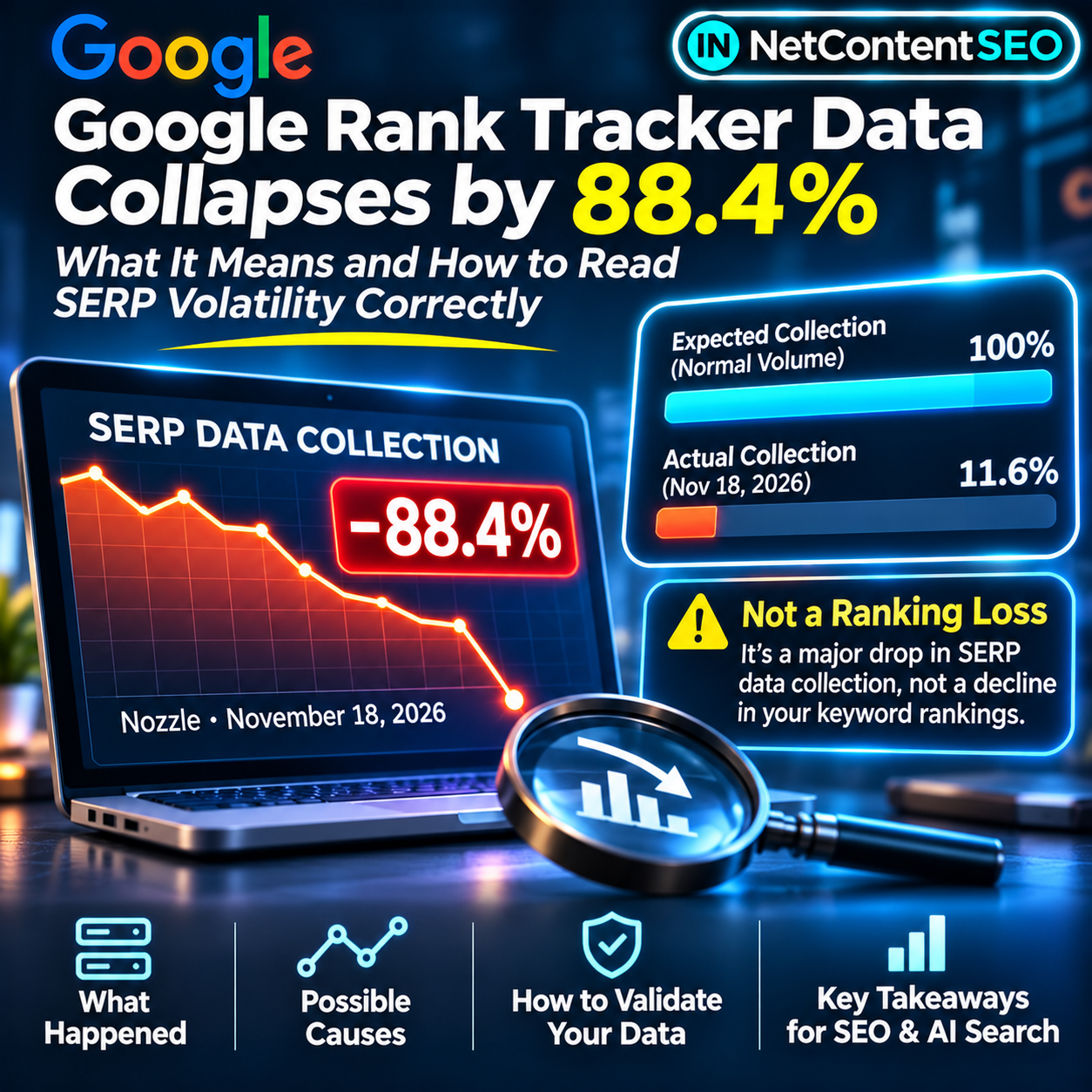

A ranking dashboard can look alarming even when its underlying problem is incomplete observation. On November 18, 2026, Nozzle experienced a major disruption in Google results delivered through its five data providers. The incident, discussed by NeoTeo and Search Engine Journal, highlights a fundamental distinction between search performance and measurement reliability.
What the numbers actually measure
Expected — 100%
Delivered — 11.6%
88.4% shortfall
Derived from reported collection over ten hours, not ranking changes or market-wide data.The measurement covers 8 a.m. to 6 p.m. ET. The aggregate hourly trough was 1.6% of the pre-disruption rate. All five suppliers experienced major interruptions, but the evidence does not quantify effects on unrelated tracking platforms.
Mobile access and authentication challenges
Earlier — approximately 19%
During disruption — approximately 90%
Device-specific figures from one provider, not the entire Google ecosystem.Authentication prompts were another obstacle. Google engineering executive Rajan Patel indicated that a first-page sign-in requirement might be an experiment. This does not establish a permanent change or prove that the November disruption was deliberately targeted at SEO tools or AI agents.
Why core updates make measurement failures harder to interpret
The incident overlapped with the November core update. Coincidence does not establish causation. A system that converts missing observations into a lowest-possible rank can manufacture apparent losses. A system that drops missing observations may instead introduce selection bias. Both can distort aggregate volatility.
How to validate a volatility signal
↓
↓
Flag uncertainty; do not assign missing ranks
Investigate genuine ranking changes
↓
Use our Search Volatility Monitor to compare independent volatility signals. Keep in mind that agreement between providers can still reflect shared upstream dependencies. Compare device-specific impressions, clicks and average position in Search Console. Its aggregated position metric is not identical to a fixed-location rank observation. Follow Google's core update guidance and allow at least a full week after completion before comparing pre-update and post-update periods.
Build data quality into rank tracking and GEO dashboards
Separate unsuccessful retrieval from a valid result in which a domain is absent. Record scheduled requests, valid responses, blocked requests, parsing failures, freshness and sample composition. Use matched keyword panels when comparing periods. Carry missing values explicitly through calculations rather than treating them as zero.
| Metric | Suggested definition |
|---|---|
| Collection coverage | Valid observations divided by scheduled observations |
| Block rate | Blocked attempts divided by total attempts |
| Matched sample | Comparable valid observations across both periods |
| AI citation rate | Answers citing target domain divided by valid evaluated answers |
For AI visibility measurement, distinguish an inaccessible engine from a successful answer containing no mention. Report the denominator and mark low-coverage periods. This is a proposed measurement discipline rather than evidence that AI engines experienced the same incident.
Conclusion
A trustworthy dashboard should tell readers whether it observed enough of the search environment to support its conclusions. The Nozzle incident is a useful reminder that collection health belongs alongside ranking and citation metrics. The original Nozzle report was not independently retrieved for this article; incident figures are attributed to the cited coverage. The scope and cause of any wider disruption remain unconfirmed.