

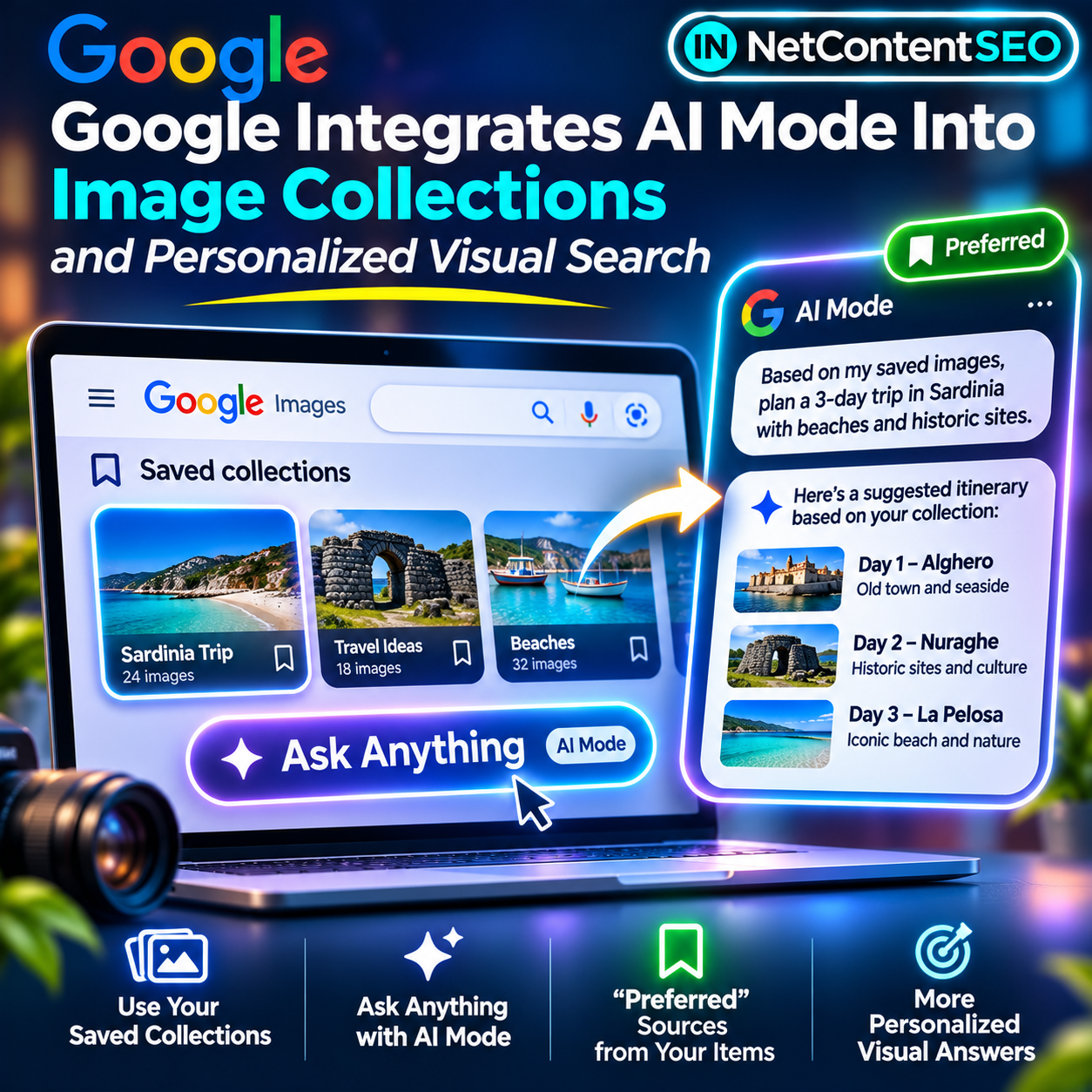
Google is bringing conversational search into saved image collections, according to a November 25, 2026 report by Barry Schwartz. The observed Ask Anything button allows users to ask questions using their saved collection as context. The feature suggests a closer connection between visual discovery and subsequent research.
This is an observed interface change, not a confirmed universal rollout. Google has not disclosed the underlying source-selection weights.
From saved images to conversational research
Instead of starting every search from scratch, users can build a collection of visual references and subsequently ask questions about the material. A traveler might collect photographs of coastal destinations before asking for an itinerary. A designer might gather interiors before asking about common materials or styles. These are illustrative use cases, not independently tested product capabilities.
↓
Multiple visual references and associated context
↓
↓
Additional information
Observed label associated with saved items
↓
NetContentSEO conceptual interpretation of the observed interface, not an official Google architecture.
What the Preferred label means — and what it does not
The report describes a Preferred label associated with sources from saved items. This is noteworthy because the user's earlier choices may become visible context for a subsequent answer. It does not establish a general ranking boost, a guaranteed citation or a relationship with other Google preferred-source features. The exact selection mechanism remains undisclosed.
Implications for visual SEO
Images can support discovery long before a user is ready to purchase, book or make a decision. Publishers should consider the usefulness of their images beyond the initial click. Original photographs, descriptive surrounding text, accurate captions and accessible image URLs can help users and automated systems understand the subject.
Google's image SEO guidance provides a practical foundation. Use relevant images on useful pages, descriptive alternative text and appropriate image formats. Avoid treating image metadata as a substitute for meaningful content or as a guaranteed route into AI answers.
How different industries could benefit
| Industry | Illustrative collection | Potential follow-up question |
|---|---|---|
| Travel | Beaches and historic sites | Which places fit a three-day itinerary? |
| Ecommerce | Furniture or clothing | Which options fit my needs? |
| Architecture | Building and interior references | What materials and styles do these share? |
| Food | Recipe photographs | What dishes could I prepare? |
Measuring personalized visual discovery
GEO measurement should distinguish ordinary image search, AI answers without saved context and answers generated from collections. A controlled experiment could compare identical questions with and without a relevant saved collection, recording cited domains, visible labels, answer relevance and repeated observations. Account settings, geography and time should be documented. A single observation cannot establish causality.
Publishers should also separate image search impressions and clicks from AI citations and attributable referral visits. The existence of a saved image does not prove that its publisher will receive traffic. No measured CTR or conversion impact is available in the supplied report.
Conclusion
The observed integration points toward a search experience in which earlier visual discoveries can inform later conversations. For SEO teams, the opportunity is to make visual content useful, identifiable and connected to trustworthy information. For GEO teams, the challenge is to measure personalized contexts separately rather than assume every user receives the same answer.
Source: Search Engine Roundtable, November 25, 2026. The feature remains an observed development; worldwide availability and ranking effects are unconfirmed.