

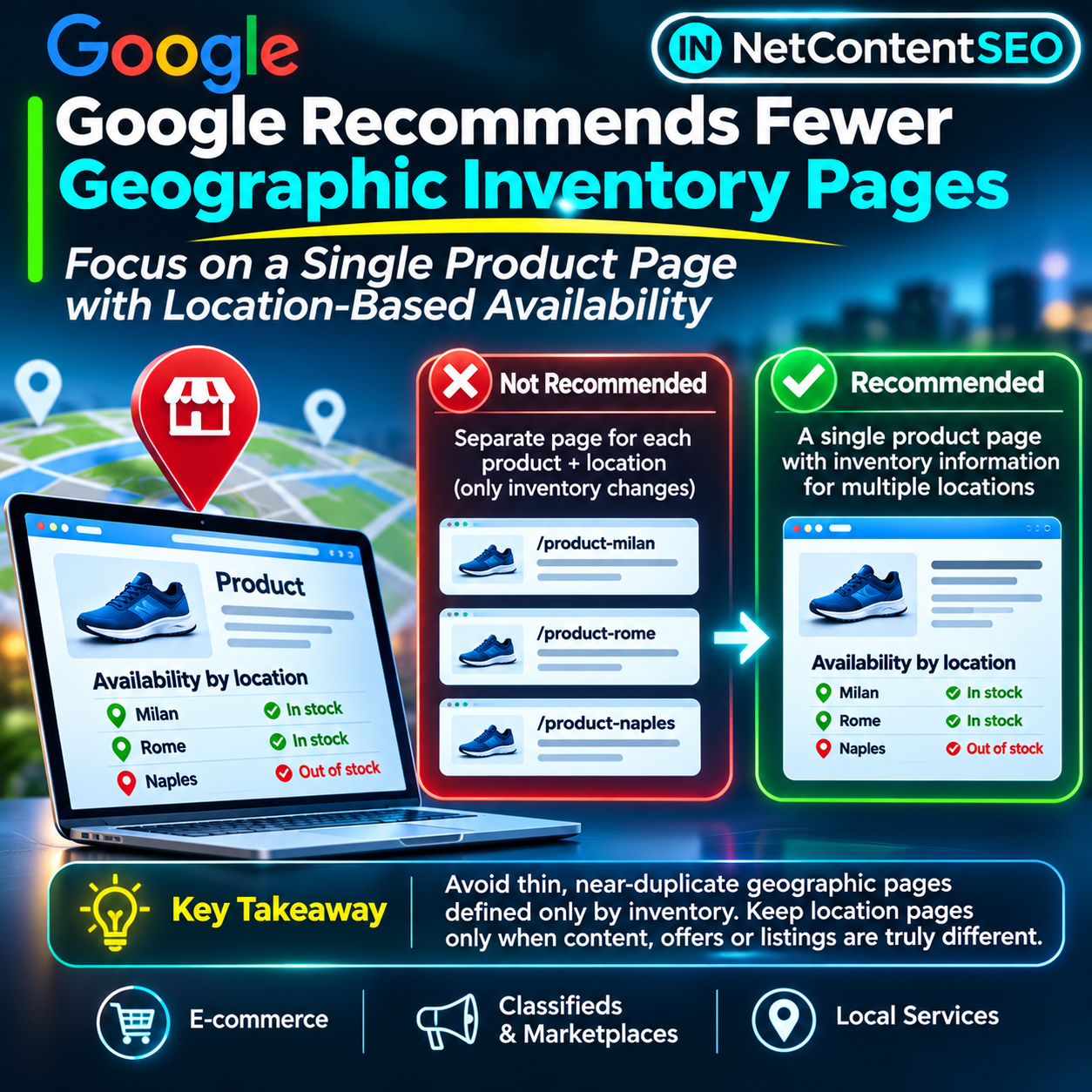

Large ecommerce websites and marketplaces can generate thousands of geographic URLs from a relatively small catalog. But when the only difference between pages is local stock availability, creating a separate indexable page for every combination may not be the most useful architecture.
According to the November 25, 2026 report from Search Engine Roundtable summarized in our editorial brief, Google's John Mueller suggested consolidating such inventory information into a product page that shows availability across locations. This is architectural advice, not an announcement of a new ranking penalty.
Two approaches to geographic inventory
Product catalog
↓
Same product, different stock status.
Product catalog
↓
Milan — In stock
Rome — In stock
Naples — Out of stock
One product page with location-specific availability.
NetContentSEO illustrative architecture; inventory values are fictional.
The scale of the URL problem
Consider a hypothetical retailer with 1,000 products and 50 locations. A full product-location matrix creates up to 50,000 URLs. A consolidated product catalog would contain 1,000 product URLs, excluding separate store pages and other necessary routes. This represents a 98% reduction in product-related URL combinations in this simplified example, not a measured improvement in rankings or crawl efficiency.
Product × location — 50,000
Consolidated product URLs — 1,000
Hypothetical calculation, not Google performance data.
When geographic landing pages deserve to exist
The distinction is search intent and substantive local value. A classifieds marketplace may have different listings, sellers and services in each city. A hotel directory may offer different properties, transport information and neighborhood guidance. A retailer's physical store page may provide its own address, opening hours and pickup services. These pages can serve independent needs even when they share a template.
Google's spam policies address doorway abuse, including pages designed to funnel users toward essentially the same destination. Shared templates alone do not establish doorway abuse. Evaluate the purpose and usefulness of the actual page.
Decision framework for marketplaces
Consider a dedicated indexable landing page
Consider consolidation or a non-indexable filter
Editorial decision framework, not an official Google ranking rule.
Technical implementation
Audit existing URLs using search performance, inventory coverage, internal links, canonical declarations and actual user needs. Keep local pages with meaningful independent value. For redundant URLs, choose the appropriate treatment: permanent redirects when a page is genuinely replaced, canonical annotations for duplicate or very similar pages, or noindex when a page should remain accessible but excluded from search. These mechanisms have different purposes and should not be applied interchangeably.
Google provides separate documentation on duplicate URL consolidation and faceted navigation. Keep internal links and sitemaps aligned with preferred URLs. Ensure local availability is accessible and accurate, and account for any requirements of merchant feeds or local inventory programs before changing product URLs.
Implications for AI Search and GEO
A coherent product page with clearly labeled location-specific availability may make retrieval and interpretation easier for automated systems. Conversely, a genuinely useful city directory can be the better source for a geographically specific question. Neither outcome is guaranteed by this reported advice. Measure organic visibility, indexed URLs, local query performance and AI citations separately before and after changes.
Conclusion
Do not remove geographic pages indiscriminately. Consolidate inventory-only duplication where appropriate, preserve pages that serve distinct local needs, and validate the effects of changes through actual search data. The goal is a useful website structure rather than an arbitrary reduction in page count.
Source note: The November 25 Mueller statement is attributed to the supplied Search Engine Roundtable report; its exact article URL and original statement were not independently available during this save. The architectural examples and GEO implications are NetContentSEO analysis.