

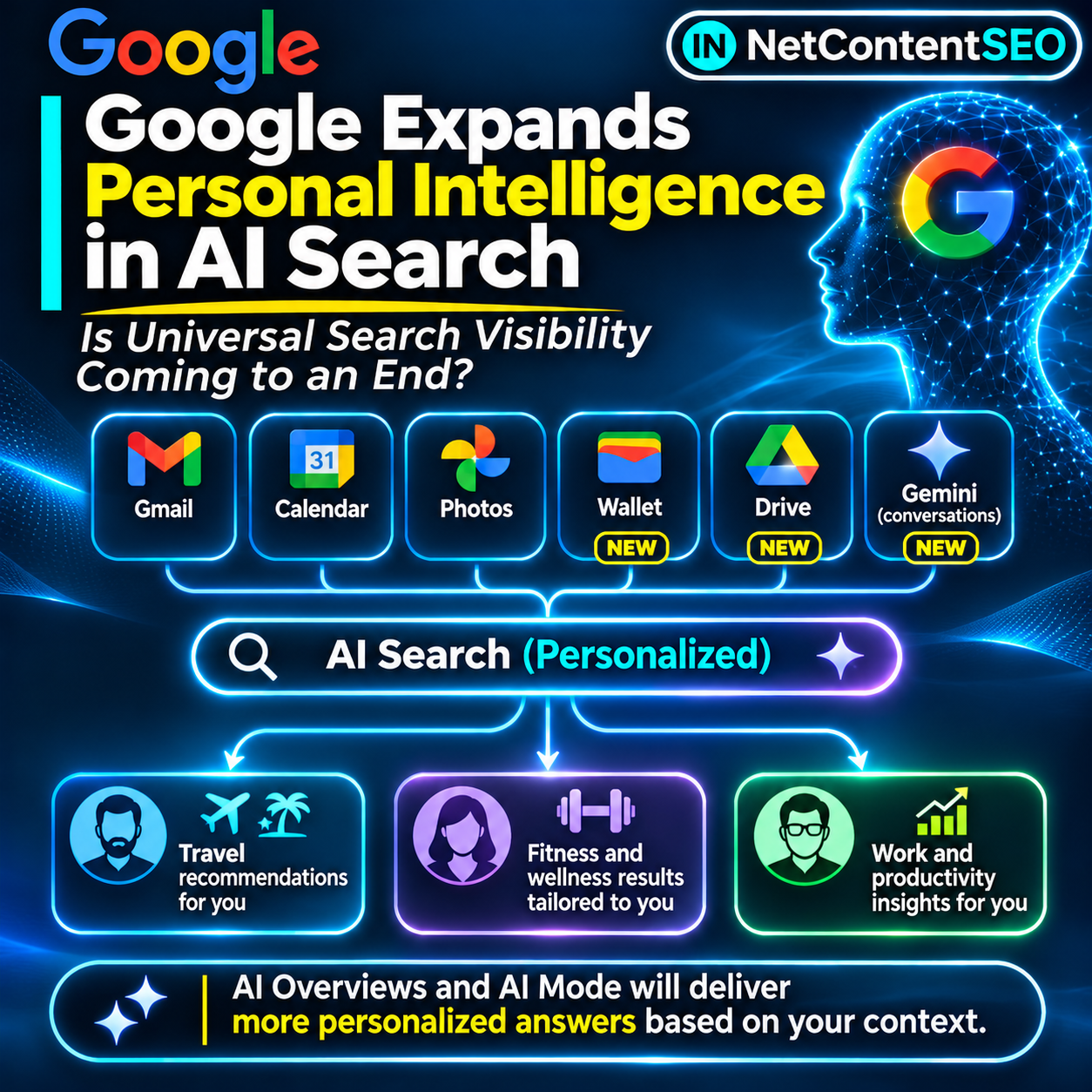

Google is expanding the personal context available to its generative search experiences, raising an important question for search marketers: how representative is any single AI answer? On November 23, 2026, Google Search product executive Robby Stein announced additional app connections and more context-aware answers. The development was also covered by Barry Schwartz at Search Engine Roundtable.
What Google has announced
According to the official announcement, the Wallet integration began rolling out on November 23. Drive and Gemini app integrations are planned for the following weeks. These additions extend existing connections with Gmail, Calendar and Photos. Users must choose to connect the apps. Wallet access is read-only and does not authorize financial transactions. Google also plans to provide an interface explaining the personal context behind tailored responses.
Separately, both AI Overviews and AI Mode will make greater use of recent search context. Users can manage personalization in Search settings. The announcement does not establish universal availability across accounts and countries.
From query-centric search to context-sensitive discovery
Search has never been completely uniform: location, language, device and other conditions can influence results. The emerging difference is the scope of contextual information that can inform generated answers. A generic request for a weekend itinerary might become a specific recommendation shaped by an existing booking or a previous discussion. A product comparison might emphasize compatibility with equipment the user already owns. These are illustrative possibilities, not verified outputs from this rollout.
A conceptual model of personalized AI visibility
↓
Relevant indexed sources
Recent searches and authorized app connections
↓
↓
Possible recommendation A
Possible recommendation B
Standard test response
Illustrative NetContentSEO framework, not a diagram of Google's internal architecture. Different recommendations are possible, not guaranteed.
Three visibility dimensions for GEO
SEO teams should distinguish conventional organic rankings from AI citations observed under standardized conditions and AI citations observed in contextualized sessions. A single test account cannot establish what every customer sees. Nor can marketers reconstruct the private context of an entire audience from aggregate analytics.
| Dimension | What to measure |
|---|---|
| Organic visibility | Rankings, impressions, clicks and conversions |
| Standard AI visibility | Brand mentions, citation frequency and linked URLs under documented baseline conditions |
| Contextual AI visibility | Variation in recommendations and citations across controlled, consented scenarios |
How to measure personalization without invading privacy
Define synthetic research scenarios representing different needs, such as a traveler with a rental car versus one relying on public transport. First test those explicit constraints in otherwise comparable sessions. Then, where features are available and permitted, compare responses from consenting test accounts with known personalization settings. Record language, market, query, conversation history and feature availability. Explicit constraints are a proxy for contextual relevance, not proof that connected-app personalization behaves identically.
Repeat tests because generated answers can vary even without personalization. Report sample sizes, separate mentions from citations and evaluate how often each recommendation changes between conditions. Never collect private documents or financial details merely to create SEO benchmarks.
Implications for publishers and businesses
Build content that resolves different legitimate customer needs rather than attempting to manipulate personal profiles. A travel publisher can describe accessibility, transport alternatives and booking conditions. A software vendor can document compatibility, pricing and deployment limitations. These attributes give readers useful information regardless of how they discover it. They are not newly confirmed Google ranking signals.
Relationship to the December core update
The December core update preannouncement also highlights personalization and complex queries, but this does not prove that the app integrations are part of that ranking deployment. Follow official update notices and our Search Volatility Monitor for conventional ranking fluctuations, while measuring generative visibility independently.
Is universal search visibility ending?
Not necessarily. Shared public information and standardized measurements remain valuable. What becomes less defensible is interpreting a single observed answer as a universal result. Google has not disclosed how personal context affects citation-selection weights or supplied evidence quantifying changes in publisher traffic. The practical opportunity is to build a more representative measurement strategy that treats context as an explicit variable rather than an invisible source of noise.