

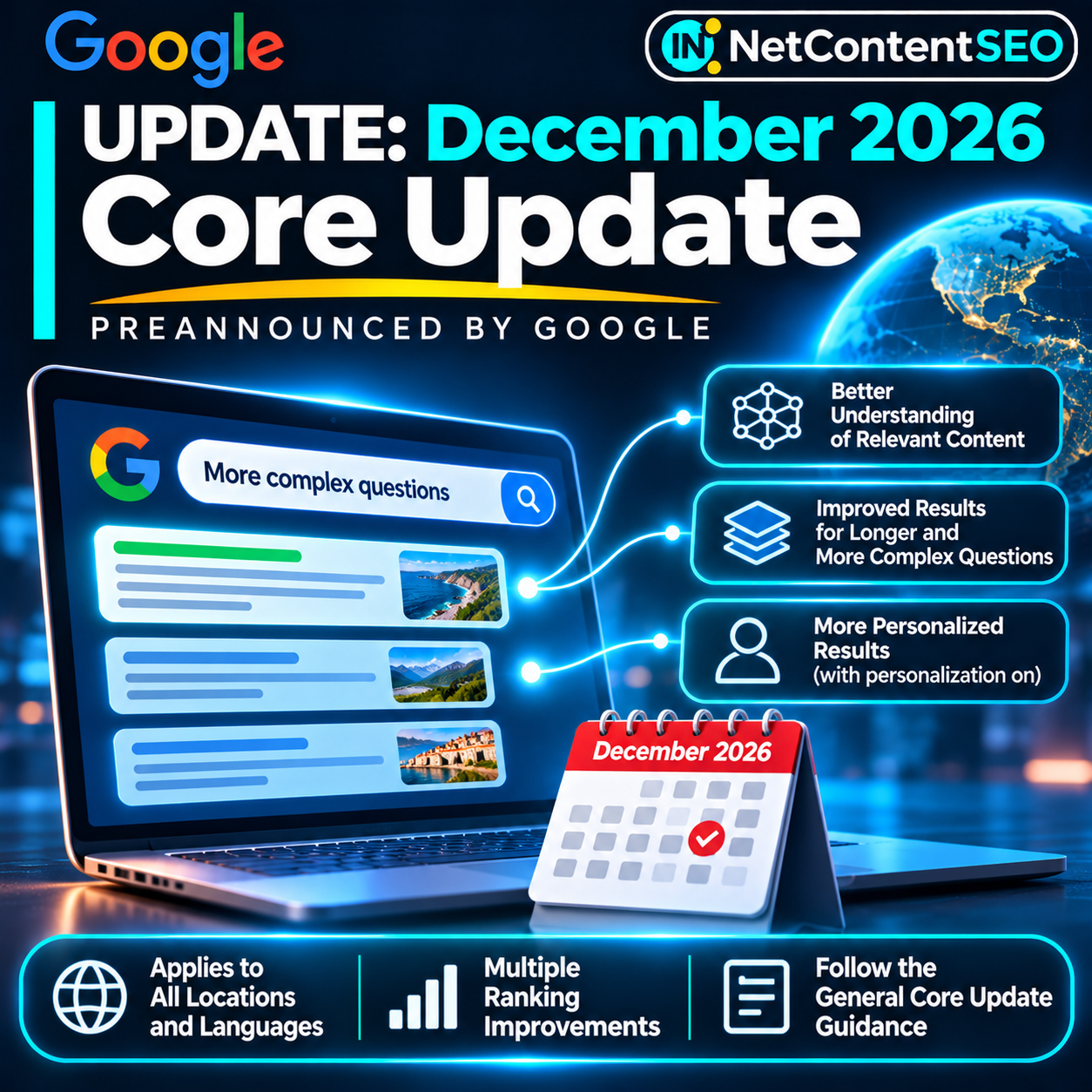

Google has announced its next broad core update before deployment, with complex questions and personalized search among its stated priorities. The December 2026 core update was preannounced on November 24, shortly after the November update finished. No exact December release date has been provided, and the new update is not yet rolling out.
What Google has confirmed
The official Google Search Status Dashboard notice, published at 07:03 PST on November 24, identifies improvements in content understanding and relevance ranking, explicitly including more complicated and longer searches. It also describes planned improvements to personalization for users who have enabled it. The update will cover every supported Search language and market, and Google's existing core update guidance remains applicable.
The dashboard records an incident start at 07:02 PST, but this is the opening of the announcement record, not the beginning of algorithm deployment. Barry Schwartz obtained confirmation from a Google spokesperson that the rollout was not active, as reported in Search Engine Land and Search Engine Roundtable.
November is finished; December has not begun
The Google Search Status Dashboard confirms that the November update finished on November 24 after almost fourteen days. This creates an important distinction for SEO analysis: movements observed today should not automatically be attributed to December's forthcoming changes. They may reflect the previous rollout, normal fluctuations or shifting demand.
Why complex queries matter
A query such as “Sardinia beaches” expresses a broad interest. A question asking which beaches near Alghero are accessible without a car, suitable for children and subject to advance booking combines multiple requirements. A useful result must address those constraints rather than simply repeat the destination name.
Google's announcement suggests that interpreting and ranking material for these more demanding requests is a development priority. It does not establish a preference for longer articles, a required word count or a new keyword formula. The practical editorial objective is to provide accurate information that resolves the user's actual problem, including limitations and exceptions where necessary.
Answer completeness and actionability
For publishers, the most valuable response is to identify the decisions readers need to make. A travel guide can explain access rules, booking procedures, prices, dates and transport alternatives. A technical article can state prerequisites, show a working implementation and explain how to troubleshoot failures. An ecommerce comparison can clarify compatibility, availability and trade-offs.
These are editorial recommendations, not newly confirmed ranking factors. A concise page can fully answer a narrowly defined question, while a lengthy page may still omit essential information. Content should be as comprehensive as the task requires, not artificially expanded to target the update.
Personalization complicates rank tracking
Google specifically limits its stated personalization improvements to people who have enabled that feature. The announcement does not identify the precise signals or weights that will change. It also does not imply that every search result will become uniquely personalized.
Nevertheless, a standardized ranking observation may not capture the complete experience of a user with different interests and settings. SEO teams should document the geography, language, device and personalization conditions of their tests. Search Console averages and actual user outcomes provide useful complementary evidence, but aggregated data cannot isolate personalization effects on its own.
Is this an AI Mode or AI Overviews update?
The announcement concerns core Search ranking. It does not establish a specific change to AI Mode source selection or AI Overview citations. Complex questions are relevant to both conventional search and conversational interfaces, making this direction strategically interesting for GEO. But traditional rankings, generated-answer citations and referral traffic must be measured separately. A change in one does not prove a change in another.
Why advance notice matters
Schwartz also reports that Google has published guidance about notifying site owners of material ranking and policy changes. Its advance-notice approach includes considerations relating to the UK's Competition and Markets Authority requirements. This is useful context, not proof that regulatory obligations uniquely determined the timing of this particular announcement.
Advance notice allows publishers to prepare measurement baselines and plan resources. It does not provide a precise algorithm specification or a guaranteed method of avoiding losses.
Follow the rollout with NetContentSEO
Our Search Volatility Monitor brings together independent volatility signals from platforms including Semrush Sensor, MozCast, AccuRanker Grump, AWR and Mangools. Each retains its own scoring scale. Compare changes in direction and timing rather than treating different numeric scores as equivalent. The monitor can identify periods worth investigating, but it cannot establish the cause of an individual ranking loss.
What website owners should do now
- Record November 24 as the announcement date, not the December rollout date.
- Preserve Search Console baselines by page, query, country and device.
- Review content that leaves important user questions unanswered or offers outdated practical information.
- Keep a representative set of complex searches for repeated measurement.
- Track traditional rankings and AI citations independently.
- Account for Black Friday, Cyber Monday and seasonal demand when comparing periods.
- Wait for official rollout completion and sufficient post-update data before making drastic changes.
What remains unknown
Google has not announced the exact release date, rollout duration, individual ranking signals or expected impact by industry. There are no measured December update winners or losers yet. Nor has Google confirmed a specific effect on publisher CTR, AI referrals or citation visibility.
The bottom line
The December update's stated focus makes intent resolution and personalized discovery important topics for SEO research. For now, the strongest strategy is accurate, useful content and a disciplined measurement plan. Follow the NetContentSEO Search Volatility Monitor once Google confirms that deployment has started.
Sources: Google Search Status Dashboard, November 24, 2026; Barry Schwartz, Search Engine Roundtable; Search Engine Land; Search Engine Journal.