

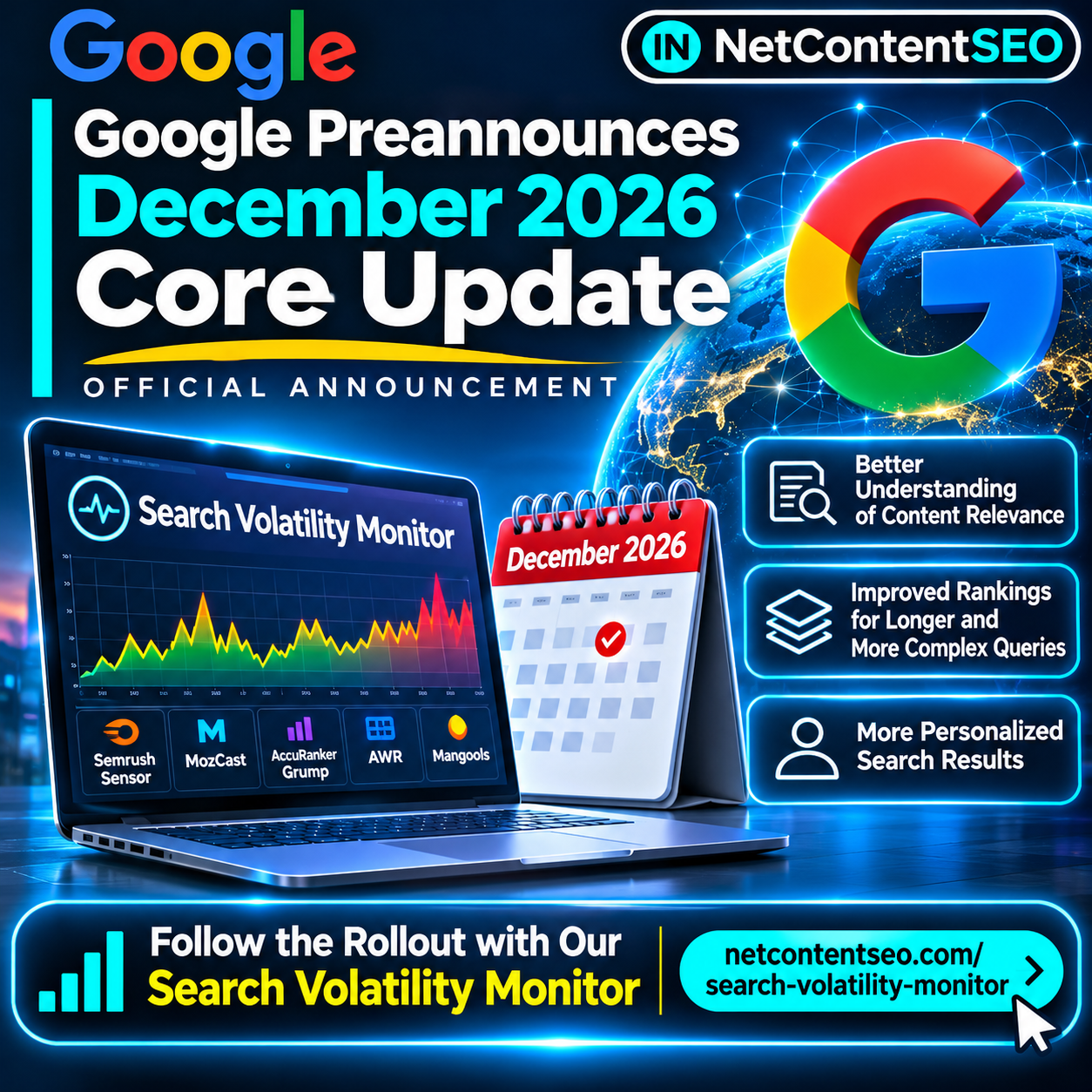

Google's preannouncement of the December 2026 core update gives SEO professionals an opportunity to establish a measurement baseline before deployment. Rather than waiting for rankings to move, website owners can begin documenting ordinary search fluctuations today using the NetContentSEO Search Volatility Monitor.
What the announcement means for monitoring
The November 24 notice on the Google Search Status Dashboard identifies improvements to relevance, complex queries and personalization for users who enable it. The update is scheduled for December and covers all supported languages and locations. The announcement itself is not evidence of active deployment. The live dashboard could not be retrieved for this follow-up, so readers should consult it for the latest rollout status.
Five independent perspectives on ranking volatility
Our monitor brings together Semrush Sensor, MozCast, AccuRanker Grump, Advanced Web Ranking and Mangools. These platforms measure fluctuations using their own samples and methodologies. Their numerical scores are not directly interchangeable. Instead, examine whether several sources move in the same direction over a comparable period and whether unusual movement persists.
Visit the live Search Volatility Monitor to inspect the available daily readings. No new numerical observations are asserted here because we could not retrieve the current chart during preparation.
Build a baseline before December
Export Search Console performance by page, query, country and device. Keep a representative set of informational, commercial, navigational and complex queries. Record the date and testing conditions, including personalization where possible. Compare equivalent weekdays and account for holiday demand around Black Friday and Cyber Monday.
Record organic impressions, clicks, average position and CTR separately. A decline in clicks can occur without a proportional change in rankings, for example when demand changes or the search results page acquires additional features.
How to interpret volatility once deployment begins
A broad increase across independent trackers can indicate widespread ranking movement, but cannot identify the cause of a particular website's losses. Use Google's confirmed rollout dates alongside your own performance data. Examine affected page groups and query intents rather than drawing conclusions from a single keyword or one day of data.
Personalized results introduce additional variability. A standardized ranking test remains useful, but does not represent every user's experience. Long and complex searches also deserve a dedicated cohort because Google has explicitly highlighted them in its announcement.
Keep SEO and GEO measurements separate
Monitor traditional rankings, AI answer citations and referral traffic independently. Google's stated focus on complex questions is relevant to conversational discovery, but does not establish a change to AI Mode citation selection. Test whether content answers practical follow-up questions, provides reliable evidence and explains important limitations. Treat those improvements as editorial quality measures rather than guaranteed ranking factors.
A practical monitoring routine
- Capture a baseline before the confirmed start date.
- Check the official dashboard for deployment announcements.
- Review independent volatility indicators daily during the rollout.
- Investigate affected pages and query cohorts rather than reacting to isolated spikes.
- Wait for confirmed completion and sufficient post-update data before attributing sustained changes to the update.
Follow the data, not the speculation
The December core update represents an opportunity to study how relevance and complex search intent evolve. The most useful preparation is a reliable baseline and consistent measurement, not speculative algorithm adjustments. Bookmark the NetContentSEO Search Volatility Monitor to follow the independent indicators as the rollout develops.