

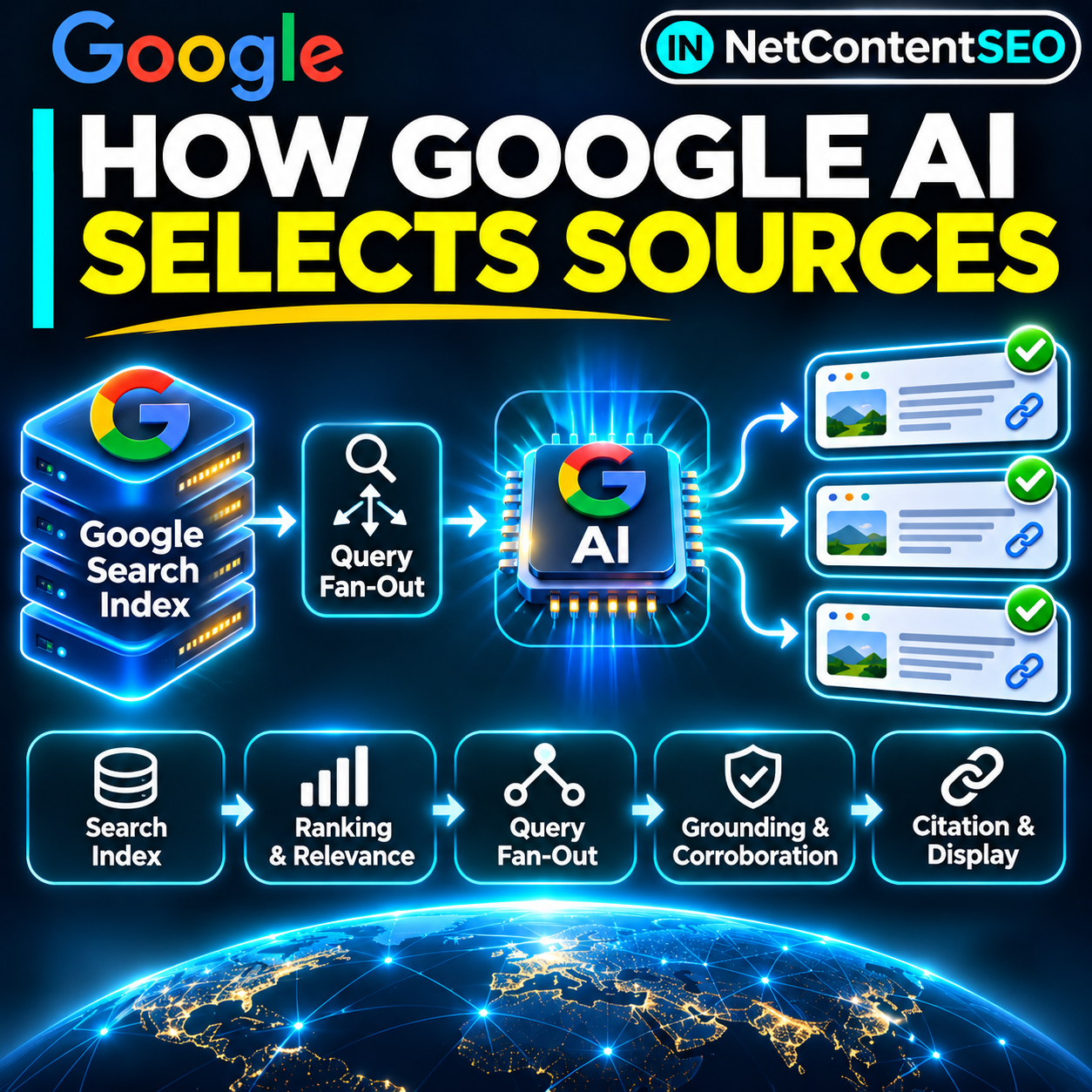

Google has explained how its generative search experiences connect answers with web sources. Its November 24 documentation offers a valuable framework for understanding the relationship between traditional search ranking and generative visibility. The official attribution and factuality guide describes mechanisms rather than publishing a new ranking formula.
How Google AI Search selects sources: a visual workflow
Original question and information needs
Ranking, relevance, freshness and eligible web content
Related searches and retrieval of supporting information
Answer generation, evidence and factual cross-checking
Supporting links, placement and presentation
Generated answer with accessible web sources
NetContentSEO editorial interpretation of Google's documentation. Not an official algorithm diagram or a strictly sequential specification.
1. Google Search Index: traditional SEO remains foundational
Google describes generative search as integrated with its established search infrastructure and a customized Gemini model. Search ranking and retrieval help identify relevant material. Indexing and eligibility to appear with a snippet remain important prerequisites, but eligibility does not guarantee selection. Freshness matters when the question calls for current information; constantly changing dates is not a substitute for substantive updates.
Publishers should prioritize accessible text, sound technical SEO, accurate information and clear source attribution. Google has not disclosed the numerical weights of individual signals.
2. Query fan-out: one question can involve multiple searches
Generative search can investigate related aspects of a question rather than relying solely on results for its original wording. Consider a traveler asking which beaches near Alghero can be reached without a car and require reservations. Related searches might concern bus routes, beach access restrictions and booking procedures. These are illustrative subqueries, not a record of Google's actual internal searches.
A specialist page answering one component may therefore be useful even when it does not rank prominently for the entire original question. This possibility makes topic coverage and answer completeness important editorial considerations, without establishing a guaranteed citation strategy.
3. Grounding and corroboration: connecting answers to evidence
Grounding connects generated statements with retrieved information. Corroboration involves checking information against supporting evidence. Google's safeguards and quality evaluations aim to improve factual reliability, but errors remain possible. A fluent answer is not proof that every claim is supported.
For publishers, clearly identifiable sources, precise dates, original research and unambiguous factual statements make information easier for readers to verify. These are practical editorial recommendations rather than disclosed individual ranking factors.
4. Citation and display: retrieval does not guarantee a visible link
The selection and presentation of links are distinct from retrieving information. A source can be useful to the generation process without receiving the most prominent visible attribution. Link placement, relevance and presentation influence the opportunity for readers to discover a publisher. The documentation does not provide a complete formula for citation selection or guarantee traffic.
Four different outcomes that GEO teams should measure
| Stage | Measurement |
|---|---|
| Retrieval | Whether a source was retrieved; generally not directly observable externally |
| Grounding | Whether evidence supports a claim; internal use cannot always be established |
| Visible citation | Linked domain, URL, frequency and placement in sampled answers |
| Referral | Observable visits and conversions where attribution is available |
A practical GEO measurement framework
- Check indexing and snippet eligibility.
- Sample complex questions by language, market and device.
- Record brand mentions separately from linked citations.
- Check whether cited pages support the associated statements.
- Record citation placement and distinguish related reading links from supporting citations.
- Repeat observations and compare with available first-party traffic and conversion data.
Citation frequency can be defined as the proportion of sampled answers containing a link to a domain. Attribution accuracy can be measured as the proportion of evaluated citations that support their associated claims. These are proposed analytical metrics, not official Google scores. Define denominators and sampling conditions consistently.
Does this explain the December 2026 core update?
Google's December core update preannouncement also emphasizes relevance and complex questions. However, the timing does not establish that the attribution guide describes changes introduced by that update. Follow confirmed rollout dates and independent ranking fluctuations through our NetContentSEO Search Volatility Monitor. Measure ranking volatility separately from AI citation visibility.
What remains unknown
Google has not disclosed exact signal weights, every internal query, the complete citation-selection formula or a guaranteed method of obtaining links. External monitoring cannot directly observe all retrieved documents or establish every source used internally. The diagram above is a conceptual explanation, not a claim about the exact execution order of Google's proprietary systems.
The bottom line
GEO complements rather than replaces SEO. Accessible, relevant and trustworthy content provides a foundation for discovery. Generative visibility introduces additional questions about evidence, attribution, presentation and user engagement. Understanding these distinctions is more useful than treating every AI mention as a ranking or every citation as a visit.
Primary source: Google Search Central — Attribution and Factuality.