

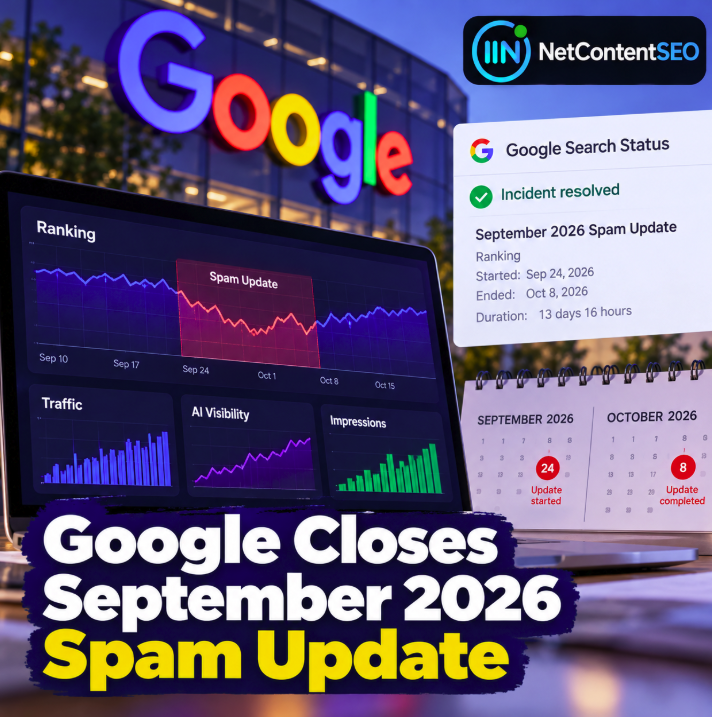

October 8, 2026. Google has completed the September 2026 spam update. According to the Google Search Status Dashboard, the ranking-system rollout began on September 24 and ended on October 8, lasting approximately 13 days and 16 hours. The completion marks the end of the announced rollout—not proof that every ranking movement has already settled.
September 2026 spam update: key dates
- September 10–23: suggested pre-update baseline for comparison.
- September 24–October 8: rollout window; annotate it separately in analytics.
- From October 9: post-rollout monitoring window; extend it long enough to compare equivalent weekdays.
Google classifies the incident under Ranking. That does not mean every loss or gain during these dates was caused by the update. Seasonality, technical changes, competitor activity and normal search volatility remain possible explanations.
How to analyze the impact in Google Search Console
Export daily clicks, impressions, average position and CTR for each of the three windows. Segment by country, device, search appearance and page type. Compare individual queries and URLs rather than relying on sitewide averages, which can conceal opposing movements. A fair comparison should normalize for the number of days and day-of-week patterns.
In Google Analytics 4, review organic landing-page sessions and conversions alongside Search Console clicks. They measure different things and should not be treated as interchangeable. Annotate any releases, migrations, robots changes or content removals that overlap the rollout.
Separate ranking changes from indexing issues
If a page disappeared, check its indexing status, canonical selection, robots directives, server response and crawl logs before concluding that a spam classifier affected it. A decline in impressions can reflect lower rankings, lower demand or loss of index coverage; each calls for a different investigation.
What about AI Overviews and AI visibility?
Track citations and mentions in AI Overviews and other AI search experiences as a separate observational dataset. There is no basis in the rollout completion notice to assert a direct, measured effect on AI citations. Where possible, preserve dated screenshots or query-level observations and distinguish visibility changes from ordinary ranking fluctuations.
What should site owners do now?
Do not rush into broad sitewide changes on the day of completion. First identify which URLs and query clusters moved, whether the change persists after the rollout, and whether it coincides with technical or editorial events. Review Google's spam policies for practices such as scaled content abuse, cloaking and manipulative links, but avoid diagnosing a particular violation without evidence.
NetContentSEO analysis checklist
- Freeze the September 10–23 baseline.
- Label September 24–October 8 as the rollout period.
- Begin post-rollout comparisons on October 9, using equal-length windows once sufficient data is available.
- Segment Search Console metrics by page, query, country and device.
- Cross-check GA4, indexing and crawl logs.
- Audit AI citation visibility separately, without attributing causality prematurely.
Official source: Google Search Status Dashboard. See also Google Search spam policies.