

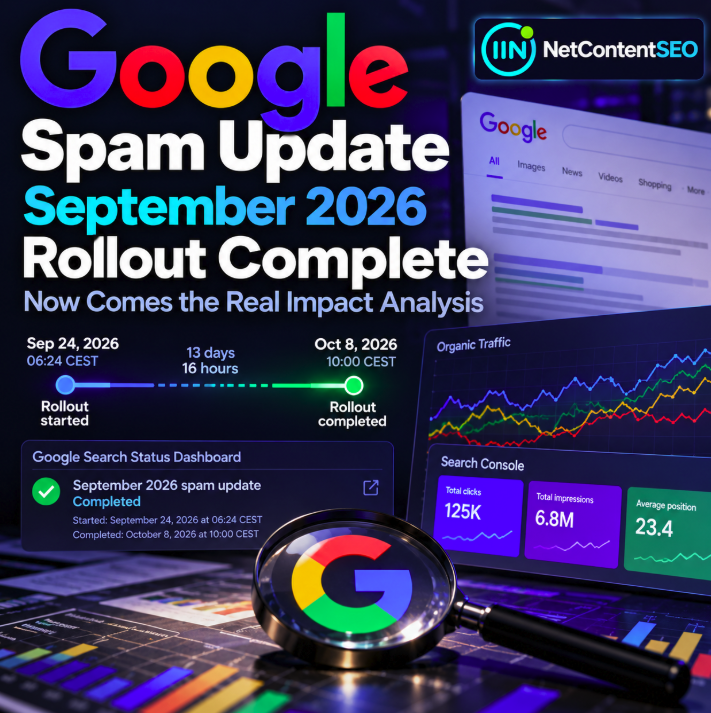

Google's September 2026 spam update has finished rolling out. According to the Google Search Status Dashboard incident cited in the official announcement, the global, all-language update began on September 24, 2026 and completed on October 8, 2026 at 10:00 CEST. The completion communication was reported at 10:37 CEST. The rollout lasted approximately 13 days and 16 hours.
The end of the rollout gives publishers a clearer point from which to examine their performance, but it does not mean that every ranking fluctuation has stopped or that every traffic change during the period was caused by the spam update. The next step is evidence-based impact analysis, not immediate assumptions about penalties.
September 2026 spam update: key facts
| Item | Details |
|---|---|
| Update | September 2026 spam update |
| Start | September 24, 2026 |
| Completion | October 8, 2026 at 10:00 CEST |
| Duration | Approximately 13 days and 16 hours |
| Scope | Global; all languages |
| Status | Rollout completed |
| Primary record | Google Search Status Dashboard |
Source note: the dates and scope above follow the supplied official-dashboard summary. Direct retrieval of the incident page was unavailable during drafting; editors should cross-check the live status entry before publication.
What does 'rollout completed' actually mean?
It means Google has marked the deployment period for this spam update as complete. It does not establish that search results are now static, that every affected site has reached a final traffic level or that Google has disclosed all underlying spam-detection mechanisms.
Search rankings change for many reasons: competing content, indexing changes, seasonality, technical incidents, query demand and other Google systems. The update's completion date is a useful analysis boundary, not proof that every site-level movement shares one cause.
How to analyze the impact in Google Search Console
1. Compare sensible date windows
Begin with a pre-update baseline before September 24, the rollout window from September 24 through October 8, and the post-rollout period beginning October 9. Compare equal-length windows when enough data is available, and account for weekday patterns. Because this article is being prepared immediately after completion, the post-rollout window is still too short for robust conclusions. Revisit the data after additional days and weeks.
2. Separate impressions from clicks
A drop in clicks can occur even when impressions remain stable, due to changes in click-through rate, SERP layout or search intent. Conversely, falling impressions across many stable queries may indicate reduced search visibility or demand. Inspect both metrics instead of relying on an overall traffic graph.
3. Segment by page, query, country and device
Use Search Console's Performance report to identify which page groups and queries changed. Segment branded versus non-branded searches, country, device and search appearance where available. A sitewide decline is different from a single directory losing impressions, and a country-specific movement may not reflect a global quality assessment.
4. Check average position carefully
Average position is an aggregate, not a fixed ranking for one query. Changes in query mix, impressions and device distribution can move the average without a straightforward one-position drop across every keyword. Inspect query-page combinations and actual SERP observations when possible.
5. Rule out technical and measurement causes
Before assigning causality to a spam update, inspect indexing status, canonicalization, robots directives, accidental noindex tags, server availability, redirects, major content changes and analytics tracking. Search Console clicks and GA4 sessions are different measures; discrepancies do not by themselves prove ranking problems.
What types of sites should review their practices?
Every publisher can use the event as an opportunity to audit compliance with Google Search spam policies. These cover a range of manipulative practices. However, Google has not identified the specific signals used in this particular rollout in the supplied status summary. It would be speculative to attribute a change to a newly invented AI-content detector, a particular link metric or an unannounced ranking factor.
Review scaled content abuse, site reputation abuse, link spam, cloaking, deceptive redirects and other practices described in the current official policy documentation. Evaluate the actual site behavior against published rules rather than treating any use of AI tools as automatic spam.
If organic traffic dropped, what should you do?
- Document the change: export affected pages, queries, countries and date ranges.
- Check for manual actions: inspect the Manual Actions report; an algorithmic visibility change is not the same as a manual action.
- Audit compliance: review Google Search spam policies and identify practices that may violate them.
- Verify technical health: check indexing, canonical URLs, robots rules and availability.
- Prioritize durable corrections: remove or substantially improve manipulative or misleading practices rather than applying cosmetic rewrites.
- Monitor over time: use additional post-rollout data before claiming recovery or a permanent loss.
Google does not promise immediate recovery after changes. Avoid asserting a fixed recovery timetable or a guaranteed effect from any one adjustment.
What if traffic increased?
An increase during or after the update is worth investigating, but it does not prove that Google 'rewarded' a specific technique. Check whether gains are concentrated in particular query groups or pages and whether they persist beyond short-term volatility. Also inspect changes in search demand and competitor visibility before attributing growth to the spam rollout.
What this update does not confirm about AI Search
The status announcement concerns a Google Search spam update. It does not, by itself, establish a new rule for AI Overviews, AI Mode citations, Google Discover distribution or visibility in ChatGPT, Grok, Gemini and other assistants. Some publishers may observe changes across different surfaces, but causal claims require separate evidence and measurement.
In particular, no conclusion about an alleged new AI-generated-content scoring system should be presented as an official finding unless Google documents it.
Recommended monitoring checklist for the next weeks
- Record the September 24 start and October 8 completion as annotations in reporting dashboards.
- Track organic search clicks and impressions by page type, query cluster and country.
- Compare branded and non-branded search demand.
- Inspect Search Console indexing and manual-action reports.
- Check whether changes persist after the rollout window.
- Document other site deployments, outages and major content edits during the same period.
- Keep hypotheses separate from verified observations.
FAQ
When did the September 2026 Google spam update finish?
The supplied official dashboard summary reports completion on October 8, 2026 at 10:00 CEST.
When did it start?
September 24, 2026.
Was the update global?
Yes. The official summary describes global coverage across all languages.
How long did the rollout take?
Approximately 13 days and 16 hours.
Does a ranking drop mean my site was penalized?
No. A drop alone does not prove a manual action or identify a particular cause. Review Search Console, technical health and policy compliance before drawing conclusions.
Is it too early to assess the impact?
You can begin analyzing the rollout window now, but a stable post-update comparison requires more data after October 8.
Did Google announce new AI-content ranking rules?
Not in the supplied completion notice. Do not infer undocumented AI-content or citation rules from a rollout status update.
NetContentSEO analysis: now comes the real work
The completed rollout is a milestone, not the final verdict for every affected website. Serious analysis begins with segment-level evidence: which URLs changed, which queries moved, whether the changes began during the rollout, and whether they remain after it ended. That approach helps distinguish a plausible spam-update effect from ordinary search volatility, measurement changes and unrelated technical problems.
For publishers, the strongest response is a documented audit grounded in Google's actual spam policies—not speculation about secret ranking systems or promises of quick recovery.
Primary sources: Google Search Status Dashboard — September 2026 spam update; Google Search Central — spam policies.