

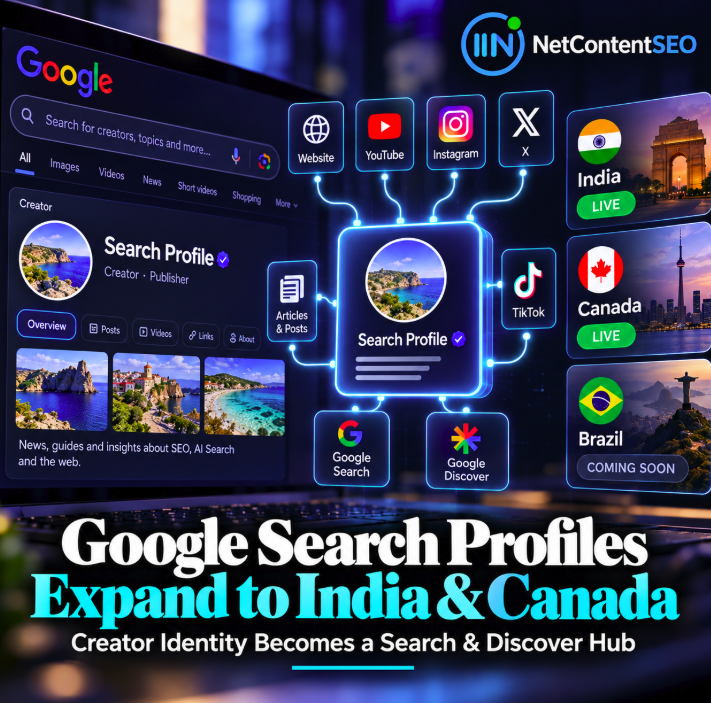

Google is expanding Search Profiles beyond the United States. As of October 6, 2026, eligible creators and publishers in India and Canada can create their own Search Profile, while Brazil is scheduled to follow soon.
Robby Stein, VP of Product for Google Search, announced the geographic expansion, describing Search Profiles as a dedicated home base on Google for creators and publishers.
For SEO and AI visibility teams, the feature deserves attention because it gives Google a first-party place to connect a creator's website, social accounts, posts, identity and audience relationship across Search and Discover.
India and Canada are now officially supported
Google's current Search Help documentation now lists three supported countries: the United States, Canada and India.
Brazil is not yet listed as available in the Help documentation, matching Stein's announcement that the country is coming next rather than already fully launched.
The distinction matters: India and Canada are live; Brazil is an announced upcoming rollout.
What a Google Search Profile is
A Search Profile is a shareable, customizable Google page that brings a publisher or creator's presence together across multiple platforms.
Google describes it as a way to combine content from websites and social platforms so people can more easily discover the creator and their work through Google Search and Google Discover.
The profile can include an avatar, bio, website, social links, articles, videos and social posts.
Google can connect multiple platforms to one identity
The current setup process supports major creator platforms including YouTube, Instagram, X and TikTok.
Once another social account is linked, Google says content from that platform can automatically be added to the Search Profile, with new content typically appearing within 24 hours.
This gives Google an explicit, creator-controlled mapping between accounts that might otherwise have to be inferred independently from the open web.
The current threshold is 10,000 followers
Google's updated Help page says a creator must currently have at least 10,000 subscribers or followers on at least one supported content platform.
The user must also be at least 18 years old and the content must comply with Google's user-generated-content policies.
Eligible platforms listed by Google currently use the same 10,000 threshold for YouTube, Instagram, X and TikTok.
Some profiles may already exist
Creators should not automatically create a new profile without checking first.
Google says it may already have generated an unclaimed Search Profile based on a person's online presence, particularly when a creator already has a Knowledge Panel and meets the eligibility requirements.
Google recommends searching for the creator name or handle and checking the Knowledge Panel for a Search Profile before starting a new claim.
Search Profiles can feed the Knowledge Panel
This is where the feature becomes especially interesting from an entity perspective.
Google says Search may integrate information from the profile — including the creator's name, bio and social links — directly into the Knowledge Panel.
Google's original launch announcement also said claiming a Search Profile may trigger creation of a Knowledge Panel for eligible publishers and creators, while existing Knowledge Panels can be enhanced with updated profile information and recent content.
But Search Profiles do not directly improve rankings
Google is unusually explicit about this point.
Its Search Profile Help documentation says that creating or editing a Search Profile does not directly affect content ranking in Google Search.
So this should not be sold as a new ranking-factor hack.
The value lies in identity, discovery, audience connection and the consistency of the information Google associates with a source.
Discover is where the audience effect becomes tangible
People can follow a creator or publisher from the Search Profile.
Google says that if someone follows the source, they may subsequently see more of that source's content in Discover.
Profiles can also be reached directly from Discover by tapping the creator or publisher name shown with content in the feed.
This creates a loop: content leads to profile discovery, the profile leads to a follow, and the follow can influence the user's personalized Discover experience.
Search Profiles now have their own performance layer
Google's management documentation says claimed Search Profiles include an Insights area.
Available performance information can include top-performing content, total clicks, total impressions and audience reach by country.
Google also says these insights can be filtered by date range and platform, including Google Search, Discover and linked social accounts.
The performance data is private to the Google Account that claimed the profile.
This looks increasingly like an entity control surface
For years, entity optimization has relied heavily on indirect consistency signals: author pages, structured data, social profiles, Knowledge Panels, external mentions and sameAs relationships.
Search Profiles introduce something different: a Google-owned interface where an eligible creator can explicitly connect several of those identity surfaces.
That does not mean Google ignores the rest of the web or blindly accepts profile claims. Google says changes to factual information such as names, social links and bios can require approval.
But the profile gives creators a much clearer way to tell Google which properties belong together.
The Recognizable Authorship implication
For publishers, this reinforces a broader trend: authorship works best when the same person is recognizable across multiple independent surfaces.
A creator whose website bio, Search Profile, Knowledge Panel and major social accounts all describe the same expertise creates a cleaner identity graph than one using inconsistent names, bios and profile links everywhere.
Search Profiles do not prove expertise by themselves. They make the entity easier to resolve.
What publishers should audit now
Publishers and creators in India and Canada who meet the threshold should first check whether Google has already generated a profile.
Then compare the website author page, profile bio, avatar, social handles and Knowledge Panel information for inconsistencies.
The goal is not to repeat an identical keyword-filled biography everywhere. It is to make the identity unambiguous: same creator, same authoritative website, same major accounts and the same underlying subject expertise.
Brazil is the next market to watch
Stein's October 6 announcement says Brazil will roll out soon, but Google has not given a specific public launch date.
Until Google's eligibility page lists Brazil or the rollout is otherwise confirmed live, publishers should treat it as announced but not yet generally available.
The geographic expansion nevertheless shows that Search Profiles are moving beyond a US-only experiment.
NetContentSEO take
Google Search Profiles are becoming a first-party creator entity hub, not a ranking shortcut.
The expansion to India and Canada matters because Google is giving more publishers and creators a structured place to connect their websites, social identities, content and audience relationship across Search and Discover.
For SEO, the practical lesson is simple: the website, author page, social profiles and Google identity should tell a coherent story about who the creator is.
The next phase of creator visibility may be less about optimizing an isolated author page and more about maintaining a recognizable identity across every surface Google can connect.