
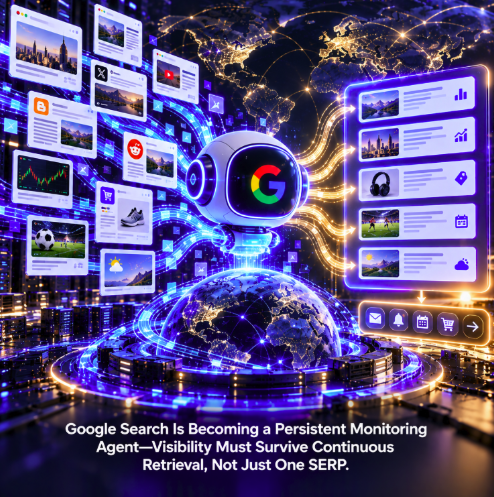
Google is preparing to turn Search from a system that waits for a query into one that can keep searching after the user leaves. Its new information agents will operate in the background around the clock, monitoring the web and Google’s freshest data for changes related to a user’s request, then returning with a synthesized update when something relevant happens.
Google announced information agents at I/O 2026 as the first major step into what it calls the era of Search agents. The company says users will be able to create, customize and manage multiple agents directly in Search. The feature was announced to launch first for Google AI Pro and Ultra subscribers during summer 2026; Google’s announcement should therefore be read as a staged rollout commitment rather than evidence that every Search user already has the capability.
For publishers, the conceptual shift is substantial. A conventional SERP represents one retrieval event at one moment. An information agent can repeatedly revisit an information need, look for changes across many source types and decide when new evidence is important enough to notify the user. Visibility therefore becomes temporal: a source has to remain useful when the system checks again tomorrow, next week or whenever the monitored condition changes.
The user can create an agent instead of repeating the search
Google describes information agents as persistent, personalized AI agents for topics, tasks and projects that matter over time. Rather than manually repeating the same query, a user can establish the objective once and let Search continue monitoring it in the background.
Google’s I/O materials say users can add “keep me updated” to a search to create an information agent and manage active agents through the AI Mode side panel. Multiple agents can run simultaneously, allowing Search to monitor several ongoing interests or tasks for the same person.
The distinction from an ordinary alert is the reasoning layer. Google says the agents intelligently reason across information to find what the user needs at the right moment, rather than simply notifying on every matching page or keyword occurrence.
Google says the agents will watch blogs, news sites and social posts
The retrieval surface is explicitly broader than conventional web pages. Google says an information agent will look across the web, including blogs, news sites and social posts, while also using Google’s fresher structured information such as real-time finance, shopping and sports data.
That creates a heterogeneous evidence environment. A breaking product announcement may first appear on a social account. A detailed explanation may follow on a company blog. News organizations may add independent reporting, while price or inventory changes can arrive through specialized Google data systems.
The agent’s job is to monitor those sources for changes related to the specific request and synthesize what matters. Google also says the resulting update can include helpful links for deeper exploration on the web.
Continuous retrieval changes what freshness means
Freshness has always mattered for time-sensitive queries, but persistent agents make it structural. The system is designed specifically to detect change over time.
A page that accurately answered a question when the agent was created can become stale while the agent remains active. A newer source can emerge with updated pricing, availability, a newly announced product or a changed event status. The agent can then have a reason to retrieve and synthesize again.
For publishers, this means maintaining accurate information can influence more than a future manual search. An active agent may be waiting for precisely the change the publisher is about to document.
The apartment-hunting example shows why the SERP is no longer the unit of discovery
Google’s clearest example is apartment hunting. A user can describe all the requirements for a home, then let the information agent continuously scan the market and notify them when listings satisfy those constraints.
There is no single stable result set in that scenario. Inventory appears and disappears. Prices change. New listings satisfy combinations of requirements that did not exist at the time of the initial request.
The useful source is consequently the one that becomes relevant at the moment the monitored state changes, not necessarily the page that would have ranked highest on day one.
This is the central SEO implication of persistent retrieval: discovery can become event-driven.
Google’s sneaker example turns announcements into agent triggers
Google offers another example involving a user who wants to know when a favorite professional athlete announces a sneaker collaboration. The information agent monitors for the event and alerts the user when a new release appears.
That request may require evidence from different parts of the web over time. A social announcement, brand product page, athlete post, news report and shopping listing can each become useful at different stages.
It also illustrates why publishing latency matters. If several sources eventually contain the same fact, the agent may have already generated its notification from the sources available when it first detected the change.
Google has not disclosed a deterministic source-selection formula for information agents, so publishers should not infer that being first guarantees inclusion. But persistent monitoring makes the timing and update quality of information an obvious part of the retrieval environment.
The output is a synthesis, not a stream of every detected page
Information agents are not described as RSS readers that forward each new result. Google says they will send intelligent, synthesized updates containing what the user needs at the right moment.
That introduces an additional selection layer. A page can be crawled or retrieved without necessarily becoming part of the user-facing update. The system has to decide whether the change is relevant enough to the monitored objective and how to incorporate it into the synthesis.
This is familiar territory for GEO teams. NetContentSEO has previously examined why retrieval visibility can be larger than visible citation visibility. Information agents extend that distinction across time: a source may participate in repeated monitoring cycles without appearing in every notification the user receives.
Search visibility now has a persistence dimension
Traditional rank tracking asks where a page appears for a query at a particular time. Persistent agents introduce another question: does the source continue to be retrievable and useful across repeated checks?
A publisher can perform well in the initial search but lose relevance because the page stops updating. Another source can become useful only after a monitored condition changes. A third may contain the best historical explanation but not the fresh fact required for the next alert.
Those are different visibility roles within one persistent task. Measurement systems built around isolated prompt snapshots will struggle to represent them.
The agents combine the open web with Google-owned real-time data
Publishers are also not competing only with other web publishers. Google explicitly says information agents can reason across its freshest finance, shopping and sports information alongside blogs, news sites and social posts.
For some questions, structured Google data may therefore supply the changing fact while web sources provide interpretation, context or supporting detail. For others, the web itself may contain the earliest or most authoritative update.
The optimal source type depends on the information need. This is another reason to avoid treating agent visibility as a simple extension of blue-link ranking.
Monitoring can lead directly into action
Google says the agent will not merely summarize changes; the user will have the ability to take action from the update. That places information agents inside a broader transformation of Search from retrieval toward task completion.
The same I/O announcement expands agentic booking for experiences and local services. Users can specify detailed criteria, have Search gather current prices and availability, and receive links for completing a booking with a chosen provider. In selected U.S. service categories, Google says Search can even call businesses on the user’s behalf.
The information agent is therefore one component of a larger architecture in which Search can monitor, reason, notify and then help advance the task.
Persistent agents create a new form of latent demand
In conventional Search, demand becomes visible when the user issues the query. With an information agent, the user can express demand days or weeks before a relevant supply event exists.
The apartment seeker is already interested before the matching listing appears. The sneaker buyer has already declared intent before the collaboration is announced. Search stores the objective and waits for the world to change.
For businesses, that means discovery can occur against a pool of pre-existing user intent. Publishing a new listing, product or announcement may satisfy an agent that was configured long before the page existed.
This is different from optimizing only for existing query volume. The future retrieval event can be triggered by the publication itself.
Social content becomes part of Search’s persistent evidence layer
Google’s explicit inclusion of social posts is also notable. Social platforms are not merely downstream promotion channels in this model; their posts can be among the information the Search agent monitors.
That makes consistent entity information across websites and social profiles more important for time-sensitive discovery. An announcement may originate socially, while a canonical page supplies fuller details later.
NetContentSEO recently reported that Google is making visibility from Instagram, TikTok, X and YouTube measurable through Search Console platform properties. Information agents add another reason to treat those surfaces as part of the broader Search ecosystem rather than as channels completely separate from Google discovery.
Continuous monitoring raises a measurement problem Google has not yet solved for publishers
Google has not announced a Search Console report specifically exposing information-agent retrievals, monitoring frequency or notification citations. Publishers therefore should not assume that every background check will appear as a recognizable Search impression.
This creates a familiar observability gap. The agent may retrieve or evaluate a source in the background, decide that nothing meaningful has changed and produce no visible user interaction. From the publisher’s perspective, that activity may be difficult or impossible to distinguish from other automated access.
Until Google documents dedicated reporting, claims about agent traffic should be conservative. Server logs, referrals and Search Console data can reveal pieces of the journey, but none should be presented as a complete view of information-agent retrieval.
Publishers should optimize the changing fact, not manufacture constant updates
Persistent monitoring does not mean every page needs daily edits. Artificially changing timestamps or rewriting unchanged content would not make the underlying information more useful.
The practical opportunity is to identify facts that genuinely change and make those changes clear. Availability, pricing, product specifications, event status, release dates, inventory, policy details and other time-sensitive fields should be accurate and easy to interpret.
When historical context matters, publishers can preserve it while clearly separating the current state from previous states. That helps both humans and retrieval systems understand what actually changed.
Agent visibility may reward pages that make state transitions legible
A monitoring agent is fundamentally looking for differences between states. Content architecture can help make those differences explicit.
Clear publication and modification dates, unambiguous availability information, structured product details, descriptive headings and direct statements of changed conditions all reduce the amount of inference required to understand an update.
None of these should be described as a special Google information-agent ranking factor; Google has announced no such checklist. They are simply sound ways to make changing information easier to retrieve and interpret in a system designed to monitor change.
The Search session can now outlive the browser session
The most profound change is temporal. Search historically begins when the user arrives and effectively ends when the user stops searching. Information agents invert that relationship.
The user can define a problem, leave, and let Search continue watching the information environment. The next meaningful interaction may occur because Google detects a change and returns to the user, not because the user decides to search again.
That turns Search into a persistent intermediary between publishers and latent demand.
SEO is moving from ranking at a moment to remaining useful over time
Information agents do not eliminate SERPs, rankings or one-shot searches. They add another discovery mode with different temporal behavior.
Google says these agents will operate in the background 24/7, monitor blogs, news sites, social posts and real-time data, synthesize changes and help users act. The company announced the initial rollout for Google AI Pro and Ultra subscribers, making this a premium-first feature rather than a universal Search behavior at launch.
For GEO and SEO teams, the implication is larger than another AI interface. A page can now be evaluated against an information need repeatedly while the underlying world changes. The relevant question is no longer only whether the source can win one result set.
It is whether the source is still accurate, retrievable and useful when the agent comes back.