
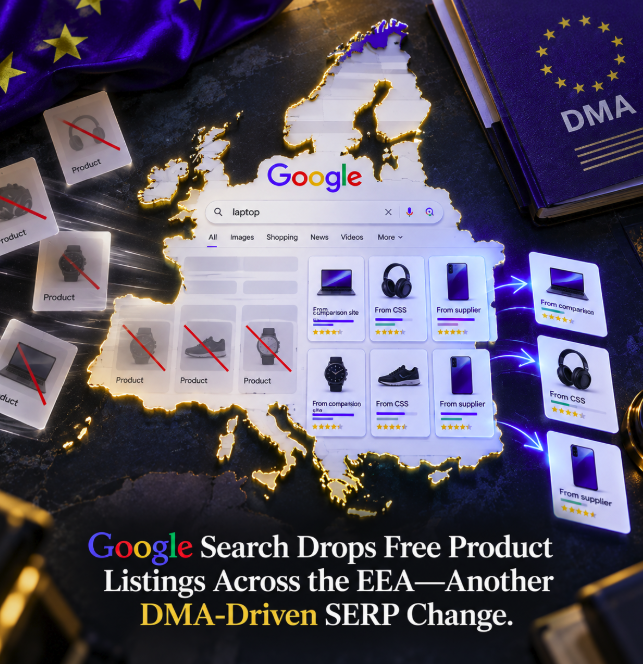
Google Search has removed its familiar free product listings and product carousel formats across the European Economic Area, producing one of the clearest ecommerce-visible consequences yet of the company's ongoing response to the European Union's Digital Markets Act. The change means commercial SERPs in the EEA can look materially different from the same kinds of searches elsewhere, with Google creating more room for comparison shopping and other vertical search services rather than presenting the same Google-operated organic product modules.
Barry Schwartz documented the change at Search Engine Roundtable on September 18, 2026. Screenshots shared by Adriaan Dekker showed free Google Shopping listings disappearing while space shifted toward Comparison Shopping Services, while Productrise's Hugo Huijer reported roughly 90–100% declines in the appearance of “Popular Products” carousels across EEA markets for which his dataset had sufficient coverage, including Germany, France, Belgium, Sweden and the Netherlands. Schwartz also reported that Google's Ads Liaison, Ginny Marvin, confirmed the removal in connection with the DMA changes.
This is bigger than a cosmetic Shopping redesign
Free product listings have been an important organic discovery surface for merchants because they allow eligible products to appear visually in Google without requiring the retailer to buy the placement as a Shopping ad. Google expanded free Shopping listings across Europe, the Middle East and Africa in 2020, describing the move at the time as a way for retailers to connect with customers regardless of whether they advertised. Their disappearance from EEA Search therefore reverses a highly visible part of the shopping-search experience that merchants have optimized for over several years.
The September change does not mean products or merchants have disappeared from Google Search altogether, nor does it mean paid Shopping advertising has simply been switched off. It concerns the free product-listing and carousel surfaces reported in the EEA SERP. Merchants can still be discovered through other Search formats, and Google's newly documented regional features provide alternative routes for suppliers and comparison services to appear.
Google's own documentation now describes an EEA-specific Search
The strongest context comes from Google's official regional differences in Search experience documentation, added in September. Google says it is evolving the results page for certain query types to create new opportunities for Vertical Search Services, Comparison Shopping Services, direct suppliers and content providers. The documentation explicitly lists the EEA as a region where product queries can trigger new aggregator units and supplier units.
For ecommerce queries, that changes the architecture of the SERP. Google's aggregator unit documentation explains that the feature is designed for Vertical Search Services including Comparison Shopping Services, metasearch engines and other aggregators. Eligible providers can populate a dedicated unit with results relevant to the user's query, and clicks within the unit lead directly to the selected aggregator's website. Google says these units are available in the EEA for product searches alongside categories such as hotels, flights and ground transportation.
Supplier units provide the other side of that model by giving direct providers a dedicated Search surface. In other words, Google is not merely removing a carousel and leaving an empty hole. It is redesigning how commercial entities and intermediary services can compete for visibility inside European search results.
The DMA is reshaping who gets the privileged SERP surface
The Digital Markets Act is intended to constrain the ability of designated gatekeepers to favor their own services over competing businesses that depend on the same platform. Google has been changing Search in Europe for years in response, including introducing dedicated comparison-site units and testing stripped-down result formats. In its own DMA compliance updates, Google has argued that some proposed remedies could reduce the usefulness of Search, while European regulators and competing services have pushed for stronger limits on self-preferencing.
The removal of free product listings should therefore be understood inside that contested regulatory context. Search Engine Roundtable characterizes it as a consequence of the European Commission's DMA requirements, and Google's current product documentation clearly establishes that EEA SERPs are being reworked to give VSS and CSS providers dedicated opportunities. That does not mean every detail of the final European shopping SERP is dictated line by line by the Commission; it means Google's regional Search design is being changed as part of its DMA compliance framework.
For merchants, free visibility can shift rather than simply vanish
The immediate ecommerce SEO concern is obvious: a merchant that previously earned exposure through a Google-operated free product carousel may no longer receive that exact placement in EEA searches. That can affect impression patterns, click distribution and the visual prominence of product feeds even if the underlying product pages remain indexed and capable of ranking elsewhere.
But the new structure also means visibility can increasingly pass through other participants. Comparison Shopping Services and other eligible vertical search providers can populate aggregator units, while direct suppliers can participate in supplier-oriented experiences. For merchants, this makes it more important to understand not just whether Google has indexed a product, but which European SERP ecosystem is now eligible to surface it.
The practical effect will vary by query, market and business model. A retailer with strong conventional organic rankings may experience the change differently from one that depended heavily on Popular Products-style modules. A merchant working through CSS partners may find new routes into the SERP, while another may see a formerly direct Google discovery surface disappear. There is not yet enough public performance data to quantify the traffic impact across ecommerce as a whole.
Do not use global SERP assumptions for EEA ecommerce SEO
This update reinforces a larger operational lesson: Google Search can no longer be treated as a globally uniform interface. Google's own regional-differences documentation now formalizes that reality. An ecommerce team checking product visibility in the United States, the United Kingdom or another non-EEA market may see a materially different commercial SERP from a customer searching in France, Germany, Italy, Spain, the Netherlands or another EEA country.
That has implications for rank tracking and SERP monitoring. Tools and internal reporting systems should preserve geographic context rather than aggregating shopping-feature visibility into a single global metric. If a product carousel disappears in the EEA because the feature itself has been removed or replaced, reporting it as an ordinary ranking loss would confuse a structural SERP change with a decline in the merchant's organic competitiveness.
Search Console and analytics remain important for measuring the real effect on a site's traffic, but ecommerce teams should also monitor the composition of the result page. The question is no longer simply whether a product ranks. It is whether the EEA version of Google Search still offers that product the same type of surface, and which supplier or comparison-service pathways have taken its place.
European Search is becoming its own product environment
Google has recently documented a growing set of EEA-specific Search experiences spanning products, travel, local businesses and other verticals. The disappearance of free product listings makes those regional differences tangible for retailers: this is not only a policy page or a regulatory debate, but a visible change to the commercial results consumers actually see.
The precise long-term traffic redistribution remains to be measured, and Google may continue adjusting these units as its DMA compliance evolves. What is already clear is that free Google-operated product carousels can no longer be assumed to be part of the EEA Search landscape. For European ecommerce SEO, CSS providers, retailers and SERP-tracking platforms, the new baseline is a more fragmented search surface in which regulation increasingly determines not only the rules of competition, but the physical layout of the results page itself.