

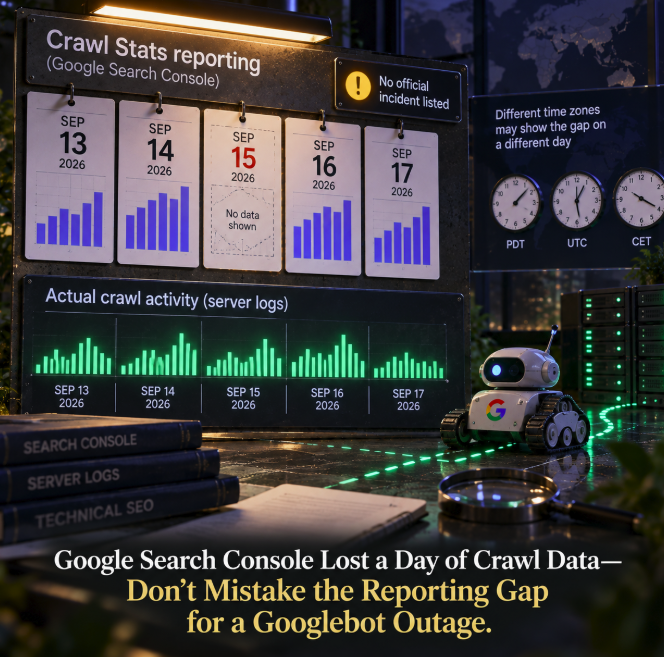

Google Search Console’s Crawl Stats report is missing an entire day of data around September 15, 2026, across multiple properties. The gap is conspicuous enough to look like Googlebot suddenly stopped crawling, but the available evidence points to a Search Console reporting anomaly rather than a confirmed crawler outage.
The issue was documented on September 20 by Search Engine Roundtable after checks across multiple Search Console profiles. Its report and screenshots show the same missing-day pattern, while noting that users in different time zones may see the gap assigned to a neighboring date.
Google has not listed a corresponding Crawl Stats incident in its official data-anomalies documentation. That absence does not prove there is no reporting problem; it means the company has not formally documented this specific September gap as an incident at the time of publication.
September 15 disappears from the Crawl Stats timeline
The anomaly is straightforward visually. Crawl activity is present on the surrounding dates, but one day is absent from the report. Search Engine Roundtable identifies September 15 as the missing date in its profiles and says the issue is visible broadly across Search Console properties it checked.
Because Crawl Stats normally displays a continuous history of Google crawling requests, a blank day can look much more serious than an ordinary fluctuation. A site owner seeing requests fall to nothing may immediately suspect a robots.txt problem, server failure, crawl-budget collapse or Googlebot outage.
That interpretation is not supported by the evidence currently available.
Crawl Stats is a report about crawling, not the crawler itself
Google’s official Crawl Stats documentation says the report shows statistics about Google’s crawling history, including how many requests were made, when they occurred, server responses and availability issues encountered while crawling.
That makes it a valuable diagnostic tool, particularly for large sites. But a missing value in the reporting interface and an actual absence of Googlebot requests are not the same event.
The report is a processed representation of crawling activity. If data collection, aggregation or display fails for a date, the graph can show a hole even when the underlying crawler continued requesting pages.
Google itself warns that Crawl Stats is not a perfect request ledger
The Crawl Stats help page contains an important qualification that is especially relevant here. Google says the report currently includes most crawl requests, but some requests may not be counted for various reasons. As a result, site owners can see differences between their own request logs and the values shown in Search Console.
That does not specifically explain the September 15 gap, and Google has not attributed this incident to that documented limitation. But it reinforces a basic technical principle: Search Console’s crawl graph should not be treated as the only authoritative record of whether Googlebot reached a server.
For that question, the site’s own server or CDN logs provide a separate source of evidence.
Check server logs before diagnosing a Googlebot outage
If Crawl Stats shows no data for September 15, the most useful verification step is to examine HTTP request logs for the same period. Look for verified Google crawler activity and compare the request pattern with the surrounding days.
If Googlebot requests are present in server or CDN logs while Search Console shows a blank date, that strongly supports a reporting-layer explanation for the property being investigated. If logs also show an unusual disappearance of crawler requests, the situation deserves deeper technical investigation.
The key is not to infer crawler behavior from a single dashboard gap when independent request-level evidence is available.
The missing date may shift with time zone
Search Engine Roundtable notes that some users may see the missing data on a different day because of time-zone differences. That detail is consistent with a reporting boundary problem being displayed differently depending on how dates are represented for the user or property.
It does not prove that time-zone processing caused the anomaly. Without a Google explanation, the underlying cause remains unknown. But teams comparing screenshots from different regions should avoid assuming they are looking at separate incidents merely because one graph is missing September 15 while another appears shifted by a day.
The more meaningful pattern is a single-day hole surrounded by otherwise normal Crawl Stats data.
Google currently lists no recent Crawl Stats issue
Google maintains a Search Console data anomalies page for known events that can affect reporting. As of September 20, its Crawl Stats section says “No recent issues.”
This creates an important distinction in the status of the story. The missing data has been independently observed and reproduced across multiple properties, but Google has not yet added it to the official anomalies log or published an explanation.
That means the correct status is a verified reporting anomaly without official incident confirmation, rather than a Google-confirmed outage.
Search Console has had reporting-only incidents before
Google’s anomalies documentation shows that reporting failures can affect Search Console data without representing a failure of the underlying Search system. In August 2026, for example, Google documented logging errors that reduced reported impressions in Generative AI and Discover performance data and explicitly said those incidents affected data logging only.
Those are different reports and different incidents, so they do not establish the cause of the September Crawl Stats gap. They do demonstrate why a dashboard anomaly should not automatically be interpreted as a production-system outage.
Search Console is an observability layer. Observability systems can have their own data problems.
A blank crawl day does not prove Google stopped discovering pages
Crawling is part of the process Google uses to discover and refresh web content, but Crawl Stats is not the mechanism performing that crawling. Therefore, the missing report date does not by itself establish that new pages were not discovered, updated URLs were ignored or indexing stopped.
Site owners should look for corroborating evidence before escalating the event into a crawling diagnosis. That evidence can include server logs, URL Inspection results, indexing changes, sitemap processing and whether recently updated pages were subsequently recrawled.
A genuine large-scale Googlebot outage would be expected to leave traces beyond one missing point in a Search Console chart.
Do not change robots.txt or server configuration because of the graph alone
One of the practical risks of a reporting anomaly is unnecessary remediation. A site owner who interprets the blank day as a crawling failure may start modifying robots.txt rules, CDN settings, firewall policies or server behavior without evidence that any of those systems are responsible.
Those changes can create real crawling problems while attempting to fix an apparent one.
The safer technical sequence is to verify whether Googlebot requests actually disappeared, confirm that the site remained available, review recent infrastructure changes and only then alter crawl-related configuration if the evidence points to the site itself.
The official report is designed to surface genuine serving problems
Google says Crawl Stats can help determine whether Google encountered availability problems while crawling a site. The report includes host-status information and breakdowns of server responses, file types, crawl purpose and Googlebot type.
Those dimensions are useful when a real crawling problem exists. If a host is failing, response codes change dramatically or robots.txt becomes unavailable, the report can help identify the pattern.
A single missing date across unrelated properties is a different shape of problem. When the same hole appears broadly rather than being isolated to one site’s infrastructure, the reporting system becomes the more plausible area to investigate first.
Historical precedent also points toward restoration rather than permanent loss
Search Engine Roundtable notes that similar missing Crawl Stats dates have appeared before, including previous incidents in 2021, 2022, 2025 and more recently. According to the publication, Google has generally restored the missing data in past cases.
That history is useful context but not a guarantee. Google has not yet said whether the September 2026 data will be restored, nor provided a timetable.
Until that happens, SEO teams should preserve any server-side evidence they need for historical crawl analysis rather than assuming Search Console will necessarily backfill the gap on a particular schedule.
Reporting gaps can distort crawl trend analysis
Even when no crawling outage occurred, one missing day can affect analysis. Teams monitoring crawl-budget changes, migration behavior, server-response patterns or large-scale publishing activity may use daily Crawl Stats data as part of their operational baseline.
A zero or missing day can produce misleading averages and artificial drops if exported or copied into another reporting system without annotation. Analysts should mark the September anomaly and avoid treating it as a genuine behavioral change unless other evidence confirms one.
This is especially important for automated dashboards that may interpret the gap literally and trigger alerts.
What SEO teams should verify
The immediate investigation should stay evidence-driven. Check whether the missing date appears in multiple Search Console properties, compare the date against the site’s server or CDN logs, and verify whether Googlebot requests continued. Then inspect host availability and response-code patterns around the same period.
Teams operating internationally should also account for the reported time-zone shift when comparing screenshots or datasets. A neighboring missing date may represent the same underlying reporting gap rather than a second anomaly.
If the site's own crawl evidence is normal, there is little reason to treat the Search Console hole as proof of a technical SEO emergency.
Search Console lost visibility into a day; that does not mean Googlebot did
The September 15 gap is real in the Crawl Stats interface and has been observed across multiple properties. What remains unverified is the cause, and Google has not listed an official Crawl Stats incident.
For now, the evidence is much more consistent with a reporting problem than with a documented Googlebot outage. The distinction matters because the corrective actions would be completely different.
A missing day in Search Console is evidence that the report is missing a day—not evidence, by itself, that Google stopped crawling the web. Before changing infrastructure or diagnosing a crawl-budget failure, check the logs that recorded what Googlebot actually requested.