

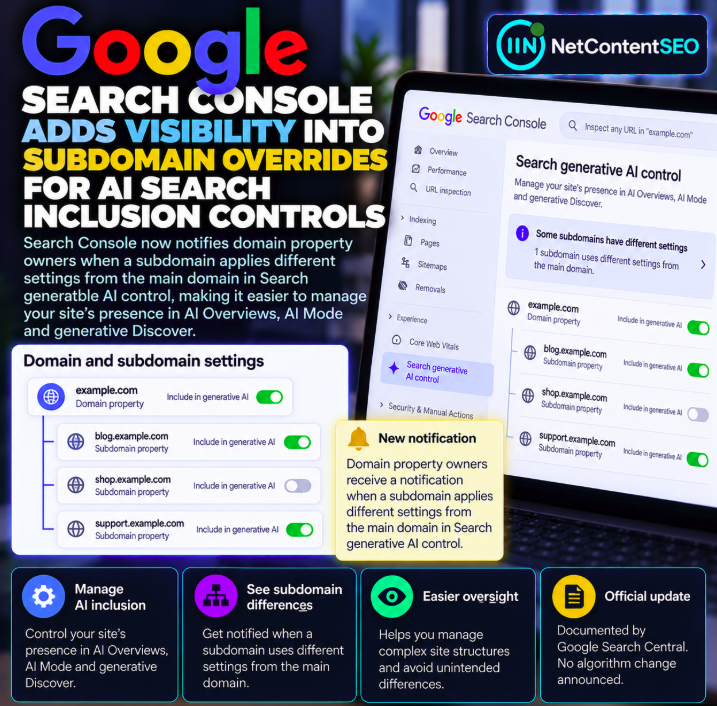

Google Search Console has clarified how domain-property owners can identify differences in Search generative AI control settings across child properties. According to a documentation change highlighted on October 6, 2026, owners of a domain property receive a notice in the Search generative AI control section when a child property has settings that differ from those applied at the parent domain level.
For organizations operating blogs, shops, help centers or regional sites on separate subdomains, the update improves visibility into configuration differences. It does not announce a new ranking signal, automatically change a child's setting or guarantee that any page will appear in an AI-generated result.
Sources: Google Search Console Help — Search generative AI control; Search Engine Roundtable — Google Search Generative AI Control Update.
What Google clarified
The documentation describes a notification for owners of a domain property when a child property applies different Search generative AI control settings. This is a visibility feature: it makes the difference apparent to a user reviewing the parent property's control section.
The practical problem is easy to understand. A company may administer example.com as a domain property while separate teams manage blog.example.com, shop.example.com or support.example.com. If one child property uses a different configuration, the parent-domain owner needs to know that the overall setup is not uniform.
Why domain properties and child properties matter
Google Search Console supports different property scopes. A domain property can encompass a domain and its subdomains, while narrower properties can represent specific hosts or URL prefixes. Organizations often use these scopes to divide reporting and administrative responsibilities.
Where a feature supports settings at different property scopes, an exception at a child level can be operationally significant. The new documentation clarifies that such a difference is surfaced to domain-property owners within the relevant control interface.
What the notification does—and does not—mean
| Confirmed meaning | Not established by the notice |
|---|---|
| A child property has different settings from the parent domain | That Google changed those settings automatically |
| The parent owner can see a notification in the control section | That the child setting is erroneous or unauthorized |
| Administrators have more visibility into configuration differences | That a page will definitely appear in AI Overviews or AI Mode |
| The documentation has been clarified | That a new search ranking algorithm was launched |
Why this matters for AI search governance
AI-related search controls are increasingly relevant to publishers deciding how their content participates in Google's generative search experiences. Managing a complex site can involve different editorial, legal and technical teams, each responsible for a distinct subdomain.
A notification about differing settings helps teams recognize where their policies may not align. However, differences are not automatically mistakes. A news publisher might deliberately manage an archive or specialized property differently from its main site, subject to the controls and eligibility rules Google actually supports.
AI Overviews, AI Mode and generative Discover: keep product scope precise
The documentation is relevant to Google's Search generative AI control and the experiences described in its current help materials. Publishers should read the product-specific scope and eligibility conditions directly in Google's documentation rather than assume that one setting operates identically across every AI surface.
In particular, inclusion controls should not be confused with ranking controls or citation guarantees. A setting governing whether content may participate in a product is not a promise that Google will select, summarize or cite it.
An illustrative subdomain scenario
Imagine a business operating example.com, blog.example.com and shop.example.com. The parent property uses one generative AI configuration, while the shop property uses a different supported setting. Under the clarified behavior, the domain-property owner can see a notice indicating that a child property's configuration differs.
This example illustrates the administrative principle. It is not a screenshot of a real property, and the precise options available to a user should be checked in the live Search Console interface.
How site owners should review their setup
- Identify the domain property. Confirm which Search Console property covers the domain and relevant subdomains.
- Open the Search generative AI control section. Review the documented controls and any notifications.
- Check child properties. Identify whether individual subdomains have different supported settings.
- Determine whether differences are intentional. Consult the responsible editorial, technical or compliance teams.
- Document decisions. Record who approved the configuration and when it was reviewed.
- Verify permissions. Ensure only authorized users can manage relevant properties and controls.
- Monitor future changes. Revisit the configuration when subdomains are launched, transferred or restructured.
The documentation clarification does not establish that a notification itself modifies access rights or synchronizes settings.
Does a parent-domain setting always override a subdomain?
Do not assume a universal inheritance rule without checking Google's current help documentation. The reported notice exists precisely because child-property differences can matter. Administrators should examine the supported scope and precedence of the particular control rather than infer it from how other Search Console features behave.
Is this a new way to optimize for AI citations?
No direct citation optimization benefit is established. The change improves visibility into administrative settings. Whether a page is selected as a source in AI Overviews or AI Mode involves additional systems and conditions that are not described by this notification alone.
For AI visibility research, a useful distinction is between eligibility and controls, observed appearances, and actual citations. These should be measured separately.
Implications for large publishers and multi-brand websites
Organizations with numerous subdomains often have distributed ownership. A central SEO team may oversee search performance while regional or product teams manage individual properties. A notice about child overrides can help the central team identify unexpected differences without relying solely on informal communication.
The feature may be especially relevant during migrations, mergers, regional launches and editorial reorganizations, when property ownership and configuration can change. Still, administrators should not treat every differing setting as a technical error.
What has not been announced
- No new standalone ranking factor tied to subdomain settings.
- No guarantee of AI Overview, AI Mode or Discover citations.
- No automatic correction of child-property settings described by the notification.
- No confirmed change to crawling or indexing algorithms.
- No evidence that every AI product uses identical inclusion logic.
FAQ
What is the new Search Console clarification?
Owners of a domain property receive a notice in Search generative AI control when a child property uses different settings.
Does the notification change subdomain settings?
No automatic setting change is established by the documented notice.
Is a different subdomain setting always a problem?
No. It may be intentional; administrators should review the reason for the difference.
Does enabling AI inclusion guarantee citations?
No. Inclusion controls and actual selection as an AI search source are distinct.
Is this a Google Search ranking update?
No. The reported change is a documentation clarification about Search Console controls.
Who should review these notices?
Domain-property owners and teams responsible for technical SEO, content governance and search configuration.
NetContentSEO analysis
The update strengthens visibility into how AI search participation settings are managed across complex domain structures. For publishers, the immediate value is governance rather than a ranking boost: identify subdomain exceptions, determine whether they are intentional and document ownership. Reliable AI visibility analysis starts by separating configuration, eligibility and observed citations.
Primary documentation: Google Search Console Help.