

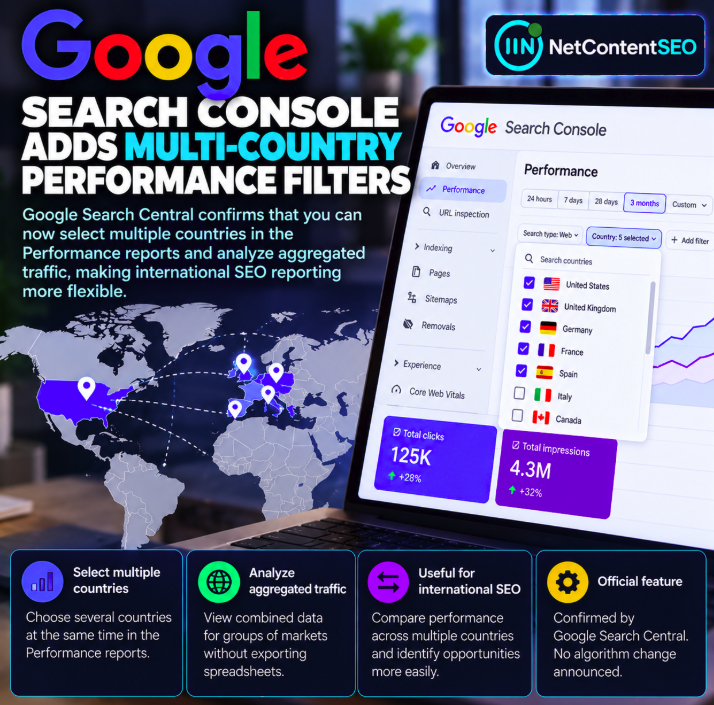

Google Search Console now lets users select multiple countries at the same time in Performance reports, making it easier to analyze search traffic across groups of international markets. The feature was highlighted by Google Search Central around October 6, 2026 and reported by Search Engine Roundtable.
For international SEO teams, the practical benefit is straightforward: instead of repeatedly filtering for one country and exporting results to combine them elsewhere, users can review aggregated Performance data for a selected group of countries directly in Search Console.
Sources: Google Search Central official LinkedIn presence; Search Engine Roundtable — Google Search Console Performance Report Country Filters.
What changed in Search Console?
The country filter in Search Console's Performance reporting now supports selecting more than one country in a single filter. The resulting report reflects the selected group of markets, allowing analysts to inspect combined search performance without assembling the same view manually from separate country exports.
This is a reporting-interface enhancement, not a new ranking factor or a change in how Google crawls, indexes or ranks websites.
Why multi-country filters matter
International websites often operate across market clusters rather than managing every country in isolation. A publisher may want to monitor English-speaking markets together, a retailer may group countries with shared logistics, and a SaaS company may evaluate several European markets as a region.
Previously, building a combined view could require exporting country-specific results and consolidating them in a spreadsheet or analytics environment. Multi-selection makes an initial grouped view more convenient inside the familiar Performance interface.
Examples of useful country groups
| Use case | Illustrative selection | Question to answer |
|---|---|---|
| English-language expansion | United States, United Kingdom, Canada | How is a content section performing across key English-speaking markets? |
| European campaign | France, Germany, Spain, Italy | What is the combined organic search visibility of the selected markets? |
| Regional rollout | A business-defined group of launch countries | Did overall search impressions change after publication? |
| International publisher | Countries served by one language edition | How much search demand does the edition attract in the chosen markets? |
These are illustrative reporting scenarios. The selected countries should reflect the site's actual audiences, content strategy and business objectives.
Aggregated analysis is not the same as a country-by-country comparison
This distinction matters. Selecting multiple countries produces a view of the selected markets together. It does not automatically provide a separate comparison for each individual country or explain which market caused a change.
If clicks rise in the combined report, one country may be growing while another declines. Analysts should still inspect individual countries when they need to identify the source of a trend.
How to use the multi-country filter
- Open the relevant verified property in Google Search Console.
- Navigate to the Performance report for the search experience you want to analyze.
- Open the country filter and select the countries to include.
- Apply the selection and review the resulting combined metrics.
- Keep the date range, search type and other filters consistent when comparing periods.
- Switch to individual-country analysis when you need to explain differences within the group.
The exact labels and placement of controls may evolve as Google updates Search Console's interface.
Which metrics can international teams examine?
Search Console Performance reports commonly present clicks, impressions, click-through rate and average position, along with query, page and other dimensions. Multi-country filtering makes it possible to inspect those metrics within the chosen geographic subset, subject to the reporting features available in the specific Performance view.
These figures should be interpreted carefully. Combined click-through rate and average position are not necessarily simple arithmetic averages of the corresponding values for each country. Search Console calculates its displayed metrics according to its own definitions and underlying observations.
Why this helps publishers
A publisher covering multiple countries can assess whether a group of markets is gaining visibility after launching a new content series. The combined view can provide a faster directional signal than reviewing each market separately.
However, publishers should avoid concluding that all selected markets responded similarly. A change in one high-volume country can dominate the group total.
Why this helps ecommerce and SaaS websites
International retailers and software companies often manage several markets under one domain or a shared site architecture. Multi-country reporting can help them examine performance for groups defined by language, product availability or commercial priority.
The feature does not replace revenue analytics, conversion attribution or market-specific business reporting. Search Console measures Google Search performance, not the complete customer journey.
What multi-country filters do not change
- They do not alter Google Search rankings.
- They do not change indexing or crawling behavior.
- They do not create automatic country-by-country comparisons from a combined report.
- They do not eliminate Search Console's normal data limitations or reporting definitions.
- They do not replace detailed exports or APIs for advanced modeling and custom reporting.
Practical reporting tips
Define country groups consistently and document why each market belongs in the group. Compare equivalent date ranges, account for seasonal changes and check whether the group's country composition changed between reports.
When sharing a combined result with stakeholders, label it clearly as a multi-country aggregate. Avoid presenting group totals as if they describe every country individually.
For deeper investigations, supplement the grouped view with country-level reports, landing-page analysis and business metrics. The new filter reduces friction but does not remove the need for careful interpretation.
FAQ
Can Search Console filter multiple countries at once?
Yes. Google Search Central has announced multi-country selection for Performance reports.
Does the filter combine traffic from selected countries?
Yes. It allows analysis of aggregated search performance for the selected group of countries.
Can I compare every selected country separately in the same combined view?
Not automatically. Aggregated reporting and separate country-by-country comparison are different analytical tasks.
Does this affect international search rankings?
No. It is a reporting feature, not an announced search ranking change.
Does it replace the Search Console API?
No. APIs and exports remain useful for custom reporting, complex analysis and data integration.
Is this useful for a multilingual website?
Yes, particularly when the site serves several countries and needs grouped market reporting. Analysts should still examine individual countries where appropriate.
NetContentSEO analysis
Google Search Console's multi-country filter is a small interface change with real practical value for international SEO reporting. It makes grouped market analysis faster, but teams should resist treating an aggregate as evidence that every included country is moving in the same direction. The best workflow combines a quick regional overview with targeted country-level investigation when trends need explanation.
Sources: Google Search Central and Search Engine Roundtable.