

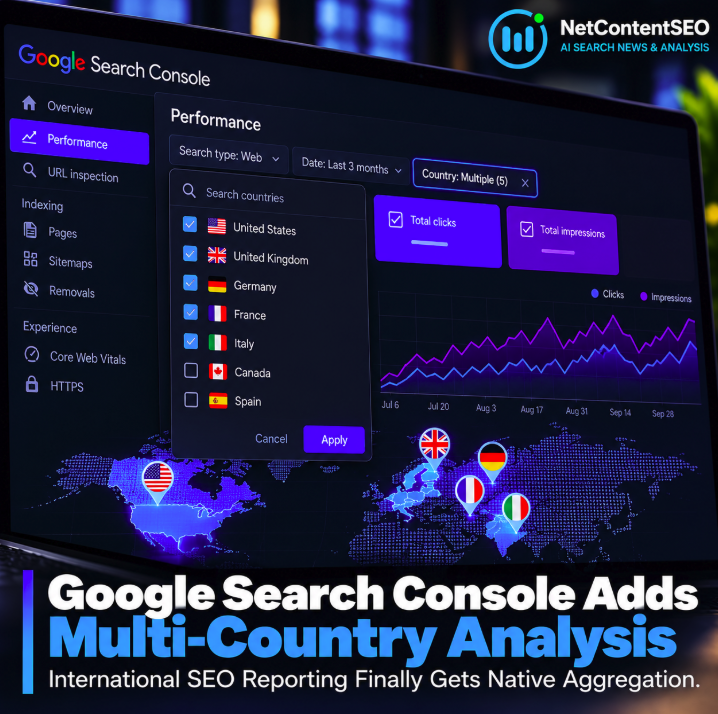

Google has upgraded the Search Console Performance report with a long-requested feature for international SEO teams: users can now select multiple countries at the same time and view their combined Google Search traffic in one filtered report.
Google Search Central announced the change on October 6, 2026, saying it is updating Performance report filters to make it easier to analyze traffic patterns across countries and devices.
Google's announcement specifically confirms that sites operating in multiple countries can now see their combined Google Search traffic.
Multiple countries can now be grouped in one filter
The new interface adds multi-selection to the Country filter. Instead of filtering the report to one market at a time, users can check several countries and apply them together.
The resulting Performance report aggregates clicks and impressions for the selected markets into a single view.
That sounds like a small interface change, but it removes a recurring reporting problem for international websites.
Previously, country comparisons were much more limited
Search Console's documentation historically required users who wanted to examine multiple countries, devices, Search types or Search appearance values to use comparison mode, which was limited to two items.
That made it easy to compare, for example, the United States against the United Kingdom, but awkward to answer broader questions such as how a group of five European markets was performing as a whole.
Teams often had to export the data to spreadsheets, Looker Studio, the Search Console API or a data warehouse to create those combined market views.
International SEO teams can create regional views directly in Search Console
The most obvious use case is regional aggregation.
An international site could select France, Germany, Italy and Spain to examine a combined European market group. Another business could group the United States and Canada, or combine several countries belonging to the same commercial territory.
Clicks, impressions, CTR and average position can then be interpreted within that selected geographic set without manually merging country-level exports.
This is filtering, not a replacement for country-by-country analysis
The new feature is useful for aggregation, but international SEO teams should not abandon individual market analysis.
A combined view can hide opposite trends. Strong growth in one large country can compensate for a decline in a smaller market and make the regional total appear stable.
The best workflow is therefore to use multi-country filtering for portfolio-level monitoring and retain individual country analysis when diagnosing ranking or demand changes.
Google also mentioned device filtering
Google's announcement says the Performance report filters are being updated across different countries and devices.
However, Google's published screenshot and the clearest documented change focus on country multi-selection. At the time of publication, the precise scope of any new Device-filter behavior was less clearly documented.
For that reason, the confirmed headline feature is multi-country aggregation rather than a broader claim about every Performance-report dimension.
Google's help documentation is still catching up
There is another interesting detail: Google's Search Console help documentation still describes the older limitation for some multi-item dimensions, saying that multiple countries or devices require comparison mode and are limited to two items.
That documentation appears to lag behind the newly announced interface behavior.
This is not unusual during a product rollout, but it is worth noting for teams maintaining internal Search Console instructions or automated documentation.
Rollout scope has not been fully detailed
Google announced the update as an active change on October 6, but did not specify whether every Search Console property would receive the new control simultaneously.
The announcement also does not establish that the same multi-country selection applies identically to every specialized Search Console report.
Users should therefore verify the available filters inside the specific property and report they are analyzing.
Why this matters for international SEO
Search Console has gradually become more flexible as an analysis interface, but serious international reporting has often required moving data outside the product.
Native multi-country filtering closes one of those gaps.
It makes questions such as “How is our DACH visibility performing?” or “What happened across our priority EU markets?” much faster to answer without creating a separate aggregation pipeline for every quick investigation.
The NetContentSEO takeaway
Google's change is not a new ranking signal and it does not alter how Search traffic is generated. It changes how that traffic can be analyzed.
For multinational websites, that distinction is still operationally important. Search Console can now treat a user-defined group of countries as one analytical market directly inside the Performance report.
That reduces dependence on external aggregation for everyday international SEO reporting while preserving the ability to drill down into individual countries when deeper diagnosis is required.
For teams managing dozens of markets, a small filter change can remove a surprisingly large amount of repetitive reporting work.