

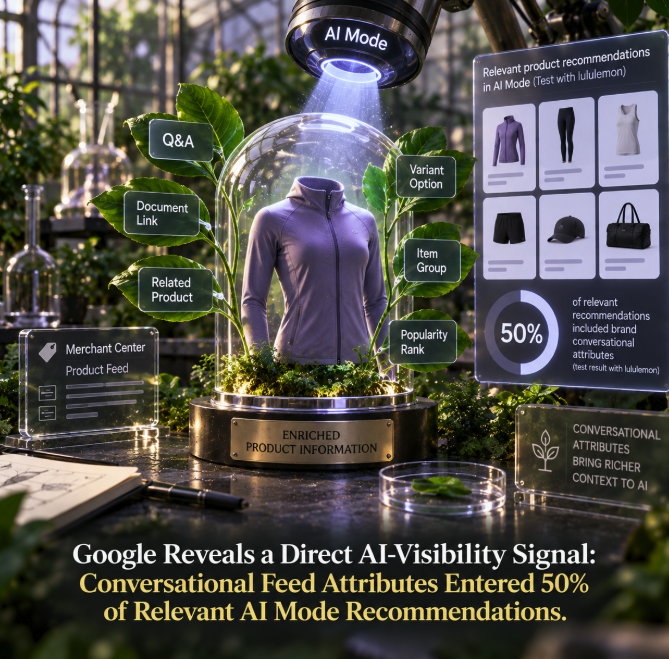

Google has published a rare first-party number connecting merchant-supplied product data directly with what appears in AI Mode recommendations. During testing with lululemon, conversational attributes submitted by the brand were incorporated 50% of the time in relevant product recommendations in AI Mode, according to Google's latest retailer update.
The result appears in Google's September 16 agentic commerce announcement, where the company recommends that retailers enrich their product feeds with conversational attributes to provide more context about their products. Google says the lululemon data helped produce more precise and useful answers for shoppers.
For AI visibility research, the importance of the figure is not that it establishes a universal 50% performance benchmark. It does not. The significance is that Google has publicly documented a case in which optional merchant-supplied contextual data was actually incorporated into AI Mode's relevant product recommendations.
Google has moved from guidance to an observed test result
Google had already told merchants that richer product information could help AI systems understand their products. In May, the company announced that conversational attributes were available globally and described strong product descriptions as important for discovery in the AI era.
The new lululemon figure goes a step further. Rather than simply saying merchants should provide richer data, Google is reporting what happened during an actual test: the brand's conversational attributes entered half of the relevant product recommendations measured in AI Mode.
That is unusually concrete for a generative shopping system. AI recommendations are dynamic and depend on the shopper's request, available products and the broader systems behind AI Mode, so merchants rarely receive a direct statement showing how often a specific category of submitted feed data was used in generated recommendations.
What Google means by conversational attributes
Google's Merchant Center documentation describes conversational attributes as optional product-data fields designed to help AI systems and conversational agents understand product-specific nuances.
They complement the main Merchant Center product specification rather than replacing it. Google currently supports conversational fields including question and answer, document link, related product, item group title, variant option and popularity rank.
Merchants can add these attributes through a supplemental data source, include them in the primary data source or submit them through the Merchant API. Google says their inclusion does not affect the approval status of existing products.
The attributes provide context that a standard product listing may not contain
A conventional feed is strong at describing structured commercial facts: title, price, availability, identifiers, color, size and other standard properties. Conversational shopping creates a different information problem because users often ask questions that require richer context.
A shopper might want to know which product is suitable for a particular activity, how two variants differ, what other product works with the item or how the manufacturer answers a detailed question. Conversational attributes give merchants dedicated places to provide that information.
Google's question-and-answer attribute, for example, is explicitly intended primarily for conversational experiences such as AI Mode in Search. It lets merchants provide product-specific questions and answers from users, merchants or manufacturers that can help people research and make purchase decisions.
The 50% figure is about incorporation, not a 50% visibility increase
The wording of Google's announcement needs to be kept precise. Google does not say lululemon received a 50% increase in AI Mode visibility, traffic, conversions or recommendation frequency.
It says the conversational attributes submitted by the brand were incorporated 50% of the time in relevant product recommendations during the test.
Those are very different claims. The statistic measures the use of the submitted information within relevant recommendations, not the incremental lift produced by adding the attributes. Google has not published a control group, before-and-after recommendation rate, conversion lift or causal visibility percentage for the lululemon test.
But the result confirms that merchant-supplied context can enter the AI answer
Even with those limitations, the test resolves an important uncertainty. Conversational attributes are not merely stored as auxiliary feed metadata with an unspecified future purpose. Google has now shown that the information can be incorporated into AI Mode product recommendations.
That gives merchants a direct content path into the product-understanding layer behind conversational shopping. A retailer can supply additional context, and at least in Google's lululemon test, that context appeared in a substantial portion of relevant recommendations.
It would be too strong to call any single attribute a deterministic ranking factor. Google has not said that adding a question-and-answer field or document link guarantees selection of a product. But the company has demonstrated that the information itself can become part of what AI Mode uses to construct product guidance.
Conversational feed optimization is different from keyword stuffing
The result also helps clarify what product-feed optimization for AI should look like. Conversational attributes are designed to add useful information, not to repeat generic search phrases.
Google explicitly tells merchants not to duplicate details already supplied in standard fields such as description, product highlight or product detail. The goal is to add information that helps explain the product's nuances, relationships, variants and answers to likely shopper questions.
That makes conversational optimization closer to structured product knowledge than traditional keyword expansion. The merchant is giving the system additional facts and context that can be retrieved when a shopper asks a sufficiently relevant question.
Question-and-answer data may be particularly important for long-tail shopping intent
The question_and_answer field illustrates why these attributes fit AI Mode. Google's documentation says it can contain questions and answers created by users, merchants and manufacturers, with the explicit purpose of answering detailed product questions and guiding research and purchase decisions.
Those are precisely the types of interactions where conversational search differs from a traditional product grid. Instead of filtering by a few standard attributes, a shopper can describe an unusual use case or ask a multi-part question.
A retailer with authoritative answers already available in support documentation, product manuals or internal merchandising content may therefore have information that can be translated into structured conversational feed data rather than leaving the AI system to infer everything from a short product description.
Document links create another path for richer product understanding
Google also supports a document_link conversational attribute. This gives merchants a structured way to point Google's systems toward additional product documentation where appropriate.
That does not mean every linked document will be quoted or used in AI Mode, and Google has not published usage percentages for individual conversational attribute types. But the existence of the field shows that Merchant Center's product model is expanding beyond a compact commerce record toward a richer information package suitable for agentic and conversational systems.
The lululemon test provides evidence that this broader category of merchant-submitted context is not purely theoretical.
Related products and variants can also be expressed explicitly
Other conversational fields let merchants describe product relationships and variant structures. The related_product attribute can communicate relevant relationships between products, while item-group and variant-option fields can give Google's systems more explicit information about how choices within a product family fit together.
This is useful in AI shopping because recommendation questions often involve alternatives rather than isolated items. A shopper may ask for another size, a different configuration, a complementary product or an option better suited to a particular constraint.
Providing those relationships directly can reduce the amount of product structure the AI system has to infer from unstructured pages.
AI Mode itself is designed around complex shopping questions
The value of richer feed context becomes clearer when viewed against how Google describes AI Mode shopping. The company says the experience combines Gemini capabilities with its Shopping Graph so shoppers can describe what they want naturally, refine requirements and receive dynamically organized product recommendations.
Google's examples include requests that require contextual reasoning, such as finding products suited to particular weather, activities or preferences. AI Mode can run multiple searches to understand the criteria behind the request and then surface relevant products.
In that environment, a product feed optimized only for short transactional queries may leave useful context unexpressed. Conversational attributes are Google's mechanism for letting merchants supply some of that context explicitly.
This creates a merchant-controlled input into generative shopping
AI visibility often feels indirect because brands cannot control how a generative system summarizes or recommends them. The lululemon result is interesting precisely because conversational attributes are a first-party, merchant-controlled input.
The retailer decides what accurate product context to submit within Google's specification. Google's systems then decide whether that information is relevant enough to use in a given shopping interaction.
That is not control over the final answer, but it is a clearer participation mechanism than hoping an AI system discovers the same information somewhere on the open web.
The result should not be generalized beyond Google's test
There are several reasons to resist turning the 50% number into an industry benchmark. Google has not disclosed the size of the lululemon test, the number of recommendations evaluated, the exact product categories involved, the prompt set, the geographic scope or the distribution of the different conversational attributes.
It also has not said that every merchant should expect half of relevant recommendations to incorporate submitted attributes. Product quality, data completeness, query relevance, catalog structure and the underlying recommendation systems can all differ.
The statistic is therefore best treated as evidence of system behavior, not as a forecast of merchant performance.
Google is building measurement around the same AI shopping layer
The timing is notable because Google has simultaneously made AI performance insights generally available in Merchant Center for eligible businesses in Australia, Canada, India, New Zealand and the United States.
As NetContentSEO reported in our analysis of Merchant Center AI performance insights, retailers can now examine share of voice, frequency, products shown, terms, attributes and shopping-stage intent across AI Mode and AI Overviews.
The combination creates the beginnings of an optimization loop: merchants can enrich product information through conversational attributes and separately monitor how their products and brands are surfacing across Google's AI shopping experiences.
The reporting does not prove that a specific feed edit caused a visibility change, and merchants should not treat correlation as causation. But Google is increasingly providing both an input mechanism and a measurement surface for AI shopping.
Product feeds are becoming knowledge inputs for AI agents
The larger shift is that a Merchant Center feed is no longer merely a database for conventional shopping listings. Google's product specification is evolving to serve AI systems that need richer context to answer questions, compare products and make recommendations.
Standard attributes remain essential because accurate identifiers, prices, availability and core product details underpin the Shopping Graph. Conversational attributes add another layer designed for questions that cannot be answered cleanly from those standard fields alone.
This changes the editorial task behind ecommerce feeds. Merchandising teams may increasingly need to think not only about how a product is displayed in a listing, but also about what an AI shopping agent would need to know in order to explain, compare and recommend it accurately.
Google has finally published a concrete signal from the recommendation layer
The lululemon test does not reveal the complete AI Mode recommendation algorithm, and it does not prove that conversational attributes increase visibility by a fixed amount. What it does provide is narrower and more useful: direct evidence that merchant-submitted contextual attributes can be incorporated into Google's generated product recommendations at meaningful frequency.
For brands building an AI shopping strategy, that makes conversational attributes difficult to dismiss as speculative metadata. They are an official Merchant Center input designed for AI systems, and Google has now published a test in which that input entered half of the relevant AI Mode recommendations.
The practical signal is not “add these fields and gain 50% more visibility.” It is that product-feed context can make its way into the recommendation itself. For ecommerce teams trying to influence how accurately their products are understood in AI Mode, that is one of the clearest first-party signals Google has provided so far.