

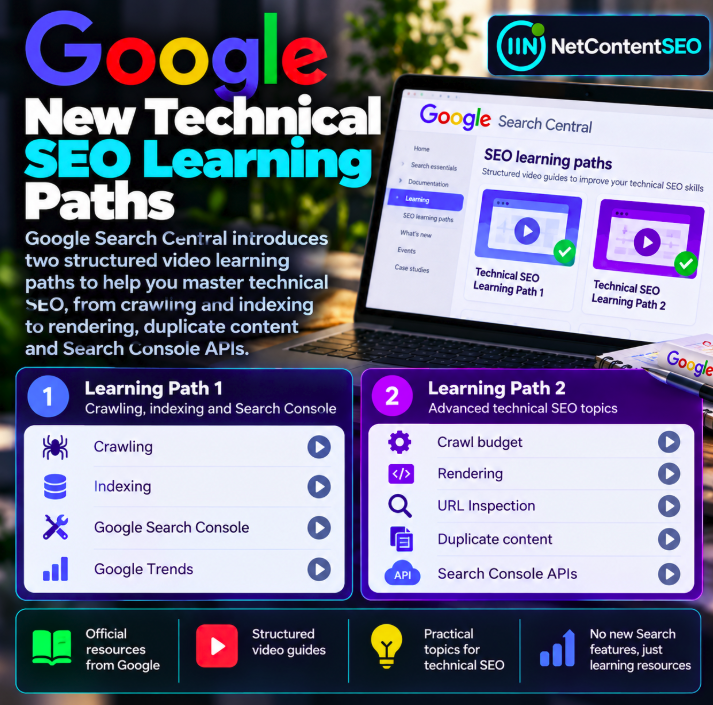

Google Search Central has introduced two structured collections of educational videos to help website owners and SEO practitioners understand how Google Search works. Announced on October 6, 2026, the new learning paths organize existing technical topics into guided sequences. The first covers crawling, indexing, Google Search Console and Google Trends. The second moves into more specialized areas including crawl budget, rendering, URL Inspection, duplicate content and Search Console APIs.
These are learning resources, not newly launched Search features or ranking factors. The announcement is useful because it gives beginners and experienced practitioners clearer routes through Google's technical documentation and video explanations.
Primary source: Google Search Central — New SEO Learning Paths.
What are Google's new SEO learning paths?
The learning paths are curated video collections arranged around connected topics. Instead of browsing individual tutorials without a clear sequence, users can work through a coherent set of lessons that builds from core search concepts toward more advanced technical workflows.
They are particularly relevant for website owners, developers, editorial teams and SEO specialists who need a shared understanding of what Googlebot can discover, how pages enter the index and how to investigate search performance.
Learning Path 1: crawling, indexing, Search Console and Trends
The first path focuses on the foundations of Google Search. It brings together four areas that frequently cause confusion in technical SEO projects:
Crawling: how Google discovers and fetches content
Crawling concerns Google's ability to discover URLs and request resources. Understanding crawling helps site owners diagnose inaccessible pages, problematic internal links, unintended blocks and infrastructure issues. A crawl does not automatically mean that a page will be indexed.
Indexing: what happens after a page is discovered
Indexing is the process by which Google analyzes eligible content for inclusion in its search systems. A page can be crawled without being indexed. Training on this distinction helps teams avoid interpreting every indexing exclusion as a crawler malfunction.
Google Search Console: diagnosing search visibility
Search Console provides site owners with information about indexing, search performance and selected technical issues. Learning to interpret its reports can help distinguish discovery problems from performance trends. Metrics such as impressions and clicks should be considered alongside the site's content, query mix and reporting limitations.
Google Trends: understanding search interest
Google Trends helps explore relative interest in topics across time and locations. It is not a direct count of all Google searches. The learning path's inclusion of Trends broadens the training beyond technical diagnostics to research about changing search demand.
Learning Path 2: deeper technical SEO investigations
The second collection addresses more specialized topics useful for complex websites and experienced practitioners.
Crawl budget
Crawl budget concerns how much crawling Google can and wants to perform on a site. It is especially relevant to larger websites, frequently updated inventories and sites with extensive URL variations. Not every small website needs elaborate crawl-budget optimization.
Rendering
Rendering matters when content or navigation depends on JavaScript. Understanding how search systems process rendered pages can help developers diagnose situations where important content is not reliably accessible in the fetched HTML or subsequent rendering stages.
URL Inspection
Search Console's URL Inspection tool helps site owners examine Google's information about a specific URL. It can assist with investigations into indexing status and selected crawling or canonicalization issues. An inspection result is a diagnostic signal, not a guarantee that a page will rank.
Duplicate content
Duplicate and near-duplicate URLs can complicate canonical selection and indexing. Training on this topic can help teams understand the roles of redirects, canonical signals, internal linking and consistent URL architecture. Duplicate content is not automatically equivalent to a spam penalty.
Search Console APIs
Search Console APIs allow authorized applications to retrieve certain data programmatically and support repeatable reporting workflows. API training can help SEO teams automate selected analyses while respecting quotas, permissions and data limitations.
At a glance: the two learning paths
| Learning path | Main topics | Who may benefit |
|---|---|---|
| Foundational technical SEO | Crawling, indexing, Search Console, Google Trends | Site owners, new SEO specialists, editorial and development teams |
| Advanced technical SEO | Crawl budget, rendering, URL Inspection, duplicate content, Search Console APIs | Technical SEO practitioners, developers, analysts and larger-site teams |
Why the structured format matters
Technical SEO is often learned reactively: a site encounters an indexing issue, a developer searches for a specific error, and a team reads isolated documentation pages. A structured learning sequence offers a more systematic alternative.
It can also help establish a common vocabulary between editors, developers and analysts. For example, understanding the difference between crawling, indexing and ranking reduces confusion when discussing why a newly published page has not appeared in search results.
How to use the resources in a practical SEO workflow
- Start with the fundamentals. Review crawling and indexing before interpreting Search Console coverage and performance reports.
- Apply each concept to a real website. Select representative URLs and document what you can verify.
- Use Search Console carefully. Distinguish indexing information from traffic and ranking performance.
- Investigate rendering where relevant. Check whether JavaScript-dependent content is accessible.
- Review URL duplication. Identify parameter variants, inconsistent canonical signals and unnecessary duplicate paths.
- Automate selectively. Use Search Console APIs for repeatable reporting when they fit the task.
- Revisit official documentation. Educational videos are helpful, but live documentation remains important as features and guidance evolve.
Does this announcement change Google's crawling or indexing behavior?
No such technical change is announced. The publication of learning paths does not itself modify Googlebot, indexing criteria, crawl-budget allocation, JavaScript rendering or the Search Console API. It is an educational announcement that brings together explanations of established concepts and tools.
Similarly, completing a Google learning path is not a certification that guarantees rankings or indexing. SEO outcomes still depend on a site's content, technical accessibility, relevance and numerous other factors.
Why this is relevant to AI Search and GEO teams
Even as AI-generated answers and agentic retrieval gain attention, fundamental web accessibility remains important. If a page cannot be discovered or reliably fetched by a relevant system, downstream research and visibility may be affected. However, Google Search crawling and third-party AI-agent retrieval are not identical systems and should not be treated as interchangeable.
The new learning paths are therefore useful foundational training for teams studying AI visibility, but they do not announce a new GEO ranking mechanism or a change in AI citation policies.
FAQ
When did Google announce the new SEO learning paths?
October 6, 2026, according to the Google Search Central announcement.
How many learning paths are included?
Two structured video collections.
What does the first path cover?
Crawling, indexing, Google Search Console and Google Trends.
What does the second path cover?
Crawl budget, rendering, URL Inspection, duplicate content and Search Console APIs.
Are these new Google Search features?
No. They are educational resources about existing topics and tools.
Does Google announce a new ranking factor?
No new ranking factor is established by the learning-path announcement.
NetContentSEO analysis
Google's new technical SEO learning paths make established Search concepts easier to study in a logical sequence. The most practical benefit is better diagnostic literacy: understanding what crawling, indexing, rendering and Search Console data actually tell you before making optimization decisions. For SEO teams, this is useful training material—not evidence of an algorithm update.
Primary source: Google Search Central — New SEO Learning Paths.