

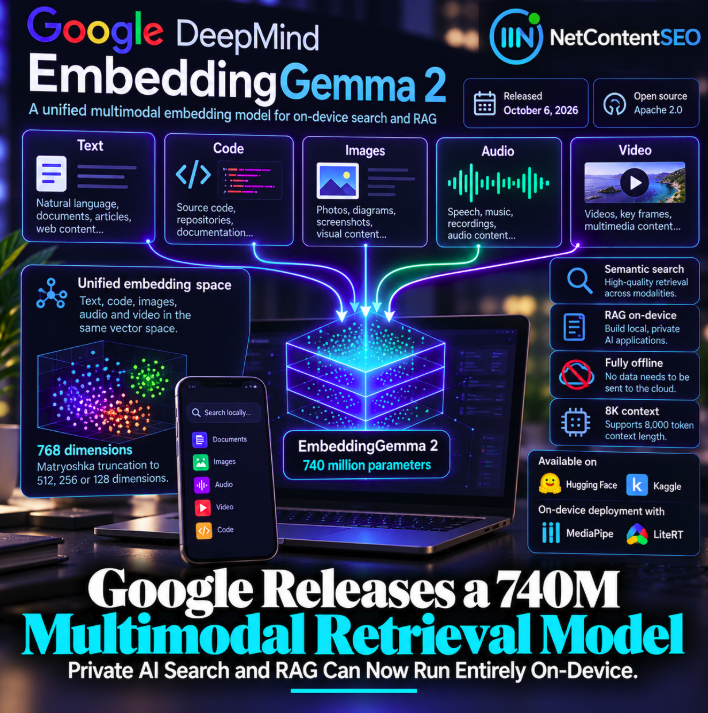

Google DeepMind has released an open embedding model small enough to run on consumer hardware while searching across text, code, images, audio and video in the same semantic space.
EmbeddingGemma 2, released October 6, 2026 under the Apache 2.0 license, contains 740 million parameters and is designed specifically for local semantic search, retrieval-augmented generation, classification and routing.
The practical implication is significant: a multimodal retrieval layer no longer has to send private documents or media to a cloud embedding API.
Five content types, one vector space
EmbeddingGemma 2 maps text, including source code, images, video and audio into a shared 768-dimensional embedding space.
That means a query in one modality can retrieve content in another. A text description can find an image or video moment; a voice memo can locate related media; a local code search can retrieve semantically related source files.
For RAG systems, heterogeneous private corpora can therefore be indexed with one natively multimodal embedding architecture instead of maintaining separate retrieval models for every media type.
740M parameters — but the model is modular
The full multimodal configuration contains 740M parameters.
Google splits that footprint into a 270M text component, a 170M vision encoder and a 300M audio encoder. Developers can load only the modalities required by an application.
A text-only workload therefore does not need to carry the complete multimodal model.
It is built for consumer hardware
Google positions EmbeddingGemma 2 as an on-device model rather than merely a smaller cloud model.
With quantization, Google reports approximately 191MB of active RAM for text-only weights and roughly 567MB for the complete multimodal model on a Pixel 11 Pro.
Those are Google measurements on its own reference hardware, but they illustrate the deployment target: phones, laptops and other edge devices.
Semantic search can work fully offline
Because embeddings can be generated locally, search does not inherently require sending source material to an external server.
Google explicitly highlights privacy, lower pipeline latency and offline cross-modal retrieval as benefits.
A company could index sensitive local documents, a developer could search a private codebase, or a mobile application could retrieve personal media while keeping the source corpus on the device.
Local RAG becomes practical too
Embeddings provide the retrieval layer rather than the final generated answer.
Google suggests pairing EmbeddingGemma 2 with a generative model such as Gemma 4: the embedding model finds relevant local material and the generative model reasons over the retrieved context.
Because both are based on Gemma 4 technology and share components including the text tokenizer and audio encoder, Google says they can be combined with a lower total memory footprint than completely independent pipelines.
The context window grows to 8K
EmbeddingGemma 2 has an 8,192-token context window, four times the context of the first EmbeddingGemma.
Google says that budget can represent up to about 5.5 minutes of audio, 29 images or 58 video frames under its default settings, or interleaved combinations of modalities.
All modalities share the same context budget, so combining text, images and audio reduces the maximum capacity available to each individual type.
Vector size can shrink from 768 to 128 dimensions
EmbeddingGemma 2 uses Matryoshka Representation Learning.
The native 768-dimensional vectors can be truncated to 512, 256 or 128 dimensions, allowing developers to trade some retrieval quality for lower storage and memory requirements.
Google says the smallest representation can reduce vector storage by up to six times.
For large local indexes, that can materially change how much searchable content fits on a device.
Smaller vectors can also accelerate similarity search
Reducing dimensions means vector databases have less data to store and compare.
That is especially useful at the edge, where RAM, disk and compute are constrained.
Google's model card warns that truncated vectors need to be normalized again before cosine similarity and that queries and documents must use matching dimensions.
A 768-dimensional query cannot simply be compared with a corpus stored at 128 dimensions.
Code retrieval gets a substantial upgrade
EmbeddingGemma 2 is not limited to natural-language documents.
Google reports an improvement from 68.76 to 78.68 on MTEB Code compared with the previous model, a gain of 9.92 points.
This makes local repository indexing and semantic code search a particularly interesting use case for coding agents that need private retrieval without uploading an entire codebase.
Multilingual search remains part of the design
The official model card says EmbeddingGemma 2 understands more than 100 languages.
That matters for local enterprise search because a single vector index may contain documents in multiple languages alongside images, recordings and video.
The goal is semantic proximity rather than exact keyword matching.
Retrieval can cross modalities
The most important conceptual shift is that the query and the result no longer need to look alike.
A natural-language query can retrieve a relevant image. Audio can locate a video moment. Text can retrieve code based on meaning rather than literal token overlap.
That turns a local vector database into a multimodal search layer rather than a document-only index.
Google is shipping ready-made on-device examples
Google points developers to several demonstrations in its AI Edge ecosystem.
Instant Media Search can use text or images to search a media library. Video Moments Finder can locate moments in video through text or audio queries. Google AI Edge Foresight combines local file retrieval with Gemma 4 reasoning.
The MediaPipe Decision Task API can also use multimodal context for classification, routing and predictive workflows.
The weights are already available
EmbeddingGemma 2 is available through Hugging Face and Kaggle, with Google also supporting deployment through MediaPipe and LiteRT.
Google lists integrations with Transformers, Sentence Transformers, MLX, vLLM, llama.cpp, SGLang, Ollama and LM Studio, among other developer tools.
The Apache 2.0 license makes the model commercially permissive for developers building their own retrieval systems.
This is not Gemini Embedding 2
The naming deserves clarification.
Google also offers Gemini Embedding 2, its production multimodal embedding service through the Gemini ecosystem.
EmbeddingGemma 2 is the lightweight open model intended for local and edge deployment.
They share underlying Google embedding technology, but they target different deployment models.
Private retrieval changes the economics of RAG
Cloud embedding APIs are convenient, scalable and often stronger for large production workloads, but every embedding request introduces network dependency, service cost and a data-governance decision.
A capable local model changes that trade-off.
For workloads where the corpus fits on local hardware, developers can create embeddings once, store them in a local vector database and retrieve without a per-query cloud embedding call.
Search systems can become hybrid by design
This does not mean cloud retrieval disappears.
A practical architecture can use EmbeddingGemma 2 for private local files while separately searching the public web or enterprise cloud sources when the task requires them.
The application can then combine retrieved evidence before handing context to a reasoning model.
That creates a hybrid search stack in which privacy-sensitive retrieval remains on-device while freshness-sensitive retrieval remains connected.
What this means for AI Search
For SEO, the release is not a Google Search ranking update and EmbeddingGemma 2 is not a new Googlebot or Search indexing system.
Its importance is architectural.
High-quality retrieval is becoming cheap enough and compact enough to move from centralized AI infrastructure into browsers, phones, laptops, apps and private agents.
That means the future of “search” increasingly includes many indexes that publishers may never see in conventional referral analytics: personal media indexes, local enterprise corpora, code repositories and agent memory stores.
Retrieval visibility is becoming multimodal
Publishers have traditionally optimized text pages for text queries.
Multimodal embedding systems broaden the retrieval surface.
Images, diagrams, audio, video and structured documents can become semantically retrievable alongside prose when applications index them with compatible systems.
This does not create a documented SEO advantage in Google Search, but it reinforces a wider AI visibility principle: useful information increasingly needs to be understandable beyond exact keywords and beyond text alone.
NetContentSEO take
EmbeddingGemma 2 makes private multimodal retrieval a consumer-hardware problem rather than exclusively a cloud-infrastructure problem.
A 740M open model can index and search text, code, images, audio and video in one vector space, shrink embeddings to 128 dimensions and operate offline.
For developers, that lowers the barrier to private RAG. For AI visibility researchers, it signals something broader: retrieval is escaping the centralized search engine.
The next generation of search can happen on a phone, inside an agent, across a private codebase or within a personal media library — without the query or the corpus ever leaving the device.