

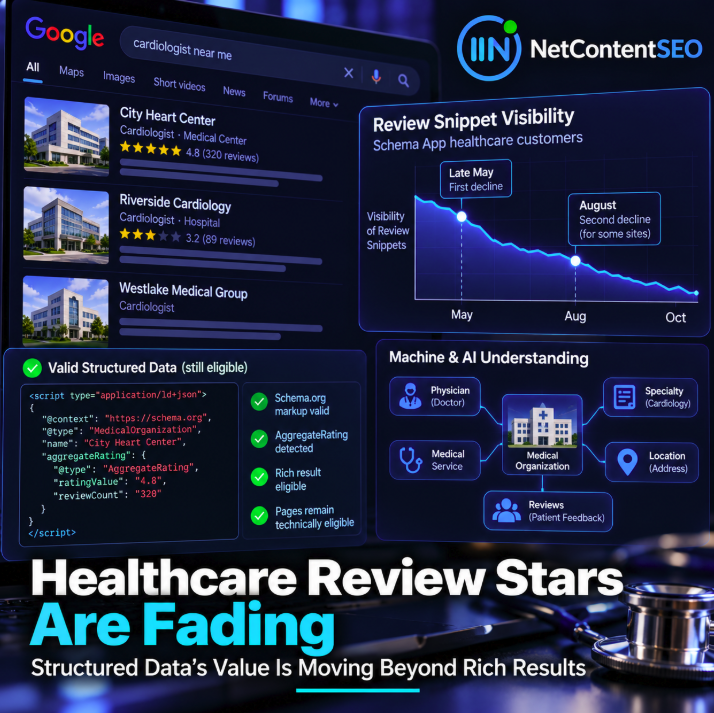

Healthcare organizations are seeing a substantial decline in Google's Review Snippet visibility even when their structured data remains technically valid and eligible.
Schema App says the pattern has appeared across multiple healthcare customers since late May 2026, with another decline affecting some organizations in early August. Its team tested different implementations of aggregateRating, alternative property paths and multi-typing healthcare entities with Product, but none reliably restored the stars.
The important caveat is that Google has not announced a healthcare Review Snippet removal or confirmed an algorithmic change. This is an observed visibility shift across Schema App's customer dataset, not an official Google rollout.
The decline began in late May
Schema App's Customer Success team observed Review Snippet visibility falling across its healthcare customers beginning in late May.
For some organizations, the data shows a second drop in early August.
That timing suggests the change is broader than an isolated markup deployment on one site, but the available evidence does not establish what Google changed internally or whether one specific system caused it.
The affected pages remain technically eligible
This is what makes the pattern particularly interesting.
Schema App says the pages it investigated still qualify for Review Snippets based on their markup and implementation.
Its team tested different ways of connecting aggregateRating, experimented with property paths and tried multi-typing healthcare entities with Product.
Those changes did not restore Review Snippet performance.
That weakens the theory that a simple schema syntax problem is responsible for the observed decline.
Google's documentation still says rich results are discretionary
Google's current Review Snippet documentation continues to explain that valid review or rating markup can make a page eligible for review stars and related information.
But eligibility has never guaranteed display.
Google uses deliberately conditional language: when it finds valid markup, it may show the rich result. The actual Search presentation can differ even when a page passes structured-data validation.
That distinction between eligibility and visibility is central to the healthcare pattern Schema App is reporting.
Google has not removed Review Snippet eligibility for healthcare
There is currently no corresponding Google Search Central announcement saying healthcare pages as a category have been removed from Review Snippet eligibility.
Google's supported review types still include several schema.org types and their subtypes, subject to the feature's technical and content guidelines.
Publishers should therefore avoid responding to the decline by automatically deleting semantically correct markup.
Self-serving review rules still matter
Healthcare sites also need to distinguish this visibility trend from Google's longstanding rules around self-serving reviews.
Google says pages using LocalBusiness or Organization are ineligible for star review features when the entity being reviewed controls reviews about itself, including ratings embedded through third-party widgets.
That rule predates the 2026 healthcare decline and should not be confused with the new observation.
A site that violates existing review guidelines has a different problem from a compliant page whose previously visible rich result has become less common.
No equivalent organic traffic decline was observed
Schema App says it has not attributed the Review Snippet decline to a corresponding fall in overall organic traffic across the affected healthcare customers.
Many customers reportedly did not notice the rich-result change until Schema App surfaced it.
That is an important counterpoint to the visual severity of disappearing stars.
Review stars can affect how a result looks and potentially how users respond to it, but a decline in the SERP enhancement does not automatically mean that rankings or overall organic discovery fell by the same amount.
The old structured-data ROI model is getting weaker
For years, structured-data programs were relatively easy to justify through visible SERP outcomes.
Add markup, earn an enhancement, measure impressions and CTR, and demonstrate value.
Google's control over rich-result presentation makes that model fragile. A site can maintain accurate markup while the interface changes around it.
The healthcare data is another reminder that rich-result appearance is an output Google controls, not an asset the publisher owns.
FAQ rich results already showed how this can happen
Schema App compares the situation with Google's major reduction of FAQ rich-result visibility in 2023.
That change reduced the visible SERP reward of FAQ markup without making structured semantic information inherently useless.
The healthcare Review Snippet decline may represent a similar measurement problem: the most visible benefit changes while the underlying data layer can continue serving other machine-understanding purposes.
Structured data now has a second job
For healthcare organizations, Schema App argues that markup should accurately define physicians, specialties, credentials, services, locations, affiliations and the relationships between them.
That is a more durable objective than chasing a specific star treatment.
A connected structured-data graph gives machines explicit information about which physician works at which location, which specialty they practice, which services an organization provides and how those entities relate.
Those relationships can remain useful even when Google chooses not to decorate a blue link with review stars.
But do not overstate the AI benefit
There is an important line between semantic usefulness and measurable AI visibility.
Structured data can make entity relationships machine-readable. That does not mean adding schema automatically causes ChatGPT, Gemini, AI Overviews or AI Mode to cite a page.
Google's current Review Snippet documentation concerns Search eligibility and presentation; it does not promise increased AI citation frequency from aggregateRating.
The safer conclusion is that accurate structured data provides a reusable semantic layer for machines. Whether and how a particular AI system consumes that layer must be measured separately.
Healthcare SEO teams should resist schema churn
If a page remains semantically accurate and technically valid, repeatedly restructuring its markup solely to recover stars can introduce unnecessary complexity.
Schema App's tests are useful precisely because several plausible implementation changes failed to reverse the observed trend.
The better workflow is to verify eligibility, monitor Search Console and organic performance, preserve accurate entity markup and continue testing without assuming that every presentation change can be engineered away.
A new structured-data scorecard
Advanced teams may need to evaluate structured data across more than one outcome.
Rich-result visibility remains valuable and measurable. But it can sit alongside entity consistency, machine-readable relationships, Knowledge Graph representation, Search feature visibility and observed AI citation or retrieval behaviour.
No single metric proves the value of the entire semantic layer.
That is especially true when Google can reduce one rich-result format without changing the underlying eligibility rules.
NetContentSEO take
The healthcare Review Snippet decline is meaningful, but it is not evidence that structured data stopped working.
Schema App is observing fewer stars across multiple healthcare customers despite technically eligible implementations, and its tests have not identified a simple markup fix. At the same time, it has not seen a matching overall organic traffic decline.
Google has not confirmed a healthcare-specific change, so the correct interpretation remains observational rather than causal.
The bigger lesson is strategic: structured data can no longer be valued only by the rich result it produces today. As search becomes more entity-driven and AI-mediated, the durable asset is the machine-readable understanding of the organization and its relationships — while stars, snippets and other visual treatments remain interfaces Google can change at any time.