

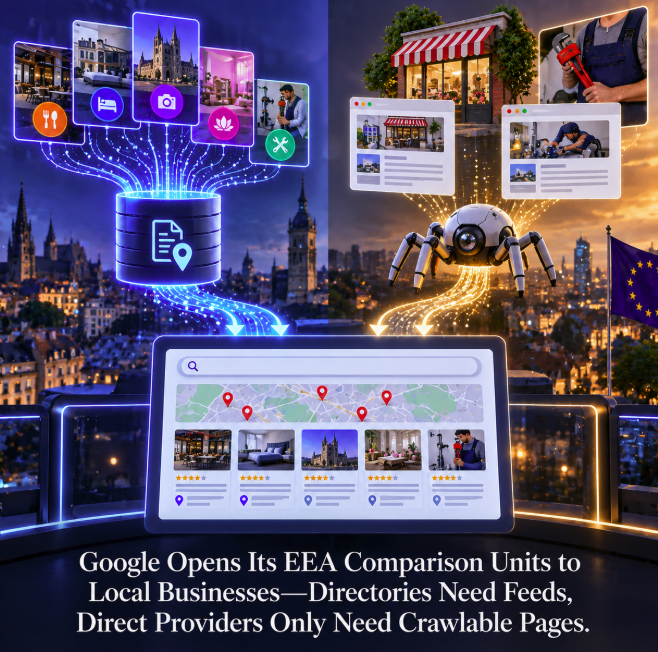

Google has expanded two EEA-specific Search features beyond travel and shopping into local-business queries, creating a new route into comparison-style results for both directories and the businesses they list. The important implementation detail is that the two sides enter the system differently: approved aggregators must supply structured local-business data through Google's Local Point of Interest feed, while direct providers can be eligible for the Supplier Unit using information Google can access through ordinary web crawling.
Google recorded the change in its Search documentation updates on September 18, stating that local-business query support had been added to both the Aggregator Unit and Supplier Unit. The update applies to users in the European Economic Area and extends a framework Google already uses for categories such as hotels, flights, long-distance ground transportation and products.
Two units, two different routes into the result
The Aggregator Unit is designed for Vertical Search Services, or VSSs, including directories, metasearch engines, comparison services and online travel agencies. When the unit appears, eligible aggregators can populate it with results relevant to the user's query. Google's documentation says the highest-ranked provider's results are expanded by default, while users can select another eligible aggregator when alternatives are available. Clicks within the unit lead to the aggregator's own website.
The Supplier Unit serves a different role. It is intended for direct providers, including individual hotels and airlines, brick-and-mortar business owners and service providers such as plumbers. It appears alongside the Aggregator Unit and only appears when the Aggregator Unit itself is shown. With the September update, both units can now participate in local-business searches in the EEA.
That creates a deliberate two-sided result structure. A user searching for a local service can potentially see results assembled by an approved directory or comparison provider while also receiving a dedicated route to businesses that provide the service directly. Google is therefore not requiring a local business to become a feed partner merely to qualify for the direct-provider side of the experience.
Directories need approval and a Local Point of Interest Feed
For aggregators, participation is an integration project. Google's documentation says a business must be approved as a Vertical Search Service, have relevant content, meet the quality standards for the feature and provide the data necessary to populate its unit. For local-business queries, that data comes through the Local Point of Interest Feed.
Google's Local VSS documentation describes the POI feed as a standardized format for entities with physical locations. It carries core information such as business name, address and phone number alongside metadata that can include category and photos. Google says data submitted through this integration is used exclusively to populate the partner's own unit and is not used to enrich Google's services or competing aggregators' units.
The Local Aggregator integration covers a broad range of physical-world entities. Google's published policies include dining, beauty and wellness, automotive services, professional services, shopping, health and fitness, and attractions among supported categories, subject to detailed eligibility rules. The destination URLs in an aggregator's feed must deep-link to a POI-specific landing page rather than forcing users through a generic search directory, login or paywall.
For directories, this means ordinary crawlability alone is not the participation mechanism. They first express interest through Google's Aggregator Features process and, once eligible, maintain a structured feed that Google can use to build the provider's result set. Google recommends rich entity details, accurate titles, high-quality images and current pricing or availability where those attributes apply.
Direct businesses do not need a mandatory feed
The Supplier Unit has a much lighter technical entry requirement. Google's documentation explicitly says a direct provider does not need to submit additional data beyond what is accessible through web crawling in order to appear. Supplier feeds can enhance results where available, but they are not described as mandatory for basic eligibility.
This distinction matters for small local businesses. A plumber, physical retailer, salon or other eligible direct provider does not need to build a Local Point of Interest feed merely because aggregators do. Instead, the site's public pages become the underlying source Google can crawl when determining eligibility and presentation for the Supplier Unit.
That makes familiar local SEO fundamentals relevant to the new feature. Business information should be available on crawlable pages, accurately describe the provider and its locations or services, and avoid technical barriers that prevent Google from accessing the content. Google's existing LocalBusiness structured data documentation also remains a way for site owners to communicate details such as opening hours and business information to Google, although the Supplier Unit documentation does not make that markup a mandatory integration requirement for participation.
This is not simply another local pack
The Aggregator and Supplier Units are regional Search experiences built specifically around provider choice in the EEA. The aggregator side is multi-provider: different approved Vertical Search Services can compete to supply the results shown inside the unit, and users can switch among available providers. The supplier side exists alongside that feature to give direct businesses their own visibility.
Google's regional Search documentation lists these experiences separately from other familiar result types. That distinction is important for measurement. A directory may gain visibility through its Aggregator Unit even when the same URLs behave differently in ordinary organic results, while a direct business can surface through the Supplier Unit without becoming an aggregator or establishing the same feed integration.
The units also create a new competitive layer for local-search intermediaries. Directories are not simply trying to rank one landing page in the traditional results; approved providers can supply a set of relevant entities directly into a comparison interface. The highest-ranked provider receives the expanded view by default, making the quality and relevance of the feed itself part of the experience users see.
The feed-versus-crawl split changes the implementation strategy
For local directories and comparison sites, the practical task is to evaluate VSS eligibility and feed readiness. Their data needs stable entity identifiers, accurate business details, appropriate categories, direct landing pages and ongoing quality control. Because local inventory changes constantly, maintaining high-fidelity entity data is not a one-time implementation exercise.
For direct providers, the first priority is different. They need to ensure that Google can crawl clear, authoritative pages describing the business, location and services. A business that hides key details behind scripts Google cannot reliably access, thin directory-style pages or authentication creates a weaker foundation for any feature that depends on ordinary crawling.
The asymmetry is intentional. Aggregators are supplying Google with a catalog of third-party entities that will populate a multi-result unit, so Google requires a structured integration. Direct suppliers are representing themselves, so Google can use information already published on their websites and supplement it with feeds where available.
A significant EEA local-search expansion
The September 18 update is concise in Google's changelog, but its scope is meaningful. Local businesses join hotels, transportation and products inside a Search framework designed to expose both intermediaries and direct providers. Directories now have a formal feed-based path to populate local comparison units, while businesses themselves can participate without building the same infrastructure.
For SEO teams operating in the EEA, that means “local visibility” increasingly needs to be analyzed across more than the traditional organic result and local pack. Approved aggregators have a new structured-data distribution surface, and direct businesses have a crawl-based supplier surface that can appear beside it. The technical requirements differ, but both are now part of the same local-search experience.
The most useful takeaway is therefore the implementation split: aggregators need approval plus a Local Point of Interest feed; direct providers need accessible, crawlable business information and can optionally benefit from supported feeds. Google has opened the same local query space to both groups, but it has deliberately given them different ways to get there.