

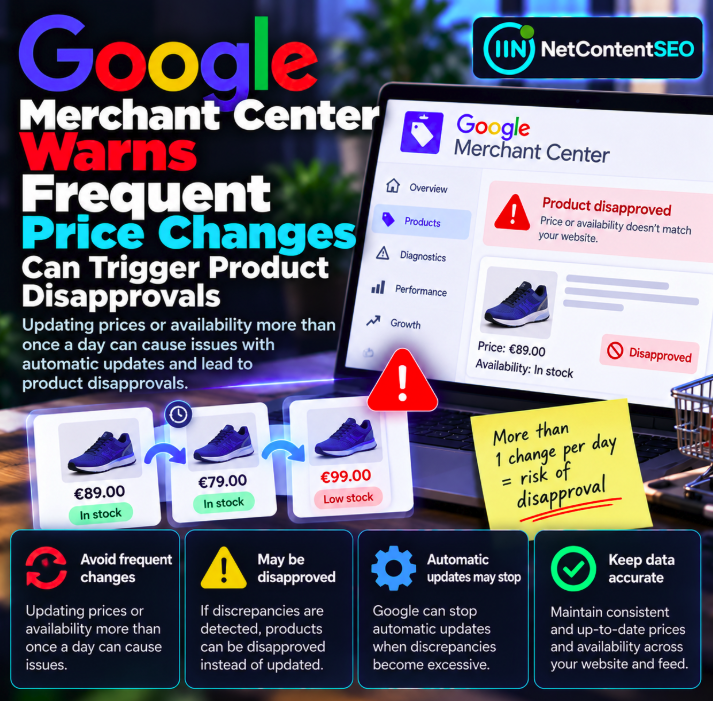

Google Merchant Center warns that automatic item updates may not work reliably when a product's price or availability changes more than once per day. If Google's systems find a mismatch between the product information submitted to Merchant Center and the corresponding landing page, an item may be disapproved rather than automatically corrected. Google may also stop automatic item updates when too many mismatches are detected.
The documentation change was reported on September 27, 2026 and discussed further on October 8. It is a clarification of operational risks, not a confirmed announcement of a new disapproval algorithm.
Sources: Google Merchant Center Help and Search Engine Roundtable.
What Google is warning merchants about
Automatic item updates are designed to help keep selected Merchant Center attributes aligned with information Google can detect on a product landing page. They can be useful when there are occasional differences between submitted product data and website content.
But this is a corrective mechanism, not a substitute for maintaining accurate product feeds or API submissions. Google explains that automatic updates may be unreliable when prices or availability change more than once a day. When discrepancies persist, product approval can be affected.
Why rapidly changing prices create a problem
Consider a product whose price changes during a flash sale. A merchant's product feed may still show an earlier price while the landing page has already changed. If another promotion or stock adjustment happens before the next data synchronization, Google may encounter conflicting information across systems.
Frequent changes make it harder for an automatic correction mechanism to keep the submitted price, landing page and displayed shopping information aligned. The risk is not that a price change itself is forbidden; it is that Google may detect inconsistent data that it cannot safely reconcile.
Automatic item updates versus feed synchronization
| Method | Role | Limitation |
|---|---|---|
| Product feed or Content API submission | Merchant-controlled source of submitted price and availability data | Must be refreshed when product information changes |
| Automatic item updates | Google attempts to correct eligible mismatches using landing page information | May fail with frequent changes or excessive inconsistencies |
| Landing page content and structured data | Shows customers and Google the current offer details | Must accurately match the offer and be accessible to Google's systems |
Merchants should treat their own product data pipeline as the primary source of accurate updates. Automatic item updates are a supporting safeguard, not the main synchronization strategy.
Can Google disapprove a product instead of updating it?
Yes. Google's help documentation warns that when discrepancies are detected, a product may be disapproved instead of automatically updated. This is especially relevant to merchants who assume that enabling automatic updates will always repair stale prices or availability values.
A disapproval can prevent an affected item from appearing in eligible Shopping experiences until the issue is resolved and the product meets applicable requirements. The precise effects depend on the item, destination and account circumstances.
Can automatic item updates be stopped?
Google also states that automatic item updates may stop when too many mismatches are found. That makes repeated inconsistency a broader operational risk: a merchant can lose the safety net they were relying on to correct occasional errors.
The announcement does not specify a universal numerical threshold for 'too many' mismatches. Publishers and consultants should not invent one or claim that a particular number of daily changes automatically triggers a disapproval.
More than one change per day is a warning, not a ban
The wording matters. Google says automatic updates may not work well when price or availability changes more than once per day. It does not establish a blanket prohibition on dynamic pricing, daily promotions or multiple stock changes.
Merchants can operate with frequently changing prices, but they need an appropriately reliable system for keeping product submissions, on-page prices and checkout details consistent.
What merchants should audit first
- Compare submitted and live prices. Check representative products in Merchant Center against the visible landing page and checkout.
- Review availability values. Confirm that stock status is consistent across feeds, structured data and the website.
- Measure update latency. Record the time between a price change on the site and its appearance in submitted product data.
- Inspect diagnostics. Review product issues and disapproval reasons rather than assuming every rejection comes from frequent updates.
- Validate structured data. Ensure eligible offer markup reflects the current product state.
- Check caching and variants. CDN caches, regional prices and product variant URLs can produce mismatches.
- Test promotions. Pay particular attention to short sales and scheduled price changes.
- Monitor recurring errors. Repeated mismatches can indicate a broken synchronization process.
Structured data is helpful but not a substitute for accuracy
Accurate product structured data can help Google understand landing page details, but markup must match what shoppers actually see. Adding a correct schema value while leaving the visible price stale does not solve a data consistency problem.
Likewise, changing only the visible page while leaving a stale feed or API submission can still cause discrepancies. The objective is consistency across the systems that describe the same offer.
What about ecommerce sites using dynamic pricing?
Dynamic pricing, inventory-driven offers and rapid promotions make reliable synchronization especially important. Businesses with frequently changing prices may need more frequent product data updates and better coordination between their ecommerce platform, feeds, inventory services and caching layers.
There is no universal update frequency that guarantees approval for every merchant. The right implementation depends on the site's operational requirements and the available Merchant Center integration.
How to respond to a disapproval
Start with the specific Merchant Center diagnostic reason. Compare the submitted product price and availability with the actual landing page and checkout. Correct inconsistent data, ensure the product can be fetched properly, and follow Google's documented issue-resolution or review process as appropriate.
Simply toggling automatic item updates on or off is unlikely to fix an underlying feed or website synchronization defect.
Is this a new Google algorithm update?
No new disapproval algorithm is confirmed by the reported documentation clarification. Google is warning merchants about the limitations of automatic item updates and the possible consequences of mismatched information.
It would be misleading to describe this as a new organic Search ranking factor or a confirmed change to AI Overview citations. The immediate issue concerns Merchant Center product data accuracy and eligibility.
FAQ
Can changing a price twice in one day automatically disapprove a product?
Not necessarily. Google's warning concerns automatic updates becoming unreliable when prices or availability change more than once per day. Disapproval risk arises from discrepancies; no automatic two-change penalty is established.
Will Google always correct mismatched prices?
No. It may disapprove a product instead of updating it.
Can Google disable automatic item updates?
Google says automatic updates may stop when too many mismatches occur.
Should merchants rely on automatic item updates instead of feeds?
No. Accurate and timely product submissions remain essential.
Does this change organic Google rankings?
The reported warning concerns Merchant Center product eligibility, not a newly announced organic ranking algorithm.
NetContentSEO analysis
The operational lesson is to treat Merchant Center automatic item updates as a backup mechanism, not a real-time price synchronization service. Fast-changing prices and inventory create genuine data consistency challenges. Merchants that measure feed latency, keep landing pages accurate and monitor disapproval diagnostics are better positioned to prevent avoidable product visibility interruptions.
Sources: Google Merchant Center Help; Search Engine Roundtable.