

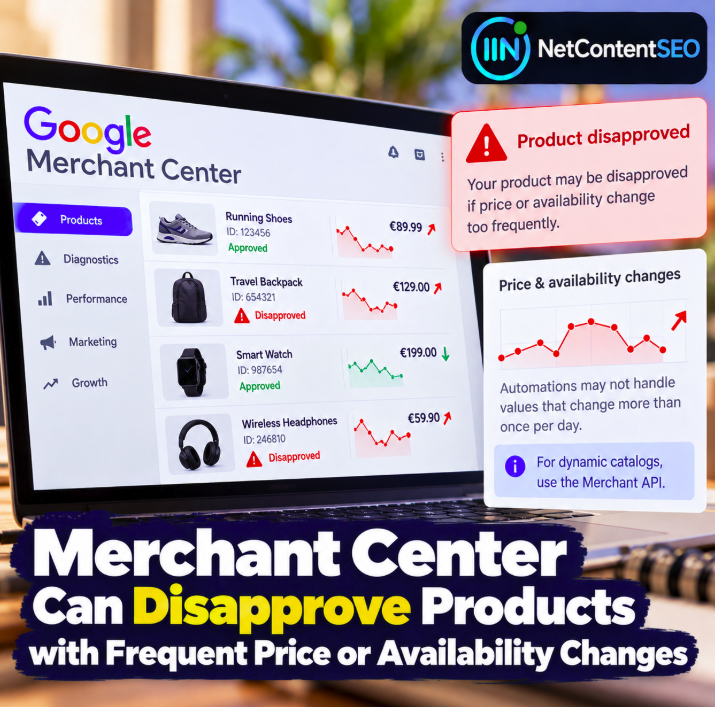

October 8, 2026. Google Merchant Center documentation warns that automatic item updates may not keep up with products whose prices or availability change more than once per day. If Google detects mismatches between submitted product data and a landing page, it may disapprove the item rather than automatically correct it. If too many mismatches occur, Google may also stop automatic updates. For merchants with fast-moving inventory, Google recommends the Merchant API.
What Google is warning merchants about
Automatic item updates are a safety mechanism, not a substitute for an accurate product feed. Google can use information found on a product landing page to reconcile certain price and availability discrepancies. But those systems have limits, especially when values change frequently. The documented warning is about mismatches and update reliability; it is not a blanket policy that disapproves every product whose price changes multiple times daily.
How a product can become disapproved
Consider a retailer that submits a product at one price while its website has already changed to another. If Google's checks encounter inconsistent values and the automatic update mechanism cannot resolve the discrepancy, the product can be disapproved. Similar issues can arise when an item is marked in stock in the feed but unavailable on the landing page. A high volume of these mismatches may cause Google to stop automatic updates, creating further operational risk.
Why dynamic catalogs face a greater challenge
Flash sales, airline-style dynamic pricing, limited inventory, marketplace stock changes and frequent promotional adjustments can create a lag between website data and Merchant Center submissions. The faster prices and stock change, the more important it becomes to synchronize the authoritative source, product page and feed. Automatic corrections should be treated as a fallback rather than the primary data pipeline.
Google recommends the Merchant API
For catalogs with frequent changes, Google's guidance points to the Merchant API for more timely product data management. An API integration can help a merchant send updates when business data changes, rather than waiting for a scheduled feed refresh. However, an API does not remove the obligation to keep landing pages, structured data and submitted values consistent.
Merchant Center audit checklist
- Measure change frequency: identify SKUs whose price or stock status changes more than once daily.
- Compare sources: check submitted feed values, visible landing-page prices, structured data and checkout pricing.
- Review diagnostics: monitor price and availability mismatch warnings and disapprovals in Merchant Center.
- Improve update speed: evaluate Merchant API integration for frequently changing items.
- Verify caching: inspect CDN, page cache and JavaScript rendering that may expose outdated values to Google.
- Monitor recovery: track disapproved SKUs after corrections and verify that eligible products become active again.
What this means for Shopping visibility
When products are disapproved, they may lose eligibility to appear in relevant Shopping placements. That can interrupt product discovery and paid or free listing performance. The scale of the impact depends on the affected products and surfaces, so merchants should quantify disapprovals rather than assuming a sitewide ranking penalty.
The NetContentSEO takeaway
For dynamic ecommerce catalogs, accurate real-time product data is part of search visibility infrastructure. The risk is not that Google forbids price changes; it is that Google's automatic reconciliation cannot reliably compensate for inconsistent or stale data. Merchants should prioritize feed-to-page consistency and use direct update mechanisms where the pace of change demands them.
Official source: Google Merchant Center Help: automatic item updates.