

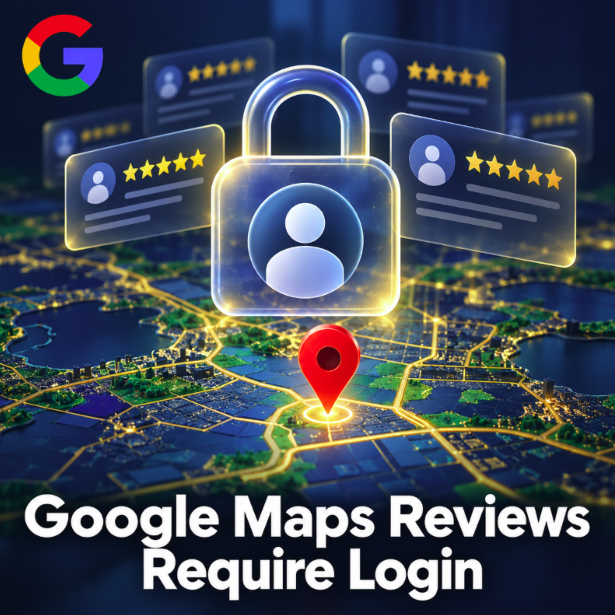

Google Maps is prompting signed-out users to log in when they try to explore a business’s full review list. The reported change introduces an account requirement for deeper review browsing, including searching and sorting. For local businesses, it raises questions about customer access and the availability of reputation evidence to outside services.
What has been observed
Search Engine Roundtable documented the behavior on September 30, 2026, with screenshots and a GIF showing a sign-in prompt when users request more reviews or sorting options. The report cites observations from several practitioners. Its suggestion that the change is intended to deter scrapers and AI platforms is explicitly speculation, not an explanation supplied by Google.
One of the cited observers, Michael B. Snow, described the restriction in Maps while reporting continued signed-out access through direct and finder search results. That distinction matters: the evidence does not establish that Google has placed every route to review content behind authentication. Nor does it establish a uniform rollout across devices or markets.
A login boundary is an access change
A customer researching a business may now encounter an extra step before examining the full range of experiences or locating a particular topic in reviews. That could interrupt the research journey, but the observations provide no measurement of abandonment or conversion. Businesses should first check the experience their own customers encounter rather than assume a quantified commercial effect.
Record the entry point, device and account state when checking a profile. Compare what is visible in Maps with what appears through Search, and distinguish summary information from the complete review list. A prompt encountered in one interface should not be treated as proof that reviews have disappeared.
The possible implications for AI Search
Our editorial inference is that an authentication requirement can make collection through the affected interface less straightforward for a tool operating without an account. That does not show which AI services use this route, whether their access has changed or whether their recommendations will become less accurate. Other access arrangements and information sources cannot be assessed from a consumer-interface observation alone.
The useful question for reputation monitoring is therefore about coverage: which source was consulted, when was it accessed and how complete was the material available? If a tool reports no recent review evidence, teams should investigate whether that reflects missing content or limited access before drawing conclusions about customer sentiment.
Reviews still matter for local SEO
Google’s local ranking guidance continues to identify reviews and positive ratings as factors that can help local ranking. It also recommends complete business information and helpful responses to customer reviews. This guidance concerns local visibility; it does not confirm the reason for the new sign-in prompt.
The access observation is not evidence of a ranking update or a reason to stop managing reviews. Keep responding constructively to feedback and maintain accurate information about services, opening hours and location. For AI visibility, clear public descriptions of those facts provide useful material, although they do not guarantee selection by any assistant.
Monitor access and representation separately
Local teams can track the signed-out review experience alongside the descriptions their businesses receive in AI answers. These are separate observations: a Maps login prompt does not demonstrate an AI recommendation change. If both change, investigate the sources and timing before assigning cause.
The confirmed news is an observed restriction on full review browsing in Maps. The broader story is a potential access challenge worth monitoring, with Google’s motivation and the actual effect on AI collection still unconfirmed.