

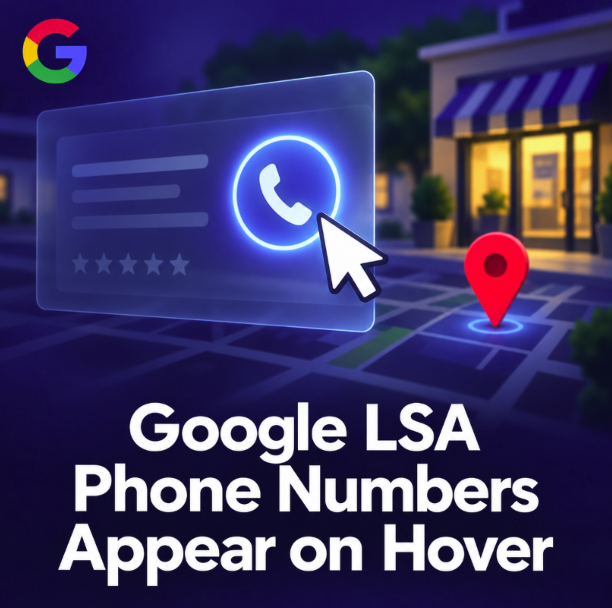

A reported Google Local Services Ads interface initially presents a phone-number action rather than visible digits, then reveals the number as the pointer approaches the ad. For local marketers, the observation raises a practical question about contact discovery within the search results, even when an advertiser's position stays the same.
What has been observed
In an October 2 report, Search Engine Roundtable's Barry Schwartz describes a “Get phone number” button and a number that appears on hover. The report includes a GIF and before-and-after images, but explicitly questions whether the behavior is new. It does not establish a Google-confirmed rollout or a measured effect on calls.
The wording itself has a history: the publication reported the button label in April 2024. The current observation concerns how the number is revealed, rather than proving the arrival of an entirely new contact action.
Visibility and contactability are different questions
An ad can occupy the same position while presenting its contact route differently. That distinction matters when explaining performance to a local business owner. Ranking reports describe where an advertiser appears; they cannot, by themselves, tell a team how readily a visitor recognizes the next step.
It is plausible that concealing digits until interaction changes the way some visitors engage. It is equally possible that the action label makes the route clear enough for many users. Neither outcome is established by this report. Describing a possible source of friction is an interpretation, not a finding that Google has reduced call conversion.
How to monitor the interface responsibly
When a team encounters this presentation, record the query, location, device, browser and whether the user is signed in. Capture the initial appearance and the transition after moving the pointer. Repeat observations over time before treating the variant as a persistent change.
Keep mobile observations separate. A touch device does not provide the same hover interaction, and the desktop report cannot establish how the contact flow works there. Accessibility checks should likewise examine the actual interface, including keyboard navigation, rather than assuming that mouse behavior describes every user's experience.
For performance analysis, compare available lead and exposure data over a meaningful period and account for changes in budgets, demand, service coverage and business hours. A coincident decline in calls would not isolate the interface as its cause. Record the date of an observed variant so it can inform analysis without becoming a premature explanation.
The implication for local SEO and AI Search
This is a paid local-search interface observation, with no demonstrated change to organic local rankings or AI answers. Its broader lesson for search operations is that visibility alone does not describe the full path to a customer interaction.
Local SEO and advertising teams can share a common review of how a prospective customer finds and contacts the business across surfaces. Keep reporting specific to the channel where the behavior was observed. Until broader evidence emerges, the hover presentation is a monitoring item rather than a reason to rewrite an entire lead-generation strategy.