

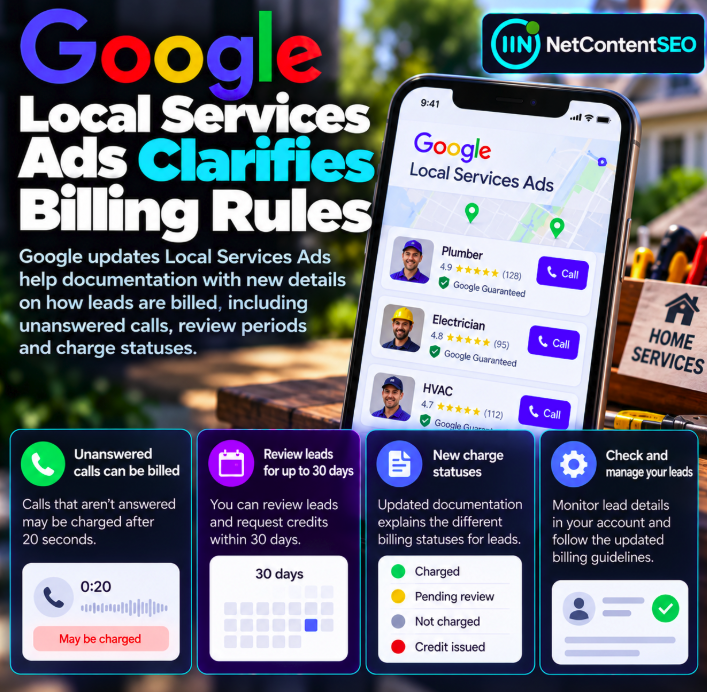

Google has expanded its Local Services Ads help documentation to explain how leads are billed, including cases in which a call is not answered. The clarification, identified on October 8, 2026, notes that certain unanswered calls may still be chargeable when they last at least 20 seconds. It also provides more information about reviewing leads within a 30-day window and understanding charge statuses.
For local businesses, the key lesson is that an unanswered call is not automatically a free lead. However, the updated help text should not be interpreted as proof that every missed call lasting 20 seconds will be billed, or as confirmation of a newly introduced pricing algorithm.
Sources: Google Local Services Ads Help and Search Engine Roundtable.
What Google clarified about Local Services Ads leads
Local Services Ads connect people looking for eligible local services with participating providers. Rather than focusing only on website clicks, the product is designed around customer contacts such as calls and messages, with billing rules that depend on lead type and eligibility.
Google's expanded help documentation explains situations in which a contact can count as a chargeable lead. The update also adds clarity about the time window for reviewing leads and the status labels businesses may see when checking charges.
Can an unanswered call really be billed?
Yes, in some circumstances. Google's clarified documentation indicates that an unanswered call can be chargeable after 20 seconds. That detail is important because business owners may assume a missed call cannot generate a cost.
The 20-second reference is not a universal promise that every missed call will be charged. Billing may depend on the applicable lead rules and the particular call circumstances. Businesses should check the details shown for each lead rather than making assumptions based solely on whether someone answered.
What does the 20-second rule mean?
The documentation's 20-second reference identifies a duration condition relevant to certain unanswered calls. It does not establish that Google charges all calls at exactly the 20-second mark or that duration alone determines lead validity.
For example, a business may see a missed call in its phone system and still need to inspect its Local Services Ads account to determine whether Google classified it as chargeable. The product's billing record, not the business's informal call log, is the appropriate starting point for reviewing a charge.
Reviewing leads within 30 days
Google's updated information describes a window of up to 30 days for reviewing leads. This makes regular account checks important: if a business waits too long to investigate questionable contacts, it may lose the opportunity to use an applicable review or credit process.
Advertisers should consult the current help documentation and their account interface for the exact eligibility criteria, timing and available actions. A 30-day review window is not a blanket guarantee that every disputed charge will be refunded.
Understanding charge statuses
The revised documentation provides additional information about the status of lead charges. Status labels help advertisers understand whether a lead has been charged, is being assessed or has another billing outcome.
The exact names and availability of status labels may depend on the account and workflow. Rather than relying on generic descriptions, businesses should inspect the current status and details of each lead in their own Local Services Ads interface.
What local businesses should monitor
| Item | Why it matters |
|---|---|
| Unanswered calls | Some may still be billable; missed does not always mean free |
| Call duration | The documented 20-second condition may be relevant |
| Lead date | Helps track the applicable 30-day review window |
| Charge status | Shows the billing outcome or stage associated with a lead |
| Lead details | Supports accurate investigation of questionable charges |
| Account documentation | Provides current rules and available review actions |
Practical checklist for Local Services Ads advertisers
- Check leads regularly. Avoid leaving billing reviews until the end of the month.
- Compare records. Match lead details in Local Services Ads with business phone and booking records where permitted.
- Do not dismiss missed calls. Review their charge status, including calls that were not answered.
- Track deadlines. Record when a lead arrived so review opportunities are not missed.
- Investigate patterns. Repeated missed calls may indicate staffing, routing or scheduling problems as well as billing questions.
- Follow official procedures. Use the account's documented review or credit workflow where applicable.
- Keep evidence. Maintain relevant call and appointment records in accordance with privacy and retention requirements.
Why this matters for agencies managing local advertising
Agencies should be careful when reporting lead cost and lead quality. A chargeable lead is not necessarily a booked job, and a missed call may still represent a billable contact. These distinctions affect how businesses interpret campaign efficiency.
Reports should separate leads received, leads billed, leads contacted, appointments booked and revenue generated. Treating all of those measures as equivalent can produce misleading performance conclusions.
Can better call handling reduce wasted opportunities?
Regardless of the billing policy, promptly answering relevant calls can improve a business's chance of speaking with prospective customers. Companies may benefit from reviewing opening hours, call routing, staffing and follow-up procedures.
Those operational improvements do not guarantee lower Google charges. They help businesses make better use of the contacts their ads generate.
Does this change organic local SEO?
No change to organic local search rankings or Google Business Profile ranking factors is established by this documentation update. Local Services Ads is a paid advertising product with its own eligibility and billing rules.
Businesses should keep paid lead management separate from organic local SEO performance, even when both channels contribute to customer acquisition.
Is Google announcing a new billing algorithm?
Not on the evidence provided. The reported development is an expansion of official help documentation. It clarifies circumstances in which leads may be charged and how businesses can review them, but it does not independently establish a new algorithm or a new universal price schedule.
FAQ
Are all unanswered Local Services Ads calls free?
No. Google's documentation indicates that some unanswered calls can be chargeable.
Does a 20-second unanswered call always incur a charge?
No universal automatic-charge rule is established by the clarification. Advertisers should check the specific lead's status and applicable conditions.
How long can advertisers review leads?
Google's expanded documentation describes a review window of up to 30 days, subject to applicable rules.
Can businesses dispute every lead and receive a refund?
No. Review eligibility and credit outcomes depend on Google's policies and the circumstances of the lead.
Is this a new Google Search ranking update?
No. The reported change concerns Local Services Ads billing documentation.
NetContentSEO analysis
The most important operational lesson is that missed calls and billable leads are not mutually exclusive. Local businesses and agencies should audit their lead records frequently, understand charge statuses and track review deadlines. The documentation offers more clarity about billing, but it does not establish a new local SEO ranking signal or guarantee credits for every disputed contact.
Sources: Google Local Services Ads Help; Search Engine Roundtable.