

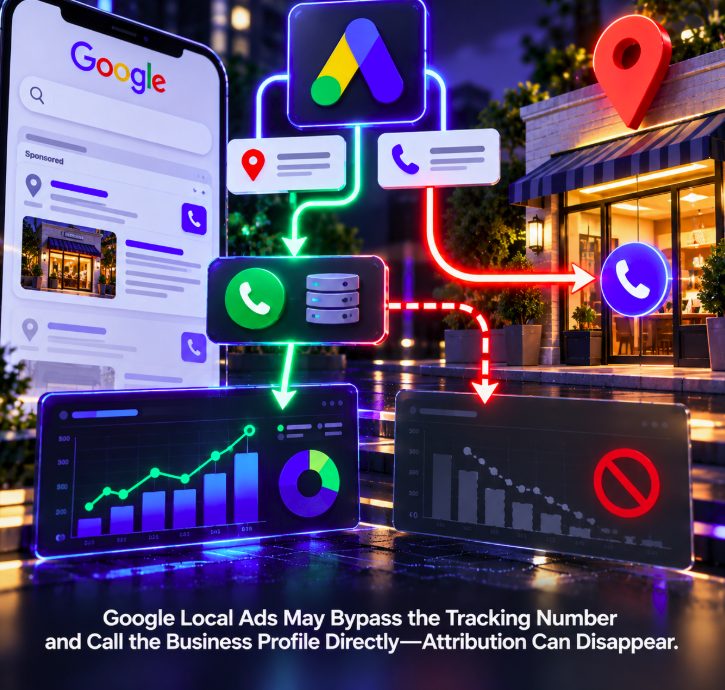

Google’s local advertising stack can create an uncomfortable attribution gap when location assets and call assets are used together. An ad tied to a specific business location may route the call to the phone number associated with that location rather than the separate number configured in the call asset, potentially bypassing the tracking setup an advertiser expected to measure the campaign.
The issue was documented by Search Engine Roundtable on September 25 after advertiser Anthony Higman repeatedly reported seeing Google Business Profile phone numbers on local ad formats despite having active and verified call assets. Google responded publicly that when both location and call assets are in use, ads featuring specific business locations may direct calls to the phone numbers associated with those locations instead of the numbers configured in the call assets.
Google’s own documentation confirms the routing behavior
This is not only an anecdotal interface observation. Google’s official documentation for call assets now states that when advertisers use both location assets and call assets, ads containing specific business locations can direct calls to the phone numbers associated with those locations rather than the numbers configured in the call assets. Google recommends location assets alongside call assets for local targeting and reach, but the combination changes which phone endpoint may be used.
Google’s local search ads documentation is similarly explicit: local search ads can include an option to call the featured location and use the phone number of that business location. Location assets themselves draw business data, including phone numbers, from Google Maps and Google Business Profile.
The result is a hierarchy that can surprise advertisers who think of the call asset as the authoritative phone configuration for an ad. Once Google renders a location-specific experience, the location’s own phone data can take precedence in the user-facing call action.
The call can still happen while the advertiser loses the expected attribution path
For the customer, nothing necessarily looks broken. They see an ad, tap a call button and reach the business. The problem appears in measurement. If the advertiser relies on a dedicated tracking number or a specific call-routing setup to identify paid-search calls, substituting the Business Profile number can remove the signal that connects the phone conversation to the ad campaign.
That distinction is important because operational success and measurable success are not the same thing. The business may receive exactly the lead it wanted while the reporting system fails to classify that lead through the expected tracking path. A campaign can therefore look weaker in downstream analytics than the actual call volume it generated.
Search Engine Roundtable’s report describes this as the central complaint from Higman: the ads were still producing calls, but the number being shown was not the Google Ads number his setup expected. He reported that the behavior later appeared to reverse in some accounts, while also saying that inconsistent behavior remained. That makes this an especially difficult attribution problem because it may not reproduce uniformly across every account or impression.
This is not necessarily a universal new rollout
The timeline requires care. The September 25 report describes a behavior that had been raised publicly since early September and confirmed in Google’s response, but it does not establish a clean launch date for a new feature. Nor does Google’s documentation frame the routing rule as a newly introduced product change.
There is also evidence that some affected accounts returned to their previous behavior. Higman told Search Engine Roundtable that he had seen the advanced Business Profile number setup working again in some accounts, although he continued to observe irregularities. Advertisers should therefore treat the issue as a routing behavior they need to verify in their own campaigns, not as proof that every local ad is now replacing every tracking number.
The durable fact is the one Google itself documents: when location and call assets coexist, a location-specific ad may use the phone number associated with that location instead of the call asset number.
Location relevance can outrank tracking-number consistency
From Google’s product perspective, there is a clear reason to associate the call action with the featured location. A user seeing a specific store, clinic, office or branch generally expects the call button to reach that exact location. Google Business Profile is the system that stores the verified phone information for those places, while the location asset is designed to connect advertising with that local entity.
For advertisers, however, the most locally accurate phone endpoint may not be the one their attribution architecture expects. Multi-location businesses often use forwarding numbers, dynamic number insertion or specialized call-tracking platforms precisely because they need to distinguish paid calls from organic Business Profile calls and other channels.
The conflict is therefore structural: Google is optimizing the ad around the location entity, while the advertiser may be optimizing measurement around a campaign-specific tracking identity.
Google does provide call tracking for location assets, but setups still need auditing
Google’s location-asset documentation says advertisers can enable call tracking and that account-level call reporting must be active to see call-tracking data from location assets. Google also notes that call tracking on Search uses Google forwarding numbers to provide conversion information.
That means the presence of a Business Profile phone number in the local advertising architecture does not automatically imply that every call is unmeasurable inside Google Ads. The attribution risk depends on the advertiser’s configuration, reporting requirements and whether the call path preserves the tracking signals the business relies on outside Google’s own reporting.
This is why advertisers should test the actual user-facing experience rather than assume the number entered in a call asset is necessarily the number every local format will expose. The question is not only whether call reporting is enabled, but which number and routing path appear when Google renders a specific location.
Business Profile data is becoming advertising infrastructure
The issue also demonstrates how deeply Google Business Profile data now participates in paid media. Location assets can import addresses, phone numbers, opening hours, photos and videos from the profile and use those data to format ads. A Business Profile is therefore not merely an organic local-search listing; it can supply operational data to the advertising system.
That makes profile governance an advertising concern. NetContentSEO recently covered Google’s growing use of automated systems to collect and manage business information. The phone-routing issue adds another reason for paid-search teams to coordinate with whoever owns Business Profile data: the phone number attached to the location can become the phone number an ad actually uses.
The same principle applies to local entity consistency more broadly. When advertising systems increasingly render campaigns from verified business data, errors or unexpected configurations in the entity layer can propagate into paid experiences rather than remaining confined to Maps or organic local results.
Multi-location advertisers face the largest measurement risk
A single-location business with one phone number may barely notice the distinction. The operational destination is the same regardless of whether Google uses the call asset or the Business Profile number. The problem becomes more serious for businesses with many locations, centralized call centers, franchise reporting, lead-routing rules or third-party tracking numbers.
Those organizations often need to know not only that a phone call occurred but which campaign, location and advertising interaction produced it. If a location-specific number bypasses the tracking route, the business may receive the lead while losing the metadata required to attribute revenue, calculate cost per qualified call or reconcile performance across branches.
Agencies can face an additional reporting problem. A client may compare the agency’s recorded paid-call volume against calls received by the business and find a discrepancy. Without checking the actual numbers shown in local ad formats, the missing calls can look like a tracking implementation failure elsewhere in the stack.
The correct audit is now impression-to-phone, not configuration-to-phone
The practical response is to audit what users actually see. Advertisers using both call and location assets should test relevant local searches and Maps experiences, inspect which location is featured and confirm which phone endpoint the call action reaches. They should compare that behavior with Google Ads call reporting and their external call-tracking platform.
Teams should also document which phone numbers are attached to each Business Profile location and whether those numbers preserve the attribution architecture the organization needs. Removing location assets simply to protect tracking may sacrifice valuable local relevance, while removing call assets can change other campaign experiences. The right configuration depends on the business rather than a universal workaround.
Most importantly, advertisers should not assume that a correctly configured call asset guarantees that its number will appear in every local ad. Google’s own documentation now makes that assumption unsafe.
Local advertising is exposing the limits of channel attribution
The larger lesson is that Google’s local products increasingly assemble an experience from multiple systems at once: Ads supplies the campaign, Business Profile supplies the location entity, Maps supplies local context and call reporting attempts to connect the interaction back to advertising. The user sees one coherent result, but the advertiser’s measurement stack may depend on boundaries between those systems that Google does not preserve in every rendering.
That is why a phone call can be successful for the customer and simultaneously disappear from the attribution model an advertiser expected. The ad did its job; the measurement path changed underneath it.
For local marketers, the safest assumption is now that the Business Profile phone number is not passive metadata. When location assets are involved, it can become the live call destination of the paid ad. Attribution therefore needs to be tested at the final rendered experience—not inferred from the number sitting inside the Google Ads configuration screen.