

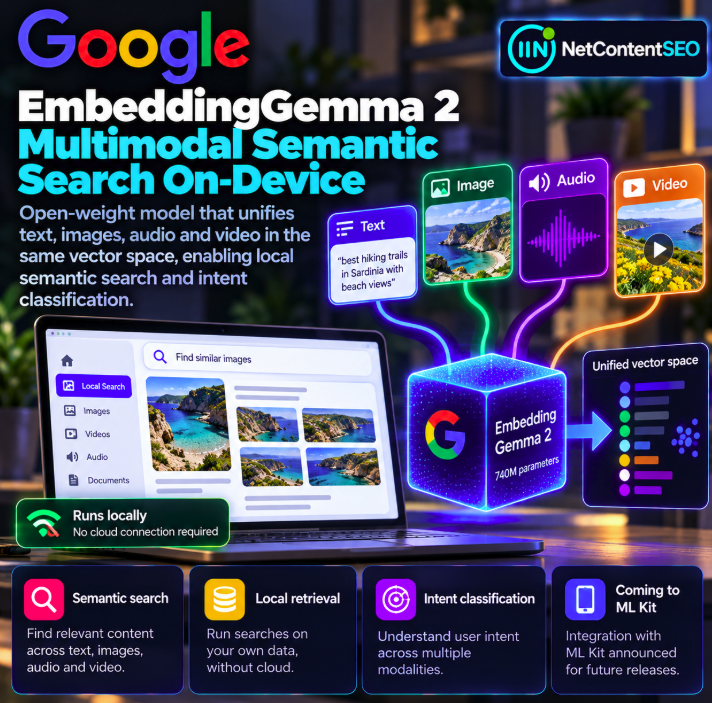

Google has introduced EmbeddingGemma 2, a 740-million-parameter open-weight embedding model designed to represent text, images, audio and video frames in a shared vector space. Announced October 6, 2026, the model is positioned for multimodal semantic retrieval and intent classification on local devices, reducing the need to send content to a cloud inference service. Google also says integration with ML Kit is planned for a future release.
The development is relevant to search technology because it brings multiple media types into one retrieval pipeline. But it is important to separate the model's capabilities from Google's public Search product: the announcement does not say EmbeddingGemma 2 has been deployed in Google Search ranking, AI Overviews or citation selection.
Primary source: Google Developers Blog — Google AI Edge with EmbeddingGemma 2.
What is EmbeddingGemma 2?
Embedding models convert inputs into numerical representations, or vectors, that can be compared mathematically. Instead of matching only identical words, a semantic retrieval system can use these representations to find material related in meaning or content.
EmbeddingGemma 2 extends this approach across text and visual or audio inputs. Google's announcement describes a unified embedding space for text, images, audio and video frames, enabling applications to compare different kinds of content through their vector representations.
Key specifications and release status
| Property | Announced detail |
|---|---|
| Model | EmbeddingGemma 2 |
| Parameter count | 740 million |
| Weights | Open-weight |
| Input modalities | Text, images, audio and video frames |
| Output | Embeddings in a shared vector space |
| Deployment focus | Local/on-device inference |
| Use cases | Semantic search, multimedia retrieval, intent classification |
| ML Kit integration | Announced for the future, not described as available now |
| Announcement | October 6, 2026 |
Google describes the model and demonstration tools as available. Open-weight availability should not be confused with unrestricted use under every license or with automatic compatibility across all devices; developers should review the published model terms and supported runtimes.
One vector space for four types of content
Traditional text search starts from words. Multimedia collections, however, may contain photographs, voice recordings, video frames and written descriptions of the same subject. A shared embedding space allows these different representations to be compared using similarity measures.
For example, a local media application could search a collection of images using a natural-language description. Another application might compare a spoken query with relevant indexed content. The precise quality of these cross-modal matches depends on the model, the preprocessing pipeline and the evaluation dataset; the announcement should not be treated as proof of perfect cross-modal understanding.
How local semantic search works
An on-device retrieval workflow can follow four basic steps:
- Prepare the local collection. Identify text passages, images, audio segments or video frames that the application is permitted to process.
- Generate embeddings. Run the model to transform supported inputs into vectors.
- Store and search the vectors. Use a local index or similarity-search implementation to compare query vectors with indexed content.
- Return relevant matches. Display the original files, passages or media segments associated with the nearest vectors.
The model supplies embeddings, not an entire turnkey search product. Developers still need ingestion, indexing, storage, retrieval logic and an interface appropriate to their application.
Why on-device execution matters
Running embeddings locally can reduce dependence on network connectivity and allow applications to process permitted content without sending each input to a remote inference endpoint. That can be useful for offline search, personal media libraries and applications operating under network constraints.
However, on-device does not automatically mean private or secure. Privacy also depends on how an application stores vectors, handles permissions, protects local files and transmits any results. Performance will vary with device hardware, memory, implementation and dataset size.
Intent classification beyond keyword matching
Semantic embeddings can also support intent classification. Instead of checking whether a query contains a specific phrase, an application can compare its representation with labeled examples or category descriptions.
For instance, a local help system might distinguish troubleshooting questions from product-comparison requests. Classification accuracy requires testing against representative inputs; a unified vector space is a capability, not a guarantee that every user intent will be identified correctly.
What does this mean for video search?
Google's announcement identifies video frames as supported inputs. Frame-level representations can help retrieve visually relevant moments from videos, especially when combined with timestamps and surrounding metadata.
That should not be exaggerated into a claim that the model necessarily understands every aspect of continuous video, temporal causality or long-form scene dynamics. The announced capability is embedding supported visual frames into the shared representation space.
ML Kit integration is planned, not yet delivered
Google also points to a future integration with ML Kit, its developer toolkit for mobile machine learning. This signals an intention to make the model easier to adopt in supported mobile workflows.
The timing and exact API surface of that integration are not established by the supplied announcement. Developers should not present EmbeddingGemma 2 as already available through a released ML Kit API until Google publishes that availability.
Why SEO and GEO professionals should pay attention
Search experiences increasingly extend beyond web pages and keyword-only matching. Multimodal embeddings make it possible to build retrieval systems that connect written descriptions with images, audio and video-related content. This is relevant to how publishers think about content organization, descriptive metadata and accessible media assets.
For SEO teams, useful experiments include comparing semantic matches across content formats, evaluating whether descriptive text improves retrieval in a controlled local collection and testing how multimedia assets can be organized for internal search. Such tests can inform content architecture, but they do not demonstrate a direct ranking effect in Google Search.
For GEO researchers, the release is another example of retrieval technology evolving beyond text. Yet the model's release does not establish its use in any public AI answer engine, nor does it prove that specific schema markup, image metadata or audio transcription practices will increase AI citations through this model.
What developers should test
- Cross-modal relevance: Can a text query find the right image, audio item or video frame?
- Latency: How quickly does the model embed inputs on the target hardware?
- Index size: How much storage is needed for the intended collection?
- Recall and precision: How often do relevant items appear among the top results?
- Offline behavior: Does the complete application work without cloud dependencies?
- Data handling: Are local files, embeddings and any telemetry protected appropriately?
- Language and domain coverage: Does performance remain useful on the actual content and languages being indexed?
FAQ
What is EmbeddingGemma 2?
A 740-million-parameter open-weight embedding model from Google designed for multimodal representations and local semantic retrieval.
Which content types does it support?
Google lists text, images, audio and video frames in a shared vector space.
Can it run without cloud connectivity?
It is designed for on-device use, enabling applications to perform local inference when the necessary model files and supporting components are installed.
Is it already integrated into ML Kit?
No. Google has announced future ML Kit integration.
Is EmbeddingGemma 2 used in Google Search?
The announcement does not confirm deployment in Google's public ranking, AI Overview or citation systems.
Does the model replace a search engine?
No. It provides vector representations; an application still needs an index, retrieval pipeline and user-facing search experience.
NetContentSEO analysis
EmbeddingGemma 2 brings multimodal semantic retrieval closer to the device, not necessarily closer to Google's public ranking algorithm. Its most immediate opportunity is for developers building local search across mixed media libraries. For SEO and AI visibility research, it illustrates why content retrieval is becoming increasingly multimodal—and why practitioners should distinguish technology capabilities from unconfirmed claims about search rankings or citations.
Primary source: Google Developers Blog — Google AI Edge with EmbeddingGemma 2, October 6, 2026.