
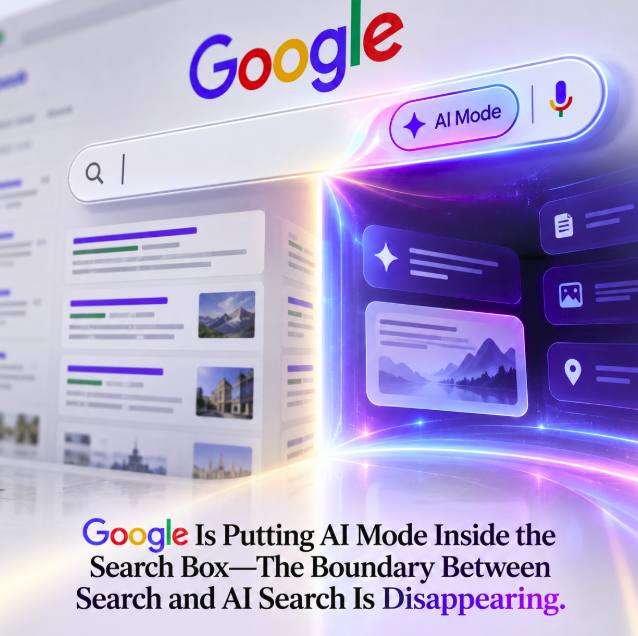
Google is testing another interface change that makes the distinction between traditional Search and AI Mode increasingly difficult to see. An AI Mode button is appearing directly inside the search box on the search results page, giving some users an immediate path from a conventional SERP into Google's conversational AI search experience while they are already in the middle of searching.
The test was documented by Barry Schwartz at Search Engine Roundtable on September 18, 2026, after an earlier sighting from Dwayne Cubbins. Schwartz was subsequently able to reproduce the interface himself. The AI Mode control does not appear consistently for every query or suggestion, which is an important limitation: this is a test, not evidence that Google has completed a universal rollout of the design.
AI Mode is moving into the place where searches begin
Google has already put AI Mode in prominent locations across Search, including dedicated navigation and shortcuts. What makes this test notable is the placement. The search box is not a secondary feature or an optional module added below the results; it is the primary control users return to when they want to refine a query. Putting AI Mode inside that control turns the choice between conventional search and conversational AI into part of the query-entry experience itself.
Schwartz's test also suggests that the interface can coexist with ordinary searching rather than simply replacing it. He reported that he was still able to execute a normal search even when the AI Mode button appeared. Cubbins, however, observed a version in which the familiar search action seemed less obvious and pressing Enter was needed to continue with regular Search. Those differences suggest Google may be experimenting with more than one interaction pattern.
This test fits Google's stated direction for Search
The experiment is less surprising when viewed against Google's public product roadmap. At Google I/O 2026, the company announced what it called the biggest update to the search bar in 25 years. In its official Search announcement, Google described a redesigned, AI-powered search bar intended to make advanced AI tools easier to access, accommodate longer questions and support multimodal inputs including text, images, files, video and Chrome tabs.
Google has also been explicit about its desire to reduce friction between standard results and AI conversations. In January, the company described a “seamless” Search experience in which users can move from an AI Overview into follow-up questions in AI Mode while preserving context. At I/O 2025, Google had already said that capabilities developed in AI Mode would progressively graduate into the core Search experience.
The new search-box test therefore looks less like an isolated button experiment and more like another implementation of a strategy Google has described publicly: make AI interaction available without forcing users to think of AI Mode as a separate destination.
The old boundary between a query and a conversation is weakening
Traditional web search has historically been built around a simple interaction loop: type a query, receive a results page, reformulate the query and search again. AI Mode changes that loop by preserving conversational context, breaking complex questions into multiple searches and allowing follow-up questions that do not need to restate everything that came before.
When the AI Mode entry point sits directly in the SERP search box, those two behaviors occupy the same interface. A user refining a normal keyword query can potentially move into an AI-generated response without navigating to a separate product or deliberately selecting a distant tab. The visual and behavioral distinction between “searching Google” and “asking Google's AI” becomes smaller.
Google itself has described AI Mode as bridging traditional search and conversational AI. In May 2026, the company said AI Mode had surpassed one billion monthly active users globally and that its queries had more than doubled every quarter since launch. Those are Google's own usage figures, but they help explain why the company has strong product incentives to make AI Mode easier to enter from the surfaces people already use.
For SEO and GEO, entry-point design matters
The immediate SEO impact of a button test should not be overstated. There is no evidence that this interface experiment changes ranking systems, indexing or the eligibility of pages to appear in Search. It can, however, influence user behavior if the design eventually rolls out broadly. A more prominent AI Mode entry point could send a larger share of follow-up and exploratory searches into a conversational environment rather than another conventional SERP.
That matters because visibility in AI Mode does not look exactly like visibility in ten blue links. AI Mode can fan a question out into multiple underlying searches, synthesize information across sources and surface links inside an AI-generated response. For publishers and marketers working on generative engine optimization, the relevant question is increasingly not only where a page ranks for a single keyword but whether its information can be discovered, selected and cited during a multi-step AI search process.
At the same time, AI Mode remains connected to the web rather than functioning as a closed answer engine. Google's official documentation and product announcements consistently emphasize links and supporting web content within the experience. The strategic challenge for publishers is therefore not simply “SEO versus AI.” It is understanding how discovery changes when conventional results, AI Overviews and conversational AI Mode become different states of the same Search interface.
A test today, but part of a much larger redesign
Because the button does not appear consistently, the current implementation should be treated as an experiment. Google routinely tests Search interfaces without shipping every variation globally, and the precise placement or behavior could change. It would be premature to say the conventional search button is disappearing or that every search box is becoming an AI Mode prompt.
What is harder to dismiss is the direction of travel. Google has spent the past two years moving AI Mode from Labs to mainstream Search, connecting AI Overviews to conversational follow-ups, redesigning the search bar around AI and expanding AI Mode into additional surfaces. A test that places AI Mode directly inside the SERP search box is consistent with all of those moves.
If that trajectory continues, users may increasingly stop thinking about “normal Google” and “AI Mode” as separate products. The search box itself can become the routing layer: a single place where Google decides — with the user's input — whether the next step is another results page, a richer AI response or an ongoing conversation. For SEO and GEO teams, that convergence is the real story behind a seemingly small new button.