

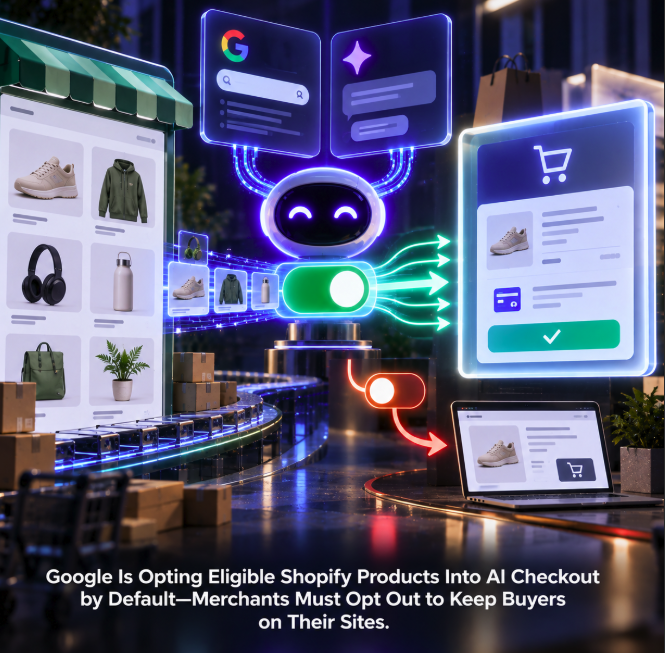

Google is beginning to move some Shopify merchants from website-based shopping into a more consequential form of agentic commerce: native checkout inside Google’s own AI interfaces. Merchant Center emails reported on September 22 tell eligible Shopify stores that qualifying products can be included automatically in UCP-powered checkout on AI Mode and Gemini, with no setup required from the merchant.
The rollout was documented by Search Engine Roundtable after merchants began receiving notices saying their Shopify stores had been matched to Merchant Center and were now eligible for native checkout. The important operational detail is the default. For affected stores, eligible products are automatically included; merchants that want buyers to complete purchases only on their own websites need to disable native checkout from Shopify under Sales channels → Agentic.
Google’s official Merchant Center documentation for the native commerce attribute explains what the feature does. Products with checkout eligibility enabled can display a Buy action on supported Google surfaces, allowing customers to discover an item and complete the purchase within interfaces such as Gemini and AI Mode in Google Search instead of being redirected to an external merchant website.
The change is therefore bigger than another product-feed setting. It shifts part of the transaction itself into the AI discovery surface and, for the Shopify merchants receiving these emails, changes the decision from “Do I want to enable Google checkout?” to “Do I want to opt out before customers begin checking out there?”
Google’s email says eligible Shopify products are included automatically
According to the Merchant Center email reproduced by Search Engine Roundtable, Google tells merchants that their Shopify store has been matched to Merchant Center, enabling native checkout on AI Mode and Gemini. To qualify, products need to be published on the Shopify storefront and available in Merchant Center.
The message says eligible products are automatically included and that there is nothing additional for the merchant to configure. That is possible because Shopify already supports Google’s Universal Commerce Protocol integration, allowing commerce systems and AI agents to exchange the structured information required to complete a transaction.
Google also tells merchants that they continue to manage and own their customer relationships, data and sales. But if a merchant prefers customers to finish the transaction on the store’s own website, the email directs the merchant to turn native checkout off through Shopify’s Agentic sales-channel settings.
This auto-enrollment behavior should not be generalized to every Shopify store worldwide. Google’s broader UCP documentation still describes checkout as available to select or participating merchants and subject to eligibility and regional rollout. The new emails show how Google is activating the capability for Shopify stores it has identified as eligible, not that every Shopify merchant has already been switched on.
Native checkout removes the traditional click back to the merchant site
The commercial significance is easiest to understand by comparing the user journeys. In a conventional Google Shopping experience, a shopper discovers a product and clicks through to the retailer’s website, where the merchant controls the product page, cart, checkout interface, merchandising, cross-sells and much of the first-party behavioral data generated during the visit.
With native checkout, Google says the customer can complete the purchase directly within a supported Google interface. Its Merchant Center documentation describes the capability as a “Buy now” flow that operates in Gemini and AI Mode without redirecting the customer to an external website.
That can reduce friction for a shopper, particularly when an AI assistant has already helped narrow a large catalog to one recommended product. But it also means a merchant can win the transaction without necessarily winning the site visit.
For ecommerce teams, that distinction will become increasingly important. Revenue can remain healthy while sessions from AI shopping interfaces decline, because the transaction is happening upstream of the website. Traditional attribution models built around referral traffic and onsite conversion rates may therefore understate the commercial value of an AI surface even as that same surface captures more of the customer journey.
The Universal Commerce Protocol is the infrastructure behind the shift
Google describes the Universal Commerce Protocol as an open standard for agentic commerce that allows agents and commerce systems to work together across discovery, buying and post-purchase support. UCP establishes a common language for consumer interfaces, merchants and payment providers rather than requiring every AI agent to integrate with every retailer through a bespoke transaction system.
Google has been gradually expanding UCP-powered checkout and its Merchant Center integration. The company’s onboarding documentation says participating merchants can enable capabilities including transfer to a merchant cart, native checkout on Google and identity linking. That gives merchants more than one architecture for AI commerce: the agent can hand a shopper back to the retailer, or the purchase can remain inside Google.
The Shopify email is notable because native checkout is no longer being framed only as a capability merchants may someday configure. For the eligible stores receiving the notice, the infrastructure is already connected and Google is telling them the feature is on unless they choose otherwise.
Merchant Center now has a product-level native commerce signal
Google’s official documentation also exposes the product-data mechanism behind native checkout. Merchant Center supports a grouped native_commerce attribute containing a Boolean checkout_eligibility value. When set to true, an eligible product can receive the Buy button on supported Google surfaces. False or an empty value leaves the item as a standard product listing.
Google recommends supplemental feeds for merchants implementing the attribute directly because they allow checkout eligibility to be changed without altering the primary product feed. The value can also be supplied through Merchant API custom attributes.
For Shopify merchants covered by the automatic integration, much of that complexity can be abstracted by the platform connection. That convenience is precisely why the default matters: a merchant may begin participating in native AI checkout without having manually built a UCP implementation or edited Merchant Center feed attributes.
AI discovery and checkout are collapsing into one interface
Search has historically been a referral channel. A search engine could rank products, ads and merchants, but the commercial objective was usually to produce a click to another website. Agentic shopping changes that model because discovery, recommendation and transaction can occur inside one conversational environment.
A shopper can ask Gemini or AI Mode for a product recommendation, refine requirements through follow-up questions and then purchase an eligible item without leaving the interface. The recommendation layer and checkout layer become part of the same funnel.
This creates a much stronger role for AI ranking. If an agent reduces a market of hundreds of products to three options and one can be purchased immediately, being selected by the agent may matter more than traditional blue-link position. The commerce competition shifts from winning a click to becoming the product the AI considers eligible, relevant and transaction-ready.
NetContentSEO recently examined another side of this transition: personalized AI agents can change which product they rank first based on inferred user characteristics. As recommendation and checkout converge, the logic used to choose a product becomes directly connected to revenue rather than merely to referral traffic.
Opting out preserves the website checkout—but also adds a strategic choice
Merchants that want to keep checkout exclusively on their own sites can disable the native checkout feature through Shopify’s Agentic sales channel, according to the Google email reported by Search Engine Roundtable. The choice is not necessarily as simple as “Google checkout versus merchant control,” because each route has different commercial advantages.
Native checkout can reduce steps between discovery and purchase. Every additional page load, login, cart transition and form creates an opportunity for abandonment. A customer already interacting with an AI assistant may prefer to finish the transaction without switching contexts.
Onsite checkout, however, gives the merchant more direct control over branding, merchandising, bundles, loyalty enrollment, subscriptions, cross-selling and the broader customer experience. It also keeps more of the journey within the merchant’s own analytics environment.
The right choice can therefore vary by retailer, margin structure and customer strategy. What makes this rollout unusual is that affected merchants need to make that choice actively if they do not want the Google-native path.
Merchant ownership does not mean the customer journey is unchanged
Google’s email emphasizes that merchants retain ownership of customer relationships, data and sales. That is an important distinction from a marketplace model in which the platform becomes the merchant of record or fully intermediates the customer relationship.
Even so, the location of checkout changes the interaction. A retailer can retain the sale while losing the opportunity to expose the buyer to a carefully designed product page, recommendation engine or promotional experience. Some of the behavioral signals that would have been generated during onsite browsing may never occur because the AI interface has already performed the discovery work.
This means ecommerce teams should avoid measuring the change only through ownership language. The more useful questions are operational: which customer data returns to the merchant, how attribution is represented, how returns and support work, whether loyalty benefits carry through, and what analytics distinguish native checkout from conventional website orders.
AI shopping analytics will need to separate visibility, clicks and transactions
As native checkout expands, AI commerce reporting will need to distinguish at least three different outcomes. A product can be visible or recommended inside an AI interface; it can generate a click or cart transfer to the merchant; or it can generate a completed native transaction without a conventional referral visit.
Those outcomes have different values and different optimization levers. A merchant might see declining AI referral traffic while native-checkout revenue rises. Another might receive strong recommendation visibility but lose transactions because its products are not eligible for native purchase. A third might deliberately opt out and use AI surfaces only as acquisition channels to its own site.
Google has already been expanding Merchant Center reporting around AI visibility and UCP. The company’s UCP integration hub documentation describes native checkout, cart transfer and identity linking as separate capabilities, reinforcing that “AI commerce” is not one funnel but several possible transaction paths.
The default setting is the real story
Google has been building toward agentic checkout for months, so the existence of native commerce is not new by itself. What changed for the Shopify merchants receiving these notifications is the activation model.
When a capability is opt-in, adoption depends on merchants discovering it, understanding it, completing setup and deciding that the expected conversion benefit outweighs the loss of some onsite control. When eligible products are included automatically, adoption can grow much faster because inaction becomes participation.
Defaults are powerful in software precisely because many users do not change them. In ecommerce infrastructure, the effect can be even larger: a default can determine where a transaction happens, which analytics system sees the customer journey and whether the retailer’s website remains a required step between product discovery and purchase.
Google is turning AI Mode and Gemini from discovery surfaces into transaction surfaces
The broader strategic direction is increasingly clear. Google does not want AI Mode and Gemini to stop at answering product questions or sending users elsewhere. UCP gives those interfaces the infrastructure to move from recommendation to transaction.
For merchants, that creates a new optimization problem. Product feeds are no longer only inputs for listings and ads; they can become machine-readable commerce infrastructure for an AI agent that recommends, evaluates and purchases products on a user’s behalf. Checkout eligibility becomes another visibility and conversion signal alongside price, availability, shipping, reviews and product content.
The Shopify rollout also shows how quickly that infrastructure can become operational when a commerce platform handles the integration. A merchant does not need to build an agentic checkout system from scratch if Shopify, Merchant Center and UCP already connect the necessary pieces.
The question is whether the merchant wants that convenience enough to let the transaction remain inside Google. For eligible Shopify stores now receiving Google’s email, doing nothing increasingly means the answer is yes.