
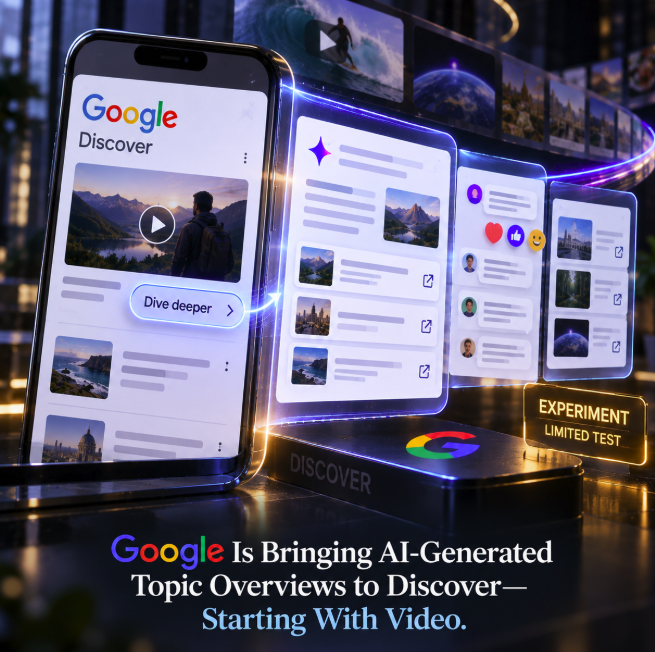
Google is testing a new way to turn a single Discover item into a broader AI-assisted exploration of a topic. The experiment, called “Dive deeper,” starts with video content and opens an AI-generated topic overview containing prominent links to related stories, community reactions and original reporting. It is a limited test rather than a general Discover rollout, but it pushes generative AI into another important Google discovery surface.
The experiment was announced by Google Search VP Robby Stein and documented by Search Engine Roundtable on September 18. Stein described it as a test designed to make it easier to explore a topic and discover related web content from Discover. Google plans to begin with videos and test multiple interface designs over the coming weeks as it evaluates how people use the experience.
“Dive deeper” does not send the first click directly to a publisher
The interaction is significant because the button changes what happens after a user becomes interested in a Discover item. Instead of immediately opening a publisher page, tapping “Dive deeper” can lead to a Google-generated overview of the topic. The example shown by Google labels the overview as AI-generated and warns that the output can make mistakes.
From there, the experience includes links that can send users outward to web content. Stein said the expanded view will feature prominent links to related stories, community reactions and original reporting. That creates a layered discovery path: content catches the user's attention in Discover, Google's AI synthesizes the surrounding topic, and external sources become part of the deeper exploration.
This is different from removing links from Discover. The test explicitly incorporates publisher and source links. The strategic change is that Google may insert an AI-generated interpretive layer between the initial content impression and the user's decision about which source to visit.
Google is starting with video
Google says the experiment will begin on videos. That choice makes sense for a feed product such as Discover, where visual content can introduce a topic quickly but may leave users wanting context about the story behind the clip. An AI-generated overview can potentially connect that video to reporting, reactions and related developments without requiring the user to formulate a search query.
The design shown publicly should not be treated as final. Stein explicitly said Google will experiment with multiple designs in the weeks ahead. Placement, source prominence, the amount of generated text and the relationship between community reactions and original reporting could therefore change substantially before Google decides whether to expand the feature.
There is also no evidence yet that “Dive deeper” will become available on every Discover video or move beyond video content. At this stage, it is best understood as a product experiment with a clearly stated starting surface rather than a new permanent Discover format.
Discover has already been moving toward AI-generated context
The experiment is not arriving in isolation. In October 2025, Google announced AI-powered Discover features that provide brief previews around trending topics and let users expand them for additional information and links from across the web. Google said that experience was intended to help people catch up on stories from a wider range of publishers and creators.
“Dive deeper” extends the same broad product direction. Discover is evolving from a feed where individual cards primarily act as destinations into an environment where Google can organize, summarize and contextualize the subject represented by a card. The user does not necessarily need to leave the feed's ecosystem to understand the basic shape of a story.
That distinction matters because Discover historically serves users without requiring a conventional query. Google introduced Discover as a way to surface information around interests before a user explicitly searches for it. Adding generative topic exploration gives that queryless discovery model a second stage: users can move from passive recommendation into AI-assisted research without first typing a search.
The publisher question is where the test becomes important
For publishers, there are two competing possibilities. A well-designed overview with prominent source links could expose users to additional publishers they might never have encountered from the original Discover card. A user attracted by a video could move into original reporting, related coverage or specialized sources through the AI-generated topic view.
But the same interface can also satisfy some informational intent before an external click occurs. If the generated overview provides enough context, users may decide they understand the story without visiting a source. Search Engine Roundtable's Barry Schwartz raised exactly that concern in his coverage of the test, arguing that an AI-generated layer could reduce the incentive to click through to publishers.
At this stage there is no public traffic data for the experiment, so neither outcome should be treated as established. Much will depend on design. A short overview with highly visible source links could function as a discovery accelerator; a comprehensive answer with less prominent links could behave more like a click substitute. Google's decision to test multiple designs suggests that this balance is still being explored.
Original reporting is explicitly part of Google's design language
One notable detail in Stein's description is the explicit reference to “original reporting.” Google has repeatedly emphasized source discovery as it expands generative AI across Search. In May 2026, the company described several AI Search changes designed to surface relevant websites, deep insights and original content, including more direct links and ways to continue exploring after an AI response.
The Discover test appears to apply a similar principle to a different entry point. Instead of beginning with a search query and producing an AI response, the journey can begin with recommended media. The generated overview then becomes the bridge to a broader set of sources and perspectives.
For publishers, that makes source selection increasingly important. Visibility may no longer depend only on earning the initial Discover card. A publisher could potentially appear downstream as a related story or original source inside an AI-generated topic exploration triggered by somebody else's video.
Discover optimization may become more topic-oriented
If the concept expands, it could complicate the way publishers think about Discover visibility. The traditional question is whether a specific article, video or page earns distribution in the feed. An AI topic layer introduces another question: whether Google's systems understand a source as useful supporting material for the broader subject a Discover item represents.
That would reinforce familiar editorial fundamentals rather than create a new markup trick. Clear topical coverage, original reporting, identifiable authorship, strong entity relationships, useful context and distinctive information all give machines more evidence about what a source contributes to a topic. None of that guarantees inclusion in “Dive deeper,” and Google has announced no optimization mechanism specifically for this experiment.
It does, however, make page-level Discover thinking less complete. When Google constructs an AI-mediated topic experience, the relevant competitive set may include videos, articles, community discussions and primary reporting from multiple sources rather than a single feed card competing for one click.
Discover and Search are moving toward a common exploration model
Google has been building similar interaction patterns elsewhere. AI Overviews can lead into deeper AI Mode exploration, while AI Mode itself increasingly offers follow-up paths and prominent links to the web. Google has described this direction as making it easier to move from a quick answer into deeper exploration while maintaining context.
“Dive deeper” brings that logic to a surface where the user may not have asked anything at all. Discover identifies the interest, the content triggers curiosity, and generative AI helps organize the next step. Search and Discover remain different products, but the interaction model is beginning to converge around AI-generated context followed by pathways into sources.
This could be particularly consequential on mobile, where Discover already occupies a high-value recommendation surface. An AI expansion layer allows Google to keep users inside a continuous exploration experience rather than requiring them to alternate between feed cards, publisher sites and new search queries.
For now, this is a limited experiment—not a Discover-wide change
The scope should remain clear. Google has announced an experiment, not a universal rollout. It starts with video, Google will test different designs, and there is no published timeline for broader availability. There is also no evidence yet showing how the feature affects publisher clicks, Discover traffic or inclusion patterns.
Even with those limitations, the experiment is worth watching because it changes the role Discover can play. The feed has traditionally predicted what users might want to read or watch. “Dive deeper” tests whether Google can also synthesize the topic around that recommendation and become the interface through which the user chooses what to explore next.
If the experiment expands, Discover will be doing more than recommending content: it will be generating a topic layer around that content. The critical question for publishers will be whether those AI-generated overviews become a new route into original reporting and related stories—or whether they absorb enough context to reduce the need for the click. Google's upcoming design tests may determine which direction the feature takes.