

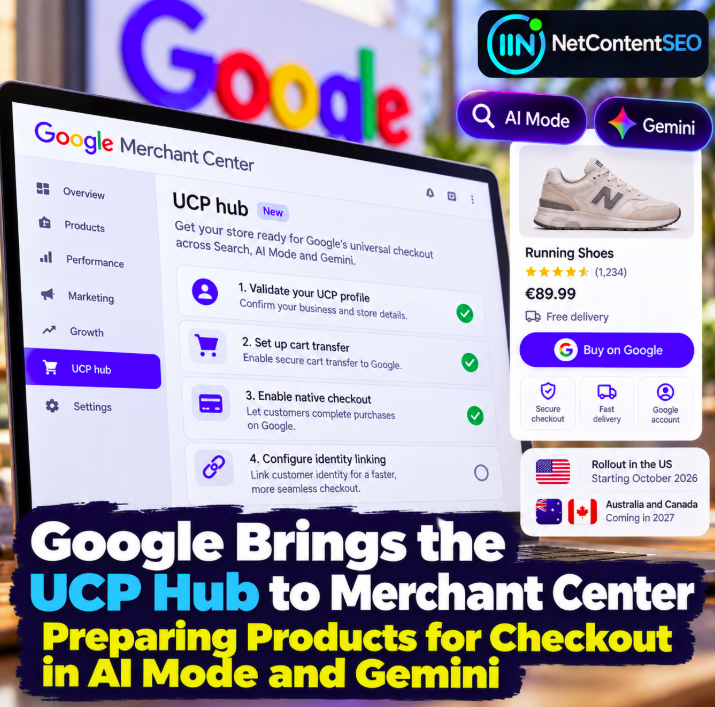

October 8, 2026. Google has introduced a Universal Commerce Protocol (UCP) onboarding hub in Merchant Center, with a gradual rollout beginning in the United States. The hub helps eligible merchants prepare integrations for shopping experiences that can lead to checkout directly within Google's AI Mode and Gemini. Google says Australia and Canada are expected to follow in 2027.
What is the new UCP hub?
The hub centralizes technical onboarding tasks for participating merchants. According to Google's Merchant Center documentation, these include validating a UCP profile, configuring cart handoff, enabling native checkout and setting up identity linking. The exact options available to a merchant depend on rollout status, eligibility and implementation requirements.
Why AI Mode and Gemini matter for ecommerce
Conventional Shopping discovery often sends a customer to a merchant's website to complete a purchase. AI-assisted shopping can compress product discovery, comparison and checkout into a conversational journey. UCP is designed to provide the technical infrastructure for these interactions, potentially allowing eligible products to be purchased through Google's AI surfaces.
This is not a claim that every product listing already supports native checkout. Merchants should distinguish an onboarding capability from a live, universally available purchase experience.
Four onboarding components to understand
1. UCP profile validation
Merchants need to expose and validate the technical information that participating systems use to understand supported commerce capabilities. Incorrect configuration can block a successful integration even if the product feed is otherwise healthy.
2. Cart handoff
Cart transfer allows a shopping journey to move between systems while retaining relevant transaction details. Retailers should test item identifiers, quantities, prices, taxes and shipping expectations to avoid inconsistencies at checkout.
3. Native checkout
Native checkout aims to support purchasing without requiring the user to navigate a conventional merchant-site checkout flow. Businesses should review payment, order processing, customer support and refund responsibilities as defined by the implementation.
4. Identity linking
Identity linking can connect a customer's relationship with a merchant to the supported shopping flow, subject to consent, account security and the specific implementation. It should not be confused with automatic access to customer identities.
GEO becomes commerce infrastructure
For SEO and AI visibility teams, the significance is structural. Search optimization has historically focused on making pages discoverable and persuasive. Agentic commerce adds another requirement: systems must be able to retrieve reliable product information and carry out supported transaction steps.
That makes feed accuracy, product identity, availability, pricing, merchant policies and API reliability important parts of AI commerce readiness. Strong rankings alone do not guarantee participation in a transaction-capable experience, and Google has not stated that UCP enrollment is a general organic ranking factor.
What merchants should audit now
- Check whether the UCP hub is available in the Merchant Center account and region.
- Review eligibility and required technical integrations before allocating development resources.
- Ensure Merchant Center product data matches landing pages, stock systems and checkout totals.
- Test cart handoff and order flows where available, including errors and refunds.
- Document attribution and reporting requirements for purchases initiated in AI Mode or Gemini.
- Monitor Google's rollout announcements before planning launches outside supported markets.
Rollout: United States first
The October 2026 announcement describes a phased US rollout, with Australia and Canada targeted for 2027. It does not establish universal merchant access or a firm launch date for every business. Availability should be checked in Merchant Center and the official documentation.
The NetContentSEO takeaway
UCP makes an important distinction visible: being found by an AI assistant and being purchasable through it are different capabilities. The next stage of ecommerce visibility will depend not just on content and entity signals, but also on dependable commerce connections. Retailers should treat this as an infrastructure readiness project rather than a simple SEO setting.
Official source: Google Merchant Center Help: UCP onboarding hub.