

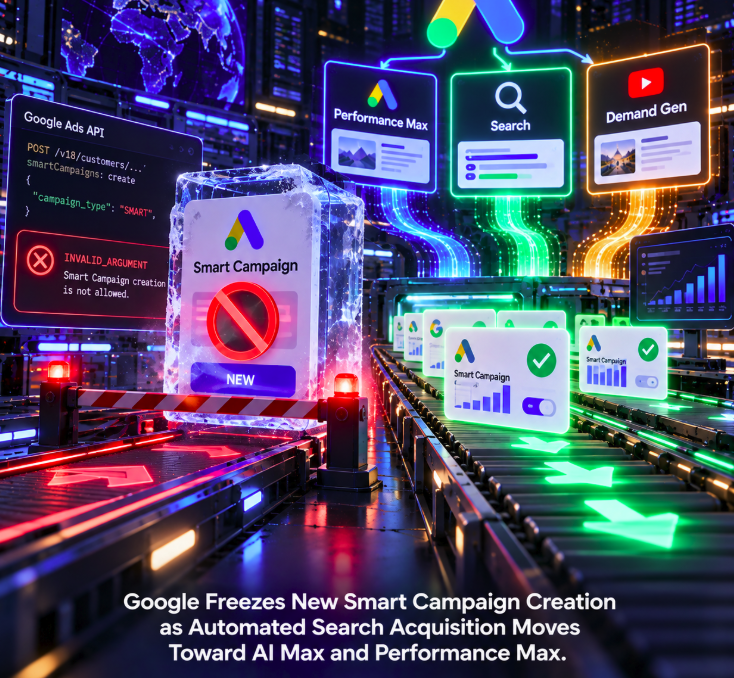

Google has closed the creation path for new Smart Campaigns through the Google Ads API. As of September 23, API clients can no longer create the simplified automated campaign type, although existing Smart Campaigns can continue serving ads and can still be updated.
The change is now effective in Google’s official Google Ads API deprecation table. Google first announced the move in a June 23 Ads Developer Blog post, then updated the schedule on August 13, moving the cutoff from August 5 to September 23.
Google explicitly recommends that developers consider other campaign types instead of creating new Smart Campaigns, naming Performance Max as its automated cross-channel alternative while also pointing to Search and Demand Gen depending on the advertiser’s goals. That makes the deprecation more than an API housekeeping change: a legacy automation product has stopped accepting new programmatic campaigns while Google’s newer acquisition systems continue expanding.
The cutoff applies to creation, not existing Smart Campaigns
Google has not shut down Smart Campaign delivery. Existing campaigns remain valid, can continue to serve ads and can still be updated through supported workflows. The deprecated operation is specifically the creation of a new Smart Campaign through the Google Ads API.
That distinction matters for agencies and software platforms managing long-lived advertiser accounts. There is no requirement in Google’s announcement to immediately migrate every existing Smart Campaign simply because new ones can no longer be created. Maintenance and optimization of the installed base can continue.
At the same time, any onboarding workflow that previously created Smart Campaigns for new customers now needs another destination. A platform cannot preserve its old campaign-generation logic indefinitely by remaining on an earlier API version: Google describes the restriction as an unversioned feature deprecation rather than a capability removed only from one new major release.
Google has made the failure mode explicit in the API
Developers can identify affected integrations by looking for campaign mutate requests with a create operation where advertising_channel_type is SMART and advertising_channel_sub_type is SMART_CAMPAIGN. Those are the requests Google says can no longer create a campaign.
The exact error depends on the API version. Google’s announcement says v24 returns SmartCampaignError.CREATION_FAILED. In v23 and earlier, the failed create operation returns OperationAccessDeniedError.CREATE_OPERATION_NOT_PERMITTED. Google’s current API definitions describe CREATION_FAILED directly as the condition that new Smart Campaigns cannot be created.
This gives campaign-management software a deterministic migration signal. Instead of treating failed creation as a temporary account or validation problem, integrations should remove Smart Campaign creation from their supported new-campaign paths.
Smart Campaigns were already a heavily automated product
The strategic direction is notable because Smart Campaigns themselves were designed around automation. Google’s documentation describes them as campaigns primarily managed by Google’s advertising technology, with fewer fields for advertisers to configure than conventional campaign types.
Smart Campaigns simplified setup around a business, landing page and goals, making them particularly suitable for advertisers that did not want to manage the complexity of conventional Search campaigns. In that sense, Google is not moving from manual advertising to automation. It is retiring the creation path for an older automation model while steering developers toward newer automated campaign architectures.
Performance Max is the clearest official successor named by Google. It extends automated acquisition beyond Search across Google’s advertising inventory and relies heavily on assets, conversion goals and machine-learning systems to determine delivery.
The migration direction is broader than Performance Max
Google does not tell every Smart Campaign advertiser to use the same replacement. Its developer announcement says Performance Max should be explored as an automated campaign type spanning Google’s channels, while Search and Demand Gen are also available depending on business objectives.
That qualification is important. A local business using a Smart Campaign for simple Search acquisition does not necessarily have the same media objective as an advertiser running cross-channel Performance Max. The deprecation removes one creation route; it does not establish that one campaign type is functionally identical to Smart Campaigns in every use case.
For developers, replacement logic therefore needs to be goal-aware. A platform that previously offered a single “create Smart Campaign” action may need to expose a choice among newer campaign types or translate its own onboarding questions into a more appropriate Google Ads configuration.
AI Max is changing what automated Search looks like
The Smart Campaign cutoff also arrives while Google is consolidating more Search automation under AI Max. In current Google Ads API releases, Google has added fields for tracking migrations of campaign-level Broad Match and Automatically Created Assets into AI Max configurations. Search automation is increasingly being expressed through features attached to the mainstream Search campaign architecture rather than through a separate simplified Smart Campaign product.
That trend is visible in other September changes. Google is removing manual Search language targeting and will instead match language using signals from ad creative, landing pages and users. NetContentSEO covered that transition in our analysis of the September 30 language-targeting deprecation.
Together, the changes show Google simplifying the number of explicit campaign controls while moving more matching decisions into its automated systems. Smart Campaigns once represented the simplified alternative to conventional Search management. AI Max increasingly brings automation into Search itself.
Performance Max remains Google’s default automated cross-channel direction
Performance Max occupies the other side of that consolidation. Instead of simplifying one Search-oriented campaign, it lets Google optimize delivery across multiple advertising channels from shared goals, assets and audience signals. Google’s Smart Campaign deprecation notice specifically calls it out when directing developers toward alternatives.
The Ads API continues to add capabilities around Performance Max rather than freeze them. The September 23 v25.2 release, for example, added URL options at the asset-group level and an automated video crawl setting for Performance Max. Those are signs of an actively expanding campaign architecture at the same moment new Smart Campaign creation is being closed.
This does not prove Google intends to eliminate every existing Smart Campaign on a particular schedule; the company has not announced that in the cited deprecation. What it does establish is that new API-driven campaign creation is expected to happen elsewhere.
Campaign-generation platforms need to change their product logic
The most immediate impact falls on software that creates campaigns rather than advertisers who simply manage existing ones. SaaS onboarding flows, agency provisioning tools, franchise systems and local-marketing platforms may have used Smart Campaigns precisely because they offered a relatively small configuration surface.
Those systems now need to decide what “simple automated Google Ads campaign” means without a new Smart Campaign endpoint. Performance Max requires a different object model and asset structure. Search campaigns expose a different set of controls and automation features. Demand Gen serves a different acquisition context.
A migration therefore cannot always be reduced to changing one enum from SMART to another campaign type. The surrounding assumptions about assets, targeting, goals, landing pages, reporting and optimization may need to change as well.
The deprecation does not mean Smart Campaign data disappears
Because existing campaigns continue to operate, reporting and management systems still need to understand Smart Campaign resources. A platform cannot simply delete its Smart Campaign code on September 23 if customers have active campaigns of that type.
The product enters a maintenance state rather than vanishing. New creation is blocked, but existing objects remain part of the advertiser’s account and can require updates, monitoring and reporting.
That creates a familiar deprecation pattern for API integrators: remove the creation path while retaining read and supported update capabilities for the installed base. Over time, the proportion of accounts depending on that legacy path can decline without forcing an immediate hard shutdown.
Google is consolidating automation into fewer, more capable campaign systems
The larger pattern is that Google’s advertising automation is becoming less synonymous with separate “smart” campaign products. Automated matching, asset creation, bidding and destination selection are increasingly capabilities inside Search, AI Max and Performance Max.
That architecture gives Google more room to evolve individual AI-driven features without maintaining a parallel simplified campaign model indefinitely. It also means advertisers encounter automation even when they choose a mainstream campaign type rather than explicitly selecting something called “Smart.”
NetContentSEO has already tracked how this shift is changing campaign controls, including Google’s move to expose more of the query-to-landing-page journey inside AI Max. More automation does not necessarily mean less advertiser information; Google is simultaneously automating decisions and building reporting intended to explain what those systems selected.
The Smart Campaign era is entering maintenance mode
September 23 is therefore a clean dividing line for API-driven Smart Campaigns. Campaigns created before the cutoff can continue serving and be updated. New programmatic creation is no longer supported, and Google directs developers toward Performance Max, Search or Demand Gen instead.
The change should not be overstated into a shutdown of Smart Campaigns altogether. Google has announced a creation freeze through the API, not an immediate termination of the existing product. Nor has Google said that AI Max is a one-to-one replacement for Smart Campaigns.
But the direction of investment is visible. Smart Campaigns represented an earlier generation of Google Ads automation built as a distinct simplified campaign type. The newer model embeds machine learning more deeply into the core campaign systems advertisers are expected to use going forward.
For developers, that transition is no longer theoretical. A request to create a Smart Campaign now fails. The next automated acquisition workflow has to be built on something else.