

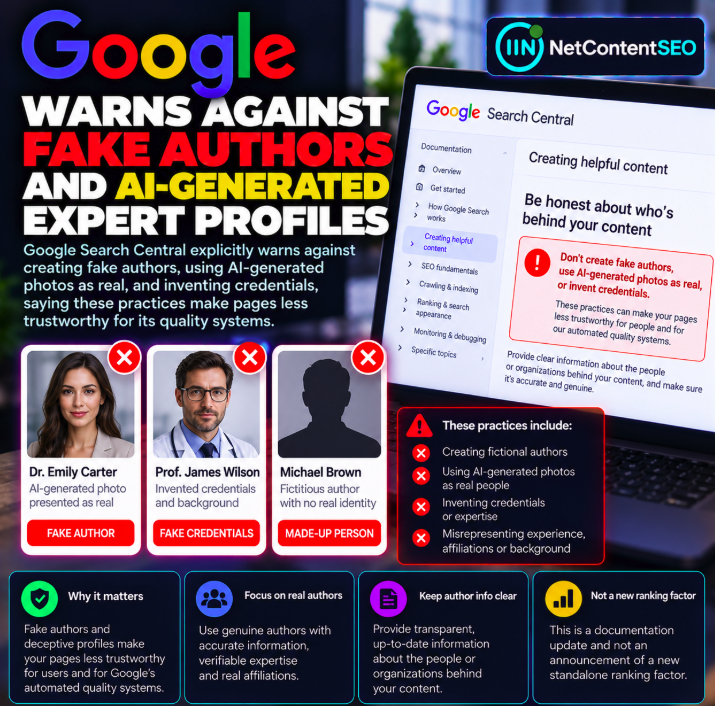

Google Search Central's helpful content guidance warns publishers against misleading author identities, AI-generated portraits presented as photographs of real people and fabricated credentials. A documentation change highlighted on October 6, 2026 brings renewed attention to a longstanding question for publishers: can readers and search systems trust the identity and expertise claimed by a page?
The important nuance is that Google has not announced a new standalone 'fake author' ranking factor. The guidance addresses deceptive representations and content trustworthiness, rather than declaring that every use of AI imagery or pseudonyms is automatically prohibited.
Sources: Google Search Central — Creating Helpful, Reliable, People-First Content; Search Engine Roundtable — Google Warns Against Deceptive Authorship Information.
What Google is warning publishers about
The concern is not simply that an author biography looks polished or that an image was created with software. It is that the page presents invented people, qualifications or experiences as authentic evidence of expertise.
Examples include a fabricated expert persona, an AI-generated face labeled as a real contributor's photograph, or professional credentials that the supposed author never earned. These practices can mislead readers about who is responsible for the information and why they should trust it.
Three authorship practices that create trust problems
| Practice | Why it is problematic |
|---|---|
| Fictional author presented as real | Misrepresents who created or reviewed the content |
| AI-generated portrait presented as a real photograph | Creates a misleading impression of an identifiable person |
| Invented qualifications or experience | Claims expertise without a factual basis |
The shared issue is deception. A publisher can create legitimate illustrations or use editorial pen names without necessarily inventing expertise, but it should not mislead users about identities, credentials or responsibility for published material.
Why authorship transparency matters for SEO
Google's people-first content guidance asks publishers to consider whether visitors can understand who created content and whether information about the author or website helps establish trust. For subjects where expertise and reliability are especially important, invented qualifications can undermine that purpose.
That does not mean adding an author box automatically improves rankings. An author biography is only useful when its claims are accurate, relevant and supported by the real editorial process.
What about Google's automated quality systems?
Google's documentation frames deceptive authorship as an issue relevant to the trustworthiness of content, including how its automated systems evaluate quality. However, Google does not publish a separate numerical weight for author identity or a simple rule that assigns a penalty to every page with an AI-generated picture.
It would be inaccurate to turn a documentation clarification into an announcement of a new ranking algorithm or manual-action category without further evidence.
AI-generated portraits are not inherently forbidden
There is a critical distinction between an illustrative image and a fake identity. An AI-created portrait clearly presented as an illustration or avatar is different from a synthetic face labeled as a photograph of a real doctor, lawyer or researcher who does not exist.
Publishers should assess what the image communicates in context. If readers are likely to understand the portrait as evidence of a real person's identity, accuracy and disclosure matter.
What if a publisher uses a pen name?
A pen name is not necessarily equivalent to a fabricated expert. Writers may use pseudonyms for legitimate reasons, including privacy or professional convention. The relevant issue is whether the surrounding biography invents credentials, employment history, qualifications or a false record of experience.
Where an editorial team uses pen names, it should maintain internal accountability and avoid claiming expertise that cannot be substantiated.
Recognizable authorship versus invented authority
For AI visibility and brand research, recognizable authorship is best treated as an evidence and attribution problem. Real contributors can have consistent names, accurate biographies, relevant work histories and links to verifiable publications. These elements help readers understand the source of a claim.
But consistency is not proof by itself. Repeating the same fictional biography across a website and social profiles does not transform an invented expert into a real one. Authenticity depends on the underlying facts.
How to audit author profiles on a publishing site
- Verify identity claims. Confirm that named authors and reviewers are genuine people or are clearly described editorial entities.
- Check qualifications. Remove degrees, titles, certifications and job histories that cannot be substantiated.
- Review portraits. Avoid presenting synthetic faces as documentary photographs of real contributors.
- Clarify responsibility. Explain whether content was written, edited, reviewed or produced with AI assistance where relevant.
- Inspect structured data. Ensure author and organization markup reflects real, accurate entities.
- Maintain biographies. Keep affiliations, roles and expertise descriptions current.
- Prioritize editorial substance. Verify sources and factual claims; an authentic byline cannot compensate for unreliable content.
Structured data does not authenticate an invented author
Schema.org author markup can help describe the people or organizations associated with a page. It does not independently verify that a claimed person exists or holds particular credentials.
Adding Person structured data, sameAs links or professional titles to a fictional profile can amplify misleading information rather than resolve it. Structured data should accurately reflect visible page content and genuine entities.
Does this mean Google penalizes all AI-generated content?
No. Google's guidance distinguishes useful content from content produced primarily to manipulate rankings, regardless of the tools used to create it. AI assistance in drafting or visual design is not automatically a sign of low quality.
The issue in this update is deceptive authorship: misleading readers about who wrote, reviewed or stands behind the material, especially by inventing credentials or identity evidence.
Is this a new ranking factor?
No new standalone authorship ranking factor was announced. The October discussion concerns official documentation and its implications for trust and quality. Publishers should avoid claiming that Google now assigns a publicly defined score to the presence or absence of an author photograph.
Practical implications for publishers and editorial teams
Editorial teams using AI at scale should review their author-profile creation process. Automated generation of biographies can accidentally invent universities, professional experience, awards or associations. Those claims should never be published without verification.
A simple, accurate attribution to a real editorial team can be more trustworthy than an elaborate fictional biography. The objective is not to maximize the appearance of authority but to provide honest information about responsibility and expertise.
FAQ
Does Google warn against fake authors?
Yes. Its helpful content guidance addresses misleading author identities and invented claims of expertise.
Are AI-generated author photos always prohibited?
No blanket prohibition is established. The concern is presenting synthetic imagery as authentic evidence of a real person.
Can websites use pseudonyms?
Using a pen name is not automatically the same as fabricating qualifications or pretending a fictional expert is real.
Does Google use author identity as a new standalone ranking factor?
No new independent ranking factor was announced in the documentation update.
Can structured data make an author profile credible?
Markup can describe an author, but it cannot make invented credentials or identities true.
Does the warning apply only to AI-written articles?
No. Misleading identity and expertise claims can appear in content created with or without AI.
NetContentSEO analysis
Google's warning reinforces a basic principle of recognizable authorship: credibility must be grounded in real, verifiable responsibility, not simulated expertise. Publishers should treat author pages as factual records, not decorative trust badges. The practical SEO response is to audit identities, portraits, credentials and structured data while continuing to prioritize the accuracy and usefulness of the content itself.
Sources: Google Search Central and Search Engine Roundtable.