

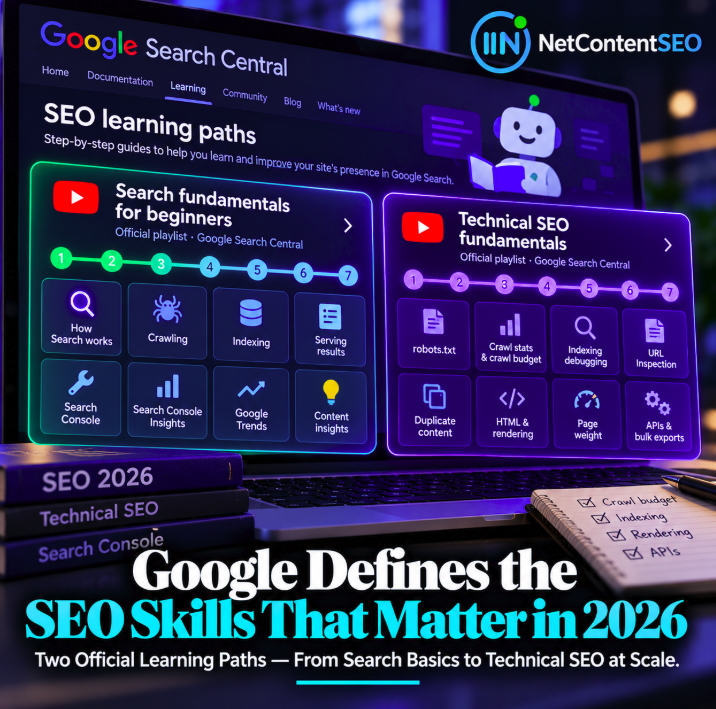

Google Search Central has turned years of scattered educational videos into two sequential SEO learning paths — and the curriculum offers a useful snapshot of what Google itself considers foundational SEO knowledge in 2026.
Published on October 6, the new playlists are called Search fundamentals for beginners and Technical SEO fundamentals. Both are already live on the Search Central YouTube channel.
The first path covers how Google Search works and how to measure performance. The second moves directly into crawl budget, robots.txt, rendering, indexing diagnostics, duplicate content and large-scale automation through Search Console APIs and bulk exports.
Why Google created the learning paths
Google Search Central has published hundreds of videos over the years through series including Search for Beginners, Ask Googlebot, Search Console Training and Search Off the Record.
The problem, according to Google, is navigation. Individual series work well for deep dives and ongoing updates, but someone starting from scratch may struggle to identify a logical sequence.
The two new playlists reorganize existing educational material into guided paths rather than introducing a new SEO certification or ranking framework.
Path one: Search fundamentals for beginners
The beginner playlist is designed for website owners, marketers, content creators and people who are new to SEO.
Google starts with the mechanics of Search: crawling, indexing and serving.
That sequencing is significant because it reinforces a basic diagnostic model: before discussing rankings, marketers need to understand whether Google can discover a URL, whether it chooses to index it and how the resulting document can appear in Search.
Search Console is treated as a core skill
The beginner curriculum then moves into Google Search Console.
Google includes setup, performance-report analysis and Search Console Insights among the foundational skills.
This makes measurement part of the basic SEO curriculum rather than an advanced reporting task.
A modern SEO practitioner is expected not only to publish content but also to understand how Google reports impressions, clicks and site performance.
Google Trends also belongs in the beginner path
The playlist includes practical use of Google Trends for SEO and for identifying trending topics.
That broadens the definition of SEO fundamentals beyond crawling and keyword optimization.
Google is effectively putting market and content demand analysis alongside Search Console measurement and basic Search mechanics.
Path two: Technical SEO fundamentals
The second playlist is explicitly aimed at developers and technical SEO specialists.
Google says it skips high-level basics and focuses on the infrastructure behind Search, including site health, crawl-budget optimization, rendering and debugging at scale.
This is where the curriculum becomes particularly useful as a technical SEO checklist.
Robots.txt and crawl budget remain fundamental
Google groups robots.txt, Crawl Stats and crawl-budget management under crawl directives and architecture.
That is a useful reminder that technical SEO at scale is not simply about making every URL crawlable.
Large sites need to understand what Googlebot is requesting, which URLs consume crawler resources and whether site architecture creates unnecessary inventories.
Indexing diagnostics are a separate competency
The technical path includes troubleshooting indexing problems and using the URL Inspection tool effectively.
Google also explicitly includes duplicate-content management.
That separation matters because crawlability and indexability are not interchangeable. A URL can be discovered and crawled without ultimately being selected for indexing.
Technical SEOs therefore need to diagnose each stage independently rather than treating “not indexed” as one generic error.
Rendering is now baseline technical SEO
Google includes browser HTML parsing, rendering considerations and page weight in the technical curriculum.
This reflects how much modern websites depend on JavaScript, client-side frameworks and complex front-end delivery.
Understanding the HTML a developer writes is no longer sufficient. Technical SEOs need to understand what the browser — and Google's rendering systems — ultimately receive and process.
Page weight makes Google's list
The inclusion of page weight is easy to overlook.
It connects technical SEO with infrastructure efficiency: unnecessarily heavy resources can affect users, rendering and crawling efficiency at scale.
Google's curriculum therefore treats performance and resource delivery as part of Search infrastructure, not merely front-end polish.
APIs and bulk exports are officially part of technical SEO
One of the strongest signals in the new curriculum is Google's inclusion of Search Console bulk data exports and APIs.
This moves automation from an optional advanced trick into Google's own technical SEO learning path.
For large sites, manually inspecting URLs or exporting small interface reports does not scale. Technical SEO increasingly requires the ability to move Search data into external systems, query it programmatically and build repeatable monitoring workflows.
The modern technical SEO skill set is becoming engineering-adjacent
Google's topic selection describes a role that sits between SEO, analytics and web engineering.
The practitioner needs to understand crawler behaviour, HTTP and directives, site architecture, browser rendering, indexing systems, Search Console data and automation.
That does not mean every SEO needs to become a software engineer.
It does mean that technical SEO at scale increasingly requires enough engineering literacy to diagnose systems rather than merely inspect individual pages.
What is notably absent
The playlists should not be interpreted as a complete list of everything that matters for SEO.
Google's announcement does not position them as a ranking-factor checklist, and the technical playlist is specifically focused on infrastructure.
Topics such as digital PR, brand authority, AI visibility, editorial strategy and commercial conversion sit outside the scope of these particular learning paths.
The curriculum tells us what Google considers useful foundational knowledge — not every competency required to grow a modern search business.
There is no new Google SEO certification
The October 6 announcement introduces curated YouTube playlists, not a new examination or professional accreditation.
That distinction matters because Google's educational launches are sometimes quickly reframed as certifications or endorsements by third-party training providers.
Google describes these simply as sequential learning paths built from Search Central educational content.
A practical team checklist
SEO leaders can use the playlists as a lightweight skills audit.
A junior practitioner should be able to explain crawling, indexing and serving; work with Search Console performance data; and use Trends to investigate demand.
A technical specialist should additionally understand robots.txt, Crawl Stats, crawl budget, URL Inspection, duplicate management, rendering, page weight and programmatic Search Console workflows.
If those areas are missing inside a team, Google's new structure provides a straightforward training sequence using first-party material.
NetContentSEO take
Google's new learning paths are interesting less because the individual lessons are new and more because Google has chosen how to organize them.
The beginner track moves from Search mechanics to measurement and market insight. The technical track moves from crawler control to indexing diagnostics, rendering and automation at scale.
That sequence captures the evolution of technical SEO in 2026: understanding pages is no longer enough. Practitioners increasingly need to understand systems, data pipelines and crawler behaviour.
For teams building an SEO training plan, Google's two playlists now provide a useful official baseline — and a checklist for identifying the skills that still need to be developed internally.