

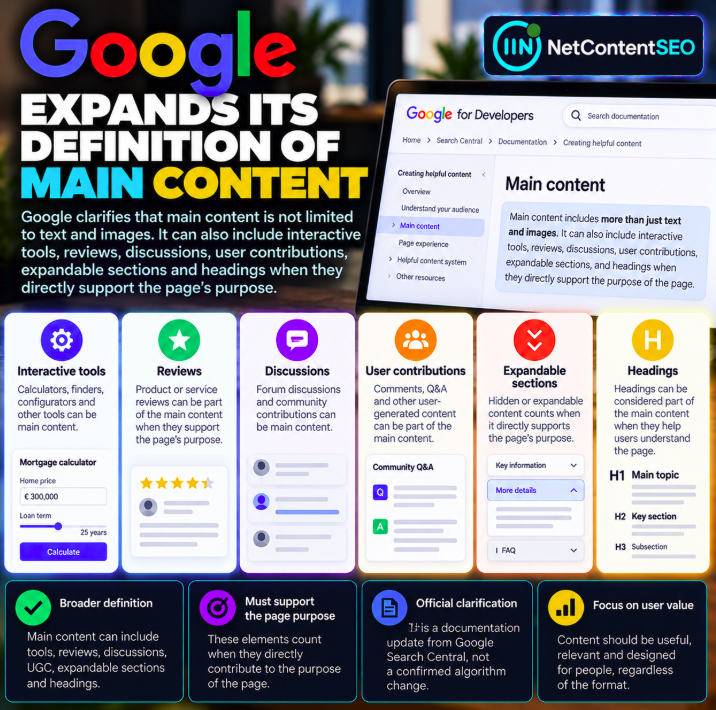

Google Search Central has clarified that the main content of a page can extend well beyond its paragraphs and images. Depending on the page's purpose, interactive tools, reviews, discussions, user contributions, expandable sections and headings may all form part of what makes the page useful. The documentation change was highlighted on October 6, 2026.
This is a documentation clarification, not an announced Google ranking algorithm update. Nor does it mean that adding a calculator, an accordion or a comments section automatically makes a page higher quality. The determining editorial question is whether the element genuinely helps the page accomplish its intended purpose.
Primary source: Google Search Central — Creating Helpful, Reliable, People-First Content.
What does 'main content' mean?
Main content is the material that directly helps a page achieve its purpose. On an informational article, that may be the explanation, examples and supporting evidence. On a mortgage calculator page, the calculator itself may be central. On a review page, the reviews can be central; on a discussion forum, the conversation can be the primary reason visitors arrive.
The format alone does not decide whether an element is main content. Its relationship to the user's task does.
Six types of content publishers should consider
| Element | When it can contribute to main content |
|---|---|
| Interactive tools | When a calculator, configurator, finder or other tool directly helps complete the page's task |
| Reviews | When evaluations provide substantive information relevant to the page's purpose |
| Discussions | When meaningful exchanges are central to answering a question or exploring a topic |
| User contributions | When community submissions add relevant knowledge or experience |
| Expandable sections | When they contain useful information directly related to the topic |
| Headings | When they clarify the subject and organize content that helps users |
This broader view is useful because many modern pages deliver value through interaction and community participation, not only through a traditional article body.
Interactive tools can be the reason a page exists
Consider a currency converter, price estimator, mortgage calculator or product configurator. A visitor may land on such a page primarily to use the tool, with explanatory text serving a supporting role.
Evaluating the page only by its word count would miss much of its usefulness. A well-designed tool can help users solve a problem directly, provided its calculations, labels and results are accurate.
However, a broken calculator or misleading output does not become high-quality content simply because it is interactive.
Reviews and discussions are not merely decorative
For product and service pages, authentic reviews can help visitors compare options and understand real experiences. In a forum, the discussion itself may be the main product of the page.
Quality still matters. Spam, fabricated reviews, irrelevant comments and repetitive low-value contributions do not automatically gain value because they were posted by users.
User-generated content and editorial responsibility
Community contributions can add firsthand experience and answer questions that an editorial team might not anticipate. But site owners should still consider moderation, accuracy, abuse prevention and how misleading submissions affect the user experience.
Calling a page 'UGC' is not a substitute for ensuring that its main content actually helps visitors. The site remains responsible for how it presents and manages its experience.
Expandable sections: useful does not mean automatically discoverable
Accordions and disclosure panels can organize complex information without overwhelming the page layout. When their content directly serves the page's purpose, it can be part of the main content.
There is an important technical distinction, however: content that exists in the rendered page and can be expanded is different from content that is never loaded, requires inaccessible interactions or is unavailable to a crawler. Google has not announced that every hidden or dynamically fetched section is guaranteed to be crawled, indexed or weighted equally.
Publishers should use accessible markup, verify rendering and avoid hiding essential information behind technical barriers.
Headings can help define the substance of a page
Headings do more than decorate paragraphs. They identify topics, describe sections and help readers navigate complex information. Clear headings can be part of the content experience, especially when they communicate meaningful information about what follows.
But stuffing headings with keywords or creating empty sections does not make a page more useful. Structure should reflect actual content and user needs.
How this affects content audits
Traditional SEO audits often focus on text length, title tags, headings and images. Google's clarification is a reminder to examine the entire experience that fulfills the page's purpose.
For a comparison page, inspect the comparison functionality. For a community page, review the quality of the discussion. For a product page, assess the usefulness of reviews and configuration options. A word-count-only audit may misclassify valuable interactive pages as thin.
A practical audit framework
- Define the page purpose. Identify the user's primary task or information need.
- Map the useful elements. Include tools, reviews, discussions, user contributions and explanatory sections.
- Check functionality. Test whether interactive features work on mobile and desktop.
- Assess content quality. Review factual accuracy, moderation and relevance.
- Verify accessibility. Make expandable content and controls understandable to keyboard and assistive-technology users.
- Inspect rendering. Confirm that essential information is available in the rendered page and not dependent on inaccessible scripts.
- Review headings. Ensure the page structure reflects meaningful topics rather than keyword repetition.
- Measure usefulness. Evaluate whether users can complete the task, not merely whether the page contains enough words.
Does Google now reward every interactive widget?
No. The documentation does not announce a new ranking bonus for interactive tools, accordions or UGC. An irrelevant widget can distract users, and a poorly maintained discussion can reduce usefulness.
The relevant principle is purpose: the content should serve the reason a person visited the page.
Does expandable content count exactly like visible text?
The clarification does not establish a universal weighting formula. Search rendering, accessibility, implementation and content quality can all matter. Publishers should not infer that text hidden in any technical configuration will always be processed identically to immediately visible content.
What this means for programmatic SEO
Programmatically generated pages sometimes deliver genuine value through structured datasets and interactive tools. The clarification supports evaluating such pages based on what they actually help users do rather than assuming all useful content must take the form of long prose.
It does not excuse low-value mass-produced pages or provide an exemption from Google's spam policies. Useful functionality and meaningful differentiation remain essential.
What about AI-powered tools on a page?
An AI-assisted calculator, recommendation widget or question-answer interface might be part of the main experience if it directly serves the page's purpose. But the documentation does not specifically certify AI widgets or promise better rankings for deploying them.
Publishers should check output accuracy, data handling and user experience just as they would for other interactive features.
FAQ
Is Google's main content definition limited to text?
No. The guidance encompasses other elements that directly fulfill a page's purpose, including tools, reviews and discussions.
Can a calculator be main content?
Yes, when the calculator is central to the task users visit the page to complete.
Can user-generated reviews count as main content?
Yes, when they are relevant and substantive; low-quality or deceptive reviews do not automatically help.
Does an accordion automatically improve SEO?
No. Expandable sections need useful content and a sound technical implementation.
Did Google announce a new ranking algorithm?
No. This is a clarification of documentation, not a confirmed algorithm update.
Should publishers stop writing explanatory text?
No. The appropriate balance of text, visuals and interaction depends on the page's purpose.
NetContentSEO analysis
Google's main content clarification reinforces a user-purpose approach to evaluating websites. A valuable page may be a tool, a discussion, a collection of authentic reviews or a combination of formats. For SEO professionals, the practical change is in how to audit content: examine what users can accomplish and what information they can access, rather than treating article text as the only meaningful part of a page.
Primary source: Google Search Central.