
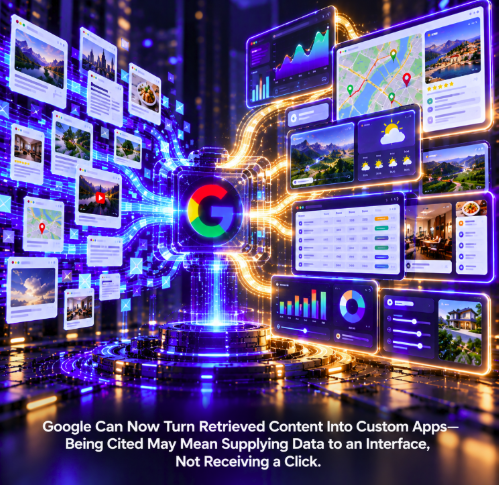
Google is preparing Search for a world in which the answer to a query is not necessarily a paragraph, a list of links or even a conventional results page. With generative UI and Antigravity-powered coding, Search can assemble interactive visuals, tables, graphs, simulations and eventually persistent mini apps around the specific problem a user is trying to solve.
The capabilities were announced at Google I/O 2026 as part of the company’s new era for AI Search. Google says generative UI will let Search build the ideal response format on the fly, using Google Antigravity and Gemini 3.5 Flash’s agentic coding capabilities. The free generative-interface layer was announced for everyone in Search during summer 2026, while more persistent custom experiences such as dashboards and trackers were scheduled to begin with Google AI Pro and Ultra subscribers in the United States.
For publishers, the important change is not simply that Google can make prettier answers. Search can increasingly transform retrieved information into a purpose-built interface. A source may contribute facts, reviews or other evidence to a tool the user manipulates without the traditional publisher page ever becoming the primary interface.
Google can choose the format after it understands the question
Search results have historically been built from a relatively stable collection of interface primitives: links, snippets, images, maps, carousels, knowledge panels and other predefined modules. Generative UI introduces a different model.
Google says Search can design a custom layout specifically for the user’s question and assemble components in real time. The company’s examples include interactive visuals, tables, graphs and simulations, with the system selecting the format that best helps explain the topic.
A question about astrophysics might therefore produce a visual explanatory tool rather than a text-heavy answer. A question about the mechanics of a watch could produce an interactive representation. The interface becomes part of the generated response.
Search is gaining an agentic coding layer
The feature is tied to Google Antigravity, the company’s agent-first development environment, and the coding capabilities of Gemini 3.5 Flash. Google’s framing is explicit: Search can code an experience for the user rather than only retrieve an existing page that contains the desired tool.
That is a significant architectural shift for discovery. Historically, if a user needed a calculator, simulator, comparison tool or tracker, Search’s job was often to find a website that had built one. Generative UI gives Google the ability to construct some of those experiences dynamically.
This does not mean Search can replace every specialized application, nor has Google said that dynamically generated tools will eliminate links to the web. Its official announcement continues to frame web information as an important input. But the destination experience can increasingly be synthesized by Search itself.
The free layer is different from the persistent mini-app layer
Google announced two related capabilities with different rollout and access models. The first is generative UI for individual Search responses: custom layouts, visual tools, tables, graphs and simulations assembled in real time. Google said these capabilities would be available for everyone in Search during summer 2026, free of charge.
The second goes further. For ongoing tasks such as planning a wedding, organizing a move or managing a recurring project, Search can build persistent dashboards or trackers that the user can return to over time. Google describes these experiences as being like mini apps built for a person’s specific task.
Those custom Antigravity experiences were announced for the coming months, starting first with Google AI Pro and Ultra subscribers in the United States. Treating both tiers as already universal would therefore overstate Google’s rollout.
A fitness tracker shows how retrieved information can become software
Google’s clearest example is a custom fitness tracker. The user asks Search to create one, and Search writes the code while drawing on fresh sources including reviews, live maps and local information such as weather.
The output is no longer merely an answer about exercise. It is an ongoing interface that can help the user manage a routine week after week while incorporating changing information.
This is where the distinction between content and application begins to blur. Reviews can become input data. Maps can become an interactive component. Weather can become a condition inside the tool. Search orchestrates those inputs into a new experience tailored to the user.
For GEO, retrieval may matter even when the page is not the destination
The publisher implication requires careful wording. Google has not said that every web source used by a generative interface will receive a visible citation, nor has it published a complete attribution model for information incorporated into dynamically coded experiences.
What Google has established is that Search can use fresh information to construct those experiences. That creates a plausible distinction between being useful to the retrieval process and receiving a conventional outbound click.
NetContentSEO has previously examined this separation in research showing that retrieval visibility can be larger than visible citation visibility. Generative UI makes that distinction even more consequential because retrieved information can potentially contribute to an interactive artifact rather than only a prose answer.
A citation can become a provenance layer rather than the interface itself
In a traditional SERP, the publisher’s page is the product the search engine recommends. The snippet exists largely to help the user decide whether to visit it.
In a generated application, the relationship can invert. Search may present the user with the working interface while supporting sources provide evidence, grounding or deeper exploration. The publisher can remain important to the answer without owning the primary interaction surface.
This does not establish that Google will hide or suppress source links. In fact, Google has repeatedly said its generative Search features are designed to surface links and help users explore the web. The point is that the link may coexist with a richer interface that satisfies more of the task before the user needs to leave Google.
The click is becoming a less complete measure of contribution
This complicates publisher analytics. If a page supplies information that helps populate a generated table, simulation or dashboard, the value of that contribution may not map neatly to a referral session.
There is already evidence that AI Search changes click behavior. A recent randomized field experiment covered by NetContentSEO found that forcing searches into Google AI Mode reduced external clicking compared with ordinary Google Search. That experiment did not test the new Antigravity mini apps specifically, so its results should not be transferred directly to this feature. It does demonstrate why citation, retrieval and referral traffic need to be measured separately in generative Search.
Freshness matters because the generated app can depend on changing data
Persistent dashboards make freshness especially important. A static explanatory page can remain useful for years, but a tracker built around local conditions, current reviews or real-time data has to keep incorporating changes.
Google’s fitness example explicitly uses reviews, live maps and weather. A wedding planner or moving dashboard could similarly depend on information that changes after the experience is first created.
The Search interface can therefore become a continuing consumer of fresh information rather than a one-time renderer of retrieved facts. That parallels Google’s separate information-agent initiative, which is designed to monitor the web continuously for changes.
NetContentSEO covered that development in Google Search Is Becoming a Persistent Monitoring Agent. Taken together, the two announcements point toward a Search architecture that can both revisit information over time and repackage it into persistent task interfaces.
Publishers may compete with interfaces generated from the same category of content
This creates an uncomfortable strategic question for sites whose differentiation is primarily interface design around broadly available data. If Search can generate a bespoke calculator, comparison table, visualizer or tracker at query time, some utility that previously required a visit to a publisher’s tool can move upstream into Search.
That does not make publisher tools obsolete. Specialized applications can contain proprietary datasets, richer workflows, expert methodology, user accounts, community features and functionality that a transient generated interface cannot reproduce reliably.
But generic utility becomes easier for Search to synthesize. Publishers whose value is deeper than presentation—original data, expertise, unique reporting, proprietary calculations or trusted first-party information—have a stronger reason for the retrieval system to continue depending on them.
Original data becomes more strategically important than a generic visualization
If Google can generate the chart, the chart itself is less defensible as the publisher’s unique asset. The underlying information can be more important.
A publisher with an original dataset, field research, proprietary benchmark or continuously updated inventory contributes something the model cannot simply recreate from interface code. Search may be able to choose a new visual format, but it still needs reliable inputs.
This suggests a durable GEO principle: invest in information scarcity, not merely presentation scarcity. A beautifully designed generic calculator can be replicated more easily than exclusive evidence.
Structured, explicit facts are easier to transform into components
Generative UI also reinforces the value of making important facts unambiguous. Tables, specifications, coordinates, dates, prices, measurements and clearly labeled relationships are easier to reason over than information whose meaning depends heavily on visual page layout.
That should not be mistaken for a newly announced ranking factor or a special Antigravity schema requirement. Google has published no markup that guarantees inclusion in a generated interface.
It is simply an information-design reality: if a system needs to turn evidence into a graph, comparison or interactive component, clearly expressed data gives it less ambiguity to resolve.
Search can increasingly answer with a tool instead of a document
The larger change is in the object Search returns. For much of the web’s history, the answer to “where can I do this?” was a document or website. Google is now building toward a system in which the answer can be a generated tool.
A simulation can help explain a physical system. A dashboard can organize an ongoing project. A tracker can combine changing inputs. A custom visual can adapt to the user’s exact question.
The user may still need external sources for authority, detail, transactions or further exploration. But Search can increasingly occupy the interaction layer between those sources and the user.
Publisher controls matter more when content can feed generated experiences
Google has also introduced more explicit controls for website owners over participation in generative Search. Its Search Console generative-AI control allows sites to exclude content from covered AI experiences while remaining available in traditional Search.
NetContentSEO covered the change in Google Finally Separates AI Search Visibility From Traditional Search. The control is strategically relevant when publishers are deciding whether the discovery benefits of generative experiences justify having their content used in AI-grounded surfaces.
Google’s public Search announcement about Antigravity does not spell out a separate publisher-control regime specifically for mini apps. Any claims about exact inclusion or exclusion behavior for a particular generated component should therefore follow Google’s documented controls rather than assumptions.
SEO measurement will need to distinguish source value from destination value
The traditional SEO funnel implicitly treats visibility as a precursor to a visit. Generative applications weaken that assumption.
A source can have destination value when the user clicks through to consume the publisher’s experience. It can have source value when its information helps Search construct the answer or tool. The same page can have both, but analytics systems usually observe the former much more clearly than the latter.
This is one reason AI visibility reporting cannot stop at referral traffic. Citations, impressions in generative Search, retrieval evidence where measurable and downstream branded demand can each reveal different parts of the relationship.
Google is turning retrieval into runtime
Generative UI changes the role of Search from selecting documents to composing experiences. Antigravity pushes it further by letting Search code persistent tools for ongoing tasks and feed those tools with fresh information.
The rollout is deliberately tiered: free generative UI for real-time visuals and simulations was announced broadly, while persistent custom dashboards and mini apps begin with Pro and Ultra subscribers in the United States. That distinction matters when assessing how widely the behavior is available.
For publishers, the deeper implication is already visible. Search can increasingly retrieve information, transform it and present the result inside a custom interface designed for the user’s exact task.
In that environment, earning a citation can still matter, but it may no longer mean winning the interface or the click. Sometimes the publisher’s most valuable role will be supplying the information from which the interface is built.