

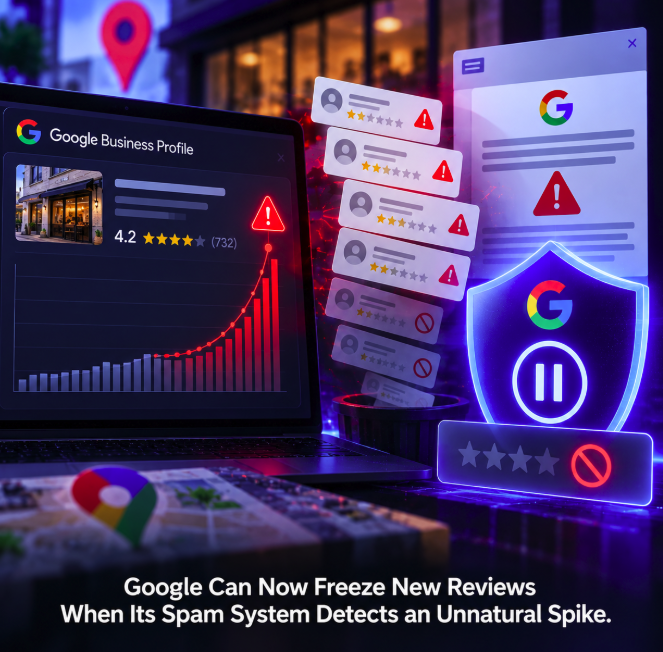

Google is giving Business Profile owners a clearer warning when its anti-spam systems decide that a sudden burst of reviews looks suspicious. A newly observed email tells businesses that Google has detected a spike in spam reviews, removed the reviews it identified as problematic and temporarily stopped the profile from receiving new ratings, reviews and other user contributions while the risk is addressed.
The notification was documented on September 22 by Search Engine Roundtable after Antoine Cameron shared a screenshot of the message. The email says the temporary pause is normally lifted once Google considers the risk mitigated, “typically within a few days,” and tells owners that no action is required unless they believe legitimate reviews were removed by mistake.
This is more than a new email template. Google’s official Business Profile restrictions documentation confirms that its enforcement tools can prevent a profile from receiving new reviews or ratings for a set period, temporarily unpublish existing reviews or display a consumer-facing warning when fake reviews have been removed. Businesses can appeal restrictions they believe were applied incorrectly.
Google can stop the review flow while it investigates the spike
The newly surfaced notification describes a protective sequence that is unusually explicit. Google first detects what its systems classify as a spike in spam reviews. It removes suspicious reviews so they do not affect the business’s rating, then temporarily pauses new ratings, reviews and other user contributions to reduce further abuse while the system reassesses the profile.
That pause matters because it changes the problem from retrospective moderation to active containment. Google has long used automated systems to identify and remove review spam, but a temporary freeze prevents additional contributions from accumulating during a period the system considers risky. For a business experiencing an actual coordinated review attack, that could limit the damage before dozens or hundreds of additional fake ratings appear.
Google’s own help documentation says it uses automated spam detection to remove reviews identified as spam and acknowledges that authentic reviews can occasionally be removed by mistake. The company directs affected businesses to support or its review-management processes when legitimate feedback is incorrectly filtered.
A sudden review spike does not automatically mean the business cheated
The wording of the observed email is important because it focuses on a detected spike in spam reviews, not necessarily on intentional misconduct by the business owner. Profiles can receive abnormal review activity for several reasons, including malicious campaigns, coordinated attacks, viral attention or aggressive but legitimate customer-review programs.
Amy Toman, commenting on the reported notification, described a former client that had opened a new location and consistently encouraged customers to leave reviews. She suspected Google may have questioned the resulting pattern and argued that the filter may still need refinement. That is an anecdotal example rather than proof of how Google’s detection model works, but it illustrates the false-positive risk whenever automated systems use unusual activity patterns as part of abuse detection.
Businesses should therefore avoid assuming that any rapid increase in legitimate reviews will automatically trigger a freeze. Google does not publicly disclose a numeric threshold for what constitutes an unnatural spike, and the available notification does not reveal the specific signals used by the spam system.
The protection can also interrupt legitimate reputation growth
For local businesses, reviews are not merely a vanity metric. They influence how potential customers evaluate a restaurant, clinic, hotel, retailer, contractor or professional service, and a steady stream of recent feedback can provide useful evidence that a location remains active and relevant.
A temporary freeze can consequently have a real operational cost even when it protects the profile from abuse. Customers who genuinely want to leave feedback may be unable to do so during the restriction period, while a newly opened location or a business running a legitimate post-purchase review program could lose several days of review collection at an important moment.
The tradeoff is understandable: accepting every contribution during an active spam event could corrupt the rating more severely. The quality of Google’s detection therefore becomes crucial. A system that freezes only genuinely abnormal attacks can protect both businesses and users; one that repeatedly mistakes normal growth for manipulation could discourage legitimate review collection.
Google already documents stronger penalties for fake engagement
The observed spam-spike email should also be distinguished from enforcement against businesses that Google believes have violated its Fake Engagement policy. In its official restrictions documentation, Google says businesses involved in fake or incentivized review activity may face measures that include a temporary block on new reviews, temporary unpublishing of existing ratings and a visible warning informing consumers that fake reviews were removed.
Those restrictions can have a different implication from a protective pause triggered by suspected incoming spam. One is designed to contain questionable activity affecting a profile; the other can be a policy-enforcement response when Google determines that the business itself violated fake-engagement rules. The interface outcome may look similar—a profile stops accepting reviews—but the reason matters.
This distinction is particularly important for agencies and reputation-management providers. If a client receives a Google email about review restrictions, teams should read the exact language rather than immediately assuming either a negative-review attack or a penalty for review manipulation.
Businesses can request a review when Google gets it wrong
The email reported by Search Engine Roundtable says businesses can request a review if legitimate feedback was removed by mistake. Google also maintains formal appeal mechanisms for Business Profile content and profile restrictions. Its appeals documentation says eligible moderation decisions can be reviewed and that businesses can provide additional evidence to support an appeal.
For individual reviews, Google’s Review Management guidance provides a separate workflow for reporting policy-violating reviews and, in eligible cases, submitting a one-time appeal after Google initially finds no violation. These processes are not identical, so businesses should use the route corresponding to the action described in the notification they received.
When challenging a restriction, maintaining evidence can help. A business that recently opened a new location, ran a legitimate customer-feedback campaign or experienced a suspicious review attack should preserve dates, customer communications and other context that can explain why review volume changed suddenly without resorting to fabricated or incentivized engagement.
Review velocity is becoming a risk signal worth monitoring
Local SEO teams have traditionally watched review velocity because a steady flow of new customer feedback can reveal changes in reputation and customer activity. Google’s new notification adds another reason to monitor it: a sudden deviation from a profile’s normal pattern may attract automated scrutiny even before the business notices anything unusual.
That does not mean businesses should artificially slow legitimate reviews to imitate a particular pattern. Manipulating the timing of feedback would miss the point and could create its own problems. Instead, multi-location brands and agencies can use monitoring to identify abnormal bursts early, investigate whether the reviewers appear to be real customers and retain documentation if Google later removes reviews or pauses contributions.
The development also reinforces why buying reviews, coordinating fake feedback or offering undisclosed incentives is increasingly risky. Automated moderation is no longer limited to deleting individual suspicious reviews after the fact; Google’s documented enforcement system can restrict the profile itself when fake engagement is detected.
A review freeze is temporary, but its implications are broader
According to the newly observed email, Google expects the protective pause associated with a spam spike to last only until the risk is mitigated, typically a few days. That makes the measure less severe than a permanent loss of review functionality, but it gives Google a powerful circuit breaker during suspected abuse.
For legitimate businesses, the best response is not panic but verification. Check which reviews disappeared, determine whether the spike corresponds to real customer activity, preserve evidence and use Google’s review or appeal tools when authentic contributions appear to have been caught by the filter. Businesses should also avoid trying to compensate for the pause through artificial review generation, which could turn a temporary protection event into a genuine policy problem.
The larger change is that review spam is becoming something Google can contain at the profile level in real time. When its systems see an abnormal wave, Google can now remove what it considers suspicious, temporarily close the door to new contributions and notify the owner about what happened. For local businesses, review monitoring is no longer only about reputation—it is also about understanding when Google’s fraud systems decide that the pattern itself looks unnatural.