

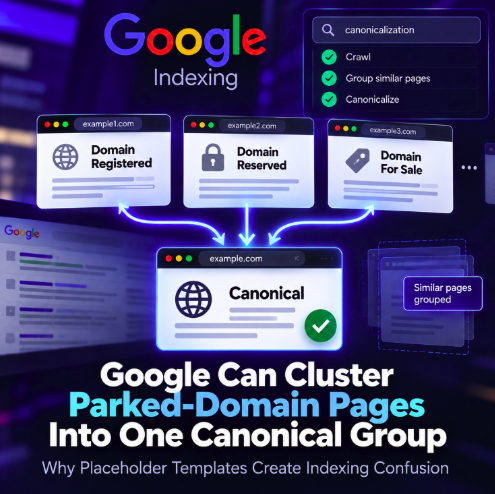

Google can quickly recognize highly similar parked-domain and placeholder pages as a single group and canonicalize them against one another, according to a public clarification from Google's John Mueller highlighted on September 29, 2026.
Mueller specifically pointed to common templates such as “domain registered,” “reserved” and “for sale” pages. When these pages are indexable and largely identical, Google may identify them as duplicates and select canonical URLs across the group.
Why parked pages are easy to cluster
Domain parking platforms and registrar placeholders frequently reuse the same HTML structure, text, navigation and visual template across large numbers of domains. From a search engine's perspective, there may be very little unique page-level information separating one URL from another.
Mueller said this similarity can make it happen quickly that the pages are recognized as a group and mutually canonicalized.
This is canonicalization, not a new algorithm update
The statement should not be interpreted as a newly announced Google Search update. It is a clarification of how Google's existing duplicate-content and canonicalization systems can behave when they encounter groups of extremely similar indexable pages.
Google's canonicalization systems attempt to choose a representative URL when multiple pages appear to contain the same or substantially similar content. Google also refreshed portions of its canonicalization documentation in August 2026, primarily to make the guidance easier to understand.
Why placeholder templates can create indexing confusion
The practical SEO problem appears when a domain that is intended to become a real website temporarily exposes an indexable generic placeholder. If Google discovers many equivalent versions of that template, the domain can initially be understood as part of a duplicate cluster rather than as an independent content property.
Once unique content replaces the placeholder, Google still needs to crawl and process the new version before its signals can reflect the changed site. This does not mean a parked page permanently damages a domain, but it provides another reason to manage pre-launch pages deliberately.
What site owners should watch
Teams launching domains should check whether registrar, hosting or staging placeholders are publicly crawlable and indexable. If a temporary page provides no search value, allowing it to become indexed may create unnecessary canonicalization and indexing noise before the actual site launches.
The same principle applies beyond parked domains. Large sets of programmatically generated placeholders with almost identical copy can give Google very little evidence that the URLs represent distinct pages.
The NetContentSEO view
Mueller's clarification is a useful reminder that indexability does not guarantee independent indexing. A page can technically be crawlable and indexable while Google's systems still decide that another URL is the better canonical representative.
For new domains and scaled publishing systems, unique page purpose and content need to be visible early. Otherwise, generic templates can unintentionally tell Google that many supposedly separate URLs are effectively the same document.