

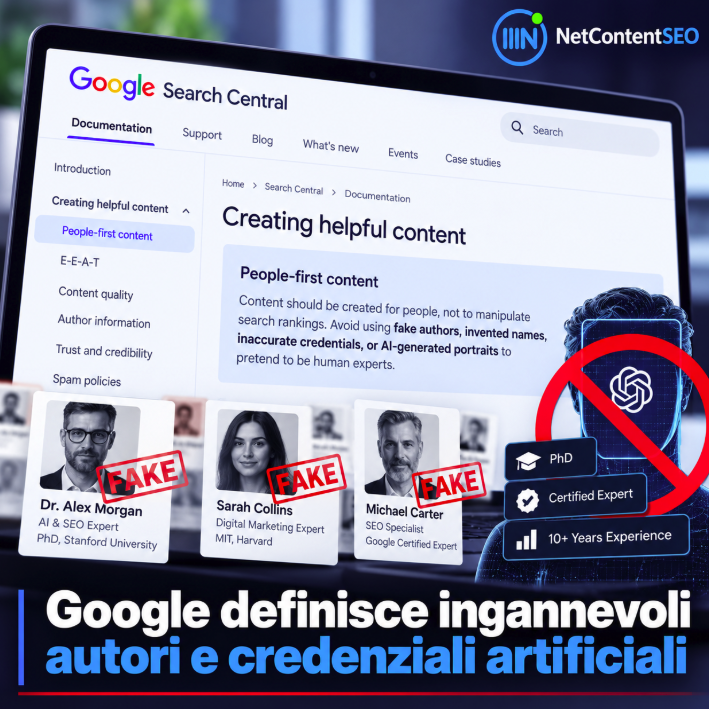

Google has sharpened its guidance around authorship and trust signals, explicitly warning against invented author identities, false credentials and AI-generated portraits when they are used to make content appear to have been created or reviewed by real human experts.
The documentation update, dated October 5, 2026 and surfaced on October 6, adds an important boundary to the debate around AI-assisted publishing. The issue is not simply whether artificial intelligence is involved in producing content. The problem is the creation of deceptive signals designed to manufacture human expertise or credibility that does not actually exist.
Fake expertise becomes an explicit quality concern
For publishers, this distinction matters. An AI-generated image used as an illustration is fundamentally different from an AI-generated headshot presented as the photograph of a supposedly real specialist. Likewise, a pen name or editorial brand is not automatically equivalent to inventing professional qualifications, employment history or certifications in order to influence a reader's assessment of authority.
Google's guidance therefore puts greater emphasis on whether authorship information accurately represents who is responsible for the content and what qualifications that person actually has. Invented names combined with fabricated biographies, nonexistent credentials or synthetic portraits can create a false impression of expertise.
E-E-A-T cannot be manufactured with synthetic personas
The update is particularly relevant to publishers building large AI-assisted editorial operations. Creating dozens of fictional “experts,” complete with realistic portraits, job titles and impressive biographies, may make a site look more authoritative at first glance. But if those identities and credentials are fictional, the presentation itself becomes a trust problem.
This reinforces a useful principle for E-E-A-T strategies: authority should be supported by verifiable people, organizations, experience and evidence rather than decorative author pages designed to imitate those signals.
AI content and fake authors are separate questions
The change should not be interpreted as a blanket prohibition on AI-assisted content or synthetic imagery. Google's long-standing focus is on the usefulness, reliability and purpose of content rather than the mere presence of automation. What this clarification targets is deception: presenting artificial identities or qualifications as authentic human expertise.
A transparent editorial workflow can therefore use AI tools while still identifying the real publisher, editor, reviewer or organization responsible for the work. The risk increases when automation is hidden behind fictional people specifically created to make readers believe a human specialist exists where none does.
What publishers should audit now
Sites using scaled editorial workflows should review author pages, biographies and expert-review labels. Author names should correspond to real identities or be clearly represented according to the site's genuine editorial model. Professional titles, certifications, degrees and experience claims should be factual and supportable. Portraits should not be used to imply that a synthetic person is a real expert.
Publishers should also examine structured data and bylines. If an author entity is represented across author pages, schema markup and article metadata, those signals should consistently describe the actual person or organization responsible for the content rather than a fabricated persona.
Recognizable authorship becomes more important
For SEO teams, the larger implication goes beyond avoiding fake profiles. As search engines and AI systems evaluate increasingly large volumes of machine-assisted content, recognizable and verifiable authorship can become a meaningful trust layer. Real editorial responsibility, consistent identity and demonstrable expertise are harder to manufacture than a polished biography and a generated portrait.
Google's clarification draws a clear line: AI can participate in a publishing workflow, but synthetic credibility should not be presented as real human authority. For publishers investing in authorship as part of their search strategy, authenticity is no longer merely a branding consideration; it is part of the quality signal itself.