

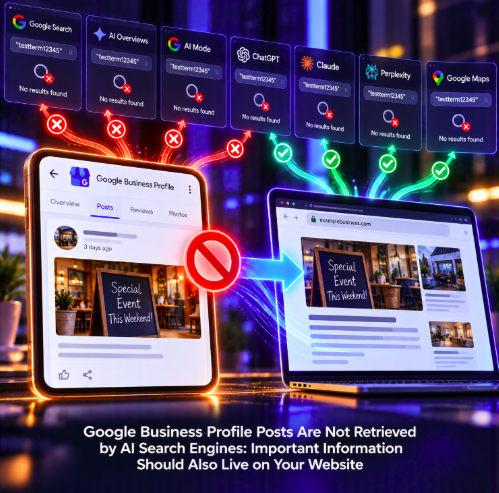

A small independent experiment has exposed an important limitation for local businesses treating Google Business Profile posts as part of their AI-search strategy. In a single-business test published September 27, a deliberately unique phrase placed in a Google Business Profile post could not be retrieved through Google Search, AI Overviews, AI Mode, Google Maps, ChatGPT, Claude or Perplexity. When a comparable unique phrase was published on the business’s own website, several systems were able to find it.
The experiment is far too small to establish that Google Business Profile posts are universally invisible to every AI retrieval system. It does support a narrower operational conclusion: a GBP post should not be treated as a reliably indexable, retrievable source for important information that a business wants search engines or AI assistants to discover later.
The experiment used a unique phrase to test retrieval
The test was designed to reduce ambiguity by publishing a term unlikely to exist elsewhere on the web. After the phrase appeared in a Google Business Profile post, the researcher attempted to retrieve it across conventional Google Search and several AI-search experiences. The phrase did not surface through the tested Google Search interfaces, AI Overviews, AI Mode, Maps, ChatGPT, Claude or Perplexity.
The researcher then ran a comparison using text placed on the company’s website. That website-published phrase was subsequently discoverable through multiple systems. The contrast is useful because the underlying information was not inherently impossible for search or AI retrieval; where it lived appeared to matter.
Still, this remains a one-business experiment. It does not establish a universal indexing rule, crawler policy or technical prohibition, and it should not be converted into a claim that no GBP post can ever influence an AI-generated answer.
Visibility inside a Business Profile is not the same as web retrievability
Google Business Profile posts are designed to let businesses publish updates, offers and events that customers can encounter through Google surfaces. That makes them useful as a customer-facing publishing format. It does not necessarily make the underlying post equivalent to a conventional web page with a stable crawlable URL and normal indexing behavior.
This distinction matters increasingly in GEO and AEO work. An information surface can be visible to a human inside a product while still being a weak retrieval target for an external search or AI system.
For local marketers, the question should therefore be more specific than “Is this information on Google?” The more useful question is: “Can the systems we care about independently retrieve this exact information when answering a relevant query?”
The website comparison is the most actionable part of the test
The experiment becomes operationally useful because it included a website control. A unique phrase published on the company site was found by several of the tested systems, while the phrase confined to the GBP post was not.
That supports a simple publishing rule for high-value local information: if the fact matters beyond the short-lived Business Profile update itself, publish it on an indexable page of the official website as well.
A holiday closure, new service, relocated office, special event, temporary promotion, newly opened branch or major policy change may all be appropriate for a Business Profile post. If the same information should remain discoverable by Search and AI assistants, however, the website should carry a canonical version that can be crawled, indexed, linked and maintained.
GBP posts and website pages serve different jobs
The result does not make Business Profile posts useless. They can still communicate with people encountering the listing directly and can support timely local merchandising. The problem begins when a business assumes that publishing a fact there is equivalent to adding that fact to its searchable web corpus.
The website is better suited to persistent information architecture. It can give an update a stable URL, surrounding context, internal links, structured data where appropriate, and a place in the site hierarchy. It can also be updated without losing the broader context around the information.
GBP posts are better treated as a distribution surface. The site can hold the durable source; the Business Profile can promote or summarize it.
This distinction is especially important for GEO
Generative Engine Optimization depends on retrieval before it depends on citation. If a system cannot retrieve the underlying information, it cannot reliably use that information as evidence in an answer.
That means local GEO programs need to distinguish between content that merely exists somewhere in a platform and content that is accessible to the retrieval systems feeding AI answers. The September experiment suggests that GBP posts should not automatically be placed in the second category.
This is consistent with a broader principle NetContentSEO has examined in its analysis of citation versus actual AI answer influence: AI visibility consists of multiple stages. A document has to be accessible and retrieved before questions about use, citation and user exposure even arise.
Google Business Profile itself still matters to AI search
The experiment should not be generalized into a claim that Business Profile data is irrelevant to AI systems. Core local entity information—business names, locations, categories, ratings, reviews, hours and other structured profile attributes—can appear throughout Google’s local and AI experiences.
The limitation being tested is much narrower: whether the free-form content inside an individual GBP post behaves like reliably retrievable web content. Those are different layers of the product.
A local business can therefore continue treating its Business Profile as important entity infrastructure while being more cautious about treating the Posts feature as a durable information repository.
The result also explains why local reputation is different from local publishing
Local AI systems can synthesize information from reviews, directories, forums, business websites and other sources even when a particular Business Profile post is not retrievable. That creates a distinction between the profile as an entity record and the post as a publishing object.
NetContentSEO’s recent analysis of local AI Overviews merging with Business Profiles found that third-party reputation sources can play an outsized role in how AI systems explain a local business. The new retrieval experiment adds a complementary warning: even content published directly through a Google-managed business surface may not necessarily function as retrievable evidence in the way marketers expect.
Critical facts should have a canonical home
A practical local content architecture should assign every important fact a canonical location. Permanent service information belongs on service pages. Location-specific facts belong on location pages. Events can have event pages. Policies should live in durable policy or FAQ content. Temporary operational changes can be published in a news or updates section when they need to remain discoverable.
The Business Profile post can then distribute that information with a concise version and a link back to the canonical page when appropriate.
This model has another advantage: when information changes, the business knows where the authoritative version lives. It reduces the risk that an expired promotion or outdated post becomes the only historical record of a fact.
Unique-phrase testing can become a useful diagnostic
The methodology behind the experiment is simple enough to adapt. A business can publish a distinctive, non-sensitive phrase inside a particular surface and later test whether relevant search and AI systems can retrieve it.
The result should not be treated as a permanent platform verdict. Retrieval can change over time, different systems have different indexes and browsing capabilities, and a negative result may reflect timing rather than structural exclusion. Repeating the test at several intervals is therefore more informative than a single check.
Used carefully, however, this method can help teams distinguish assumed visibility from demonstrated retrievability.
Do not infer crawler behavior from one negative result
A failed retrieval test does not reveal exactly why a system failed. The content may not have been crawled, may not have been indexed, may not have been available to the system’s retrieval layer, or may simply not have been selected for the query.
The experiment therefore does not prove that Google technically blocks all AI crawlers from GBP posts, nor does it establish that the tested AI companies can never access information derived from Business Profiles through other channels.
Those would require technical evidence beyond the single-business observation.
The safer publishing model is duplication with purpose
SEO advice often warns against unnecessary duplication, but this is not a case of creating dozens of identical indexable pages. It is about placing an important fact in the durable source that search systems can discover and then distributing that fact through platform-native channels.
A restaurant announcing a holiday menu can publish the full menu and dates on its website, then use a GBP post to promote it. A clinic adding a service can update the relevant service page before announcing it in the profile. A retailer changing holiday hours can update the appropriate structured and on-site information and use the post as an additional customer touchpoint.
In each case, the post amplifies the fact instead of being the only place where the fact exists.
Local AEO should audit retrievability before optimizing wording
Marketers can spend significant effort rewriting a GBP post to sound more answer-friendly, adding entity-rich wording or anticipating conversational queries. If the post itself is not reliably retrievable by the target systems, those refinements may have little effect on AI visibility.
The order of operations should therefore be retrieval first, content optimization second. Confirm that important information exists on an accessible web page, that the page can be indexed and that the fact is expressed clearly. Then use Business Profile posts, social channels and other distribution surfaces to extend reach.
A GBP post should be treated as promotion, not the only source of truth
The September 27 experiment is intentionally limited. One business and one unique-term methodology cannot define the behavior of every Google Business Profile, query or AI engine.
But the practical risk is asymmetric. If a business duplicates an important update on its own site, it gains a durable, controllable and potentially indexable source. If it publishes the information only as a GBP post and assumes AI systems can retrieve it, the experiment shows that assumption may fail across several major search and assistant products.
For GEO and AEO, that is enough to justify a conservative rule: use Google Business Profile posts to distribute important local information, but give that information a permanent home on the website whenever future search and AI retrieval matters.