

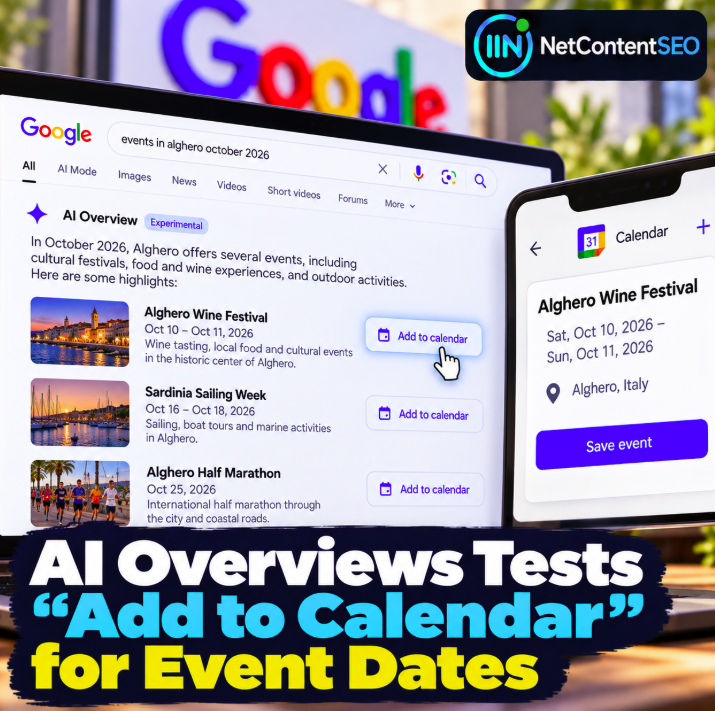

October 8, 2026. Google appears to be testing an Add to calendar action for dates mentioned in AI-generated search answers. Sightings reported between October 2 and 5, and covered on October 7, describe a calendar link within AI Overviews. A separate observation reportedly found the action in AI Mode. The interface is intermittent: it may disappear when the same query is refreshed. Google has not officially announced a rollout.
What the experimental button does
The reported interface offers a direct next step after a search answer mentions a date. Rather than manually copying an event date into a calendar, users may be able to initiate that action from the AI response. Reports do not establish a universal set of eligible queries, supported calendar apps, geographic coverage or a permanent design.
From answers to actions
The test is another example of search interfaces potentially moving beyond summarizing information toward helping users complete tasks. For event publishers, venues and organizers, the relevant question is whether users can act on accurate event details without opening the original website. The presence of a button does not by itself prove that traffic or conversions have changed.
Why this matters for event SEO
Dates, time zones, locations and event names must be precise if search systems are to present useful calendar actions. Publishers should keep event pages current, use appropriate Event structured data when eligible, and ensure that visible page details match their markup. None of these practices guarantees inclusion in an experimental AI Overview feature.
How publishers can prepare
- Verify event start and end dates, local time zones, venue addresses and cancellation notices.
- Review Event structured data against Google's published requirements.
- Keep dedicated event URLs crawlable and update them when schedules change.
- Monitor relevant queries in AI Overviews and AI Mode, documenting dates, device, region and screenshots.
- Track website visits and on-site calendar actions separately, without attributing changes to an unconfirmed experiment.
What remains unknown
Google has not confirmed broad availability, eligibility rules, ranking effects or whether calendar actions will appear consistently. The reported volatility of the interface suggests a limited UI experiment rather than a stable new Search feature.
The NetContentSEO takeaway
If Google makes calendar actions a regular part of AI-generated answers, event visibility may increasingly be measured by useful actions completed from the results page as well as by clicks. For now, publishers should prioritize trustworthy event data and avoid assuming a rollout or measurable SEO impact.