

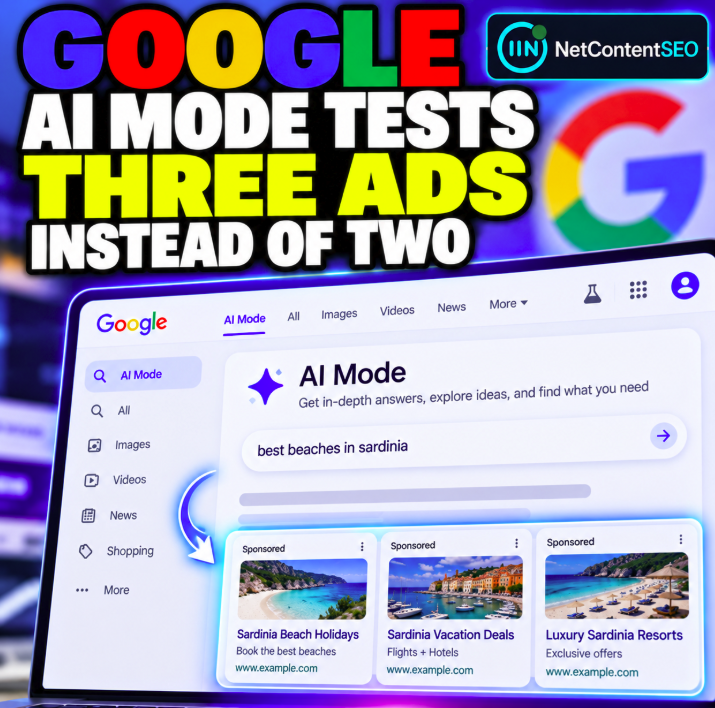

Google AI Mode has been observed showing three ads at the bottom of some responses, compared with two in an earlier documented layout. Search Engine Watch reported the observation on October 7, 2026, alongside screenshots of the two-ad and three-ad versions. The evidence supports a limited interface observation; it does not confirm that Google has generally expanded the number of ad slots across AI Mode.
What was observed in Google AI Mode?
In the screenshot reported by Search Engine Watch, three website ads appear at the bottom of an AI Mode response. An earlier screenshot showed two ads in the same general placement. The report's author describes this as a possible new change, but no broad rollout or official Google announcement was established in the report.
The distinction is important: screenshots can document what appeared for a particular search experience, but they cannot alone show how frequently the layout appears or whether the change is permanent.
What is confirmed—and what remains unknown?
- Observed: a screenshot showing three ads at the bottom of an AI Mode response.
- Comparison: an earlier screenshot showed two ads in that placement.
- Source and date: Search Engine Watch reported the observation on October 7, 2026.
- Not confirmed: a general increase in ad slots across AI Mode.
- Not established: how widely the layout appears, whether it is a temporary test, or whether Google intends to make it permanent.
- No performance data supplied: the report does not quantify effects on impressions, clicks, cost per click or conversions.
Why three ads instead of two could matter
If a three-ad layout were adopted more broadly, it could create an additional opportunity for advertisers to appear in that placement. But this is a conditional implication, not a confirmed outcome. Actual advertiser exposure would depend on eligibility, query context, auction dynamics and how often the layout is served.
For users, a larger ad group could change the balance between the AI response and sponsored results near the bottom of the experience. The screenshots do not establish whether users notice the difference or whether engagement changes.
What advertisers and PPC teams should monitor
- Repeat sightings: check multiple queries and sessions before treating the count as a consistent pattern.
- Device and context: record whether the observation occurs on desktop or mobile and capture the query and market where known.
- Placement: distinguish ads below the AI response from ads integrated within it.
- Campaign reporting: monitor actual impressions, clicks, spend and conversions rather than infer results from screenshots.
- Official confirmation: wait for a Google statement or broader evidence before describing the change as a rollout.
Does Google now show three ads in every AI Mode answer?
No. The available report documents a three-ad example and compares it with an earlier two-ad layout. It does not establish that every AI Mode response now shows three ads or that the change has rolled out generally.
Does this mean paid search is replacing organic visibility in AI Mode?
The observation alone does not support that conclusion. It documents a difference in one sponsored placement, not a measured reduction in organic links, citations or visits to publishers. Teams should evaluate paid and organic performance using their own data and avoid treating a UI screenshot as evidence of a wider traffic shift.
Frequently asked questions
When was the three-ad layout reported?
Search Engine Watch reported it on October 7, 2026.
How many ads did the earlier layout show?
The earlier screenshot cited in the report showed two ads at the bottom of the AI Mode response.
Has Google confirmed a general rollout?
No general rollout is confirmed by the cited report. The three-ad display should be treated as an observation, potentially a test.
Could the change create more opportunities for advertisers?
If the layout becomes more widespread, it could add a placement opportunity. The report does not establish broad availability or any resulting performance improvement.
What should PPC teams do now?
Track repeat sightings and campaign metrics, noting device, query and placement. Do not forecast additional reach or conversions from the screenshot alone.
The takeaway
Google AI Mode has been observed displaying three bottom ads instead of two, but a general expansion of ad inventory is not confirmed. For now, the screenshots document a limited UI observation. Advertisers should watch for repeatable evidence and rely on campaign data before drawing conclusions about reach, cost or performance.
Source
Search Engine Watch — Google AI Mode now showing three ads at the bottom instead of two (October 7, 2026).