

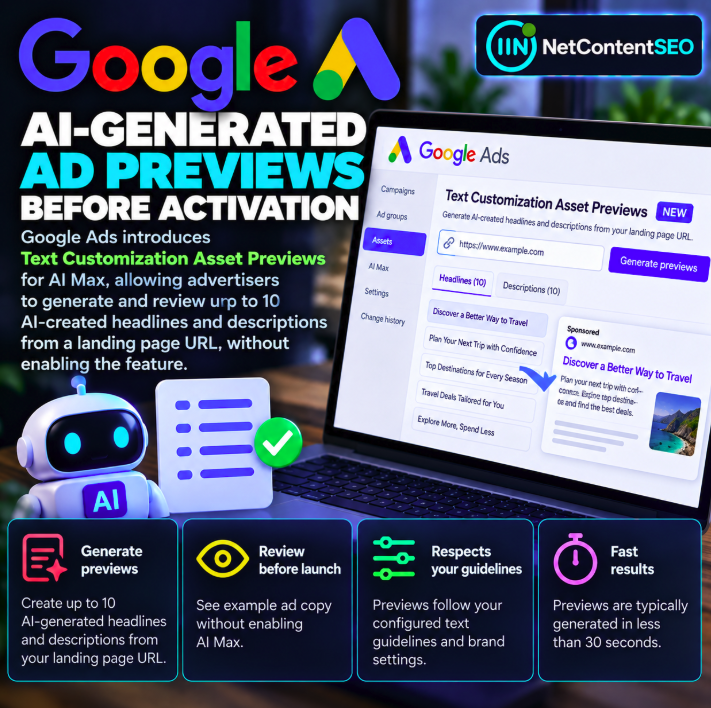

Google Ads has documented a new way for advertisers to inspect AI-generated text before switching on AI Max Text Customization. The feature, called Text Customization Asset Previews, can generate up to ten examples of headlines and descriptions using the URL of an advertiser's landing page. The examples follow configured text guidelines and are typically returned in under 30 seconds, according to the documented feature description.
The update was reported on October 9, 2026. Its main advantage is straightforward: marketers can review what AI might write for their ads before enabling the customization feature. A preview is not an active advertisement, a guarantee of what will serve or a forecast of campaign performance.
Sources: Google Ads Help and Search Engine Roundtable, October 9, 2026.
What are Text Customization Asset Previews?
Text Customization Asset Previews are a preview workflow for AI Max in Google Ads. They allow advertisers to enter or use a landing page URL and generate examples of AI-written ad text, including headlines and descriptions, without first activating the feature for a live campaign.
Previously, the decision to use automated ad text could feel like a commitment made before seeing representative examples. The preview workflow helps make that decision more informed by exposing possible outputs for review.
How the preview process works
- Provide a landing page URL. The system uses the page as the basis for generating text examples.
- Apply configured text guidelines. The preview generation follows the relevant text customization guidance or restrictions set by the advertiser.
- Generate example assets. The system produces up to ten headline and description examples.
- Review the language. Inspect claims, tone, relevance and consistency with the landing page.
- Decide whether to enable the feature. Reviewing examples does not itself require switching on AI Max Text Customization.
Google says the generation step generally takes less than 30 seconds. That is a typical time, not a guaranteed service-level limit.
Why previewing ad copy matters
Automatically generated text can be useful for creating variants, but it can also introduce risks. A headline might overstate an offer, a description might imply a service is available in a location where it is not, or the wording might diverge from a brand's approved tone.
Seeing examples in advance gives advertisers an opportunity to evaluate these issues before enabling the automation. It does not eliminate the need for continued monitoring once a campaign is active.
What the preview can and cannot tell you
| Preview can help assess | Preview does not guarantee |
|---|---|
| Potential AI-written headline wording | Exactly which headline will serve in every auction |
| Potential AI-written descriptions | Campaign clicks, conversions or return on ad spend |
| Alignment with the landing page | That all claims are accurate without human review |
| Compliance with configured text guidelines | Approval of every future asset in every context |
| General style of possible AI assets | Identical outputs over time |
Text guidelines are an important safeguard
Google says previews respect configured text guidelines. That can help advertisers guide tone and messaging, but the presence of guidelines is not a substitute for checking the final examples.
Marketers should still look for unsupported superlatives, inaccurate prices, misleading availability statements and mismatches between the ad text and the destination page. Legal or regulated advertising claims may require additional review.
What this means for PPC teams
For PPC specialists, the new preview option can become part of a pre-launch quality assurance process. Teams can compare the proposed AI text with manually written assets, check for inconsistencies and discuss whether enabling Text Customization fits the campaign's objectives.
Agencies can also use the previews during client approval discussions. Rather than describing AI Max's text generation only in abstract terms, they can review representative examples. The feature does not mean clients are approving every future dynamically generated asset.
Landing page quality still matters
Because the examples are generated from a landing page URL, the page's content is an important input. A page with unclear product descriptions, inconsistent offers or missing essential information can make it harder to assess whether generated ads are accurate.
This creates a practical reason for PPC and SEO teams to coordinate on landing page clarity, even though Google Ads AI Max is an advertising product and this update does not change organic search rankings.
How to review ten generated examples effectively
- Check factual accuracy. Verify product features, prices, locations and availability against the actual page.
- Review brand voice. Look for wording that conflicts with the advertiser's established style.
- Inspect policy-sensitive claims. Pay particular attention to regulated or high-stakes categories.
- Check landing page alignment. Make sure each example reflects what a visitor will find after clicking.
- Identify repetition. Consider whether the examples add useful variety or merely rephrase the same claim.
- Record feedback. Document recurring problems and adjust the available guidelines where appropriate.
Does generating previews activate AI Max?
No. The key point of the announced workflow is that advertisers can generate examples without enabling Text Customization in advance. Activating the feature for a campaign is a separate decision.
Will the previewed headlines definitely run?
No. The generated items are examples intended for inspection. The announcement does not establish that every preview will become a served asset, nor that the final serving combinations will match the preview exactly.
Are previews a performance test?
No. A preview does not measure click-through rate, conversion rate or return on advertising spend. Those metrics require actual campaign delivery and appropriately designed measurement.
Does this affect organic SEO?
The feature concerns Google Ads and AI Max. It is not an update to Google's organic search indexing, ranking or AI Overview citation systems. The indirect relevance for SEO teams is that clearer, accurate landing pages can support better coordination with paid search messaging.
FAQ
What did Google Ads add to AI Max?
Text Customization Asset Previews, which generate example AI-written headlines and descriptions before the advertiser enables the feature.
How many previews can advertisers generate?
Up to ten examples, according to the documented feature description.
What information is used to generate them?
The landing page URL, with configured text guidelines applied.
How long does generation take?
Google says examples are typically generated in less than 30 seconds, although individual experiences may vary.
Does previewing mean the campaign is live?
No. The preview workflow is separate from enabling the customization feature.
Does the preview guarantee better ad performance?
No. It supports review of potential copy, not performance forecasting.
NetContentSEO analysis
The notable change is greater visibility into AI-generated advertising text before activation. For advertisers concerned about accuracy, brand consistency and control, being able to inspect sample headlines and descriptions is a practical improvement. The responsible next step is to treat previews as quality assurance inputs—not as final approvals, promises of ad delivery or proof that automation will improve campaign results.
Sources: Google Ads Help; Search Engine Roundtable.