

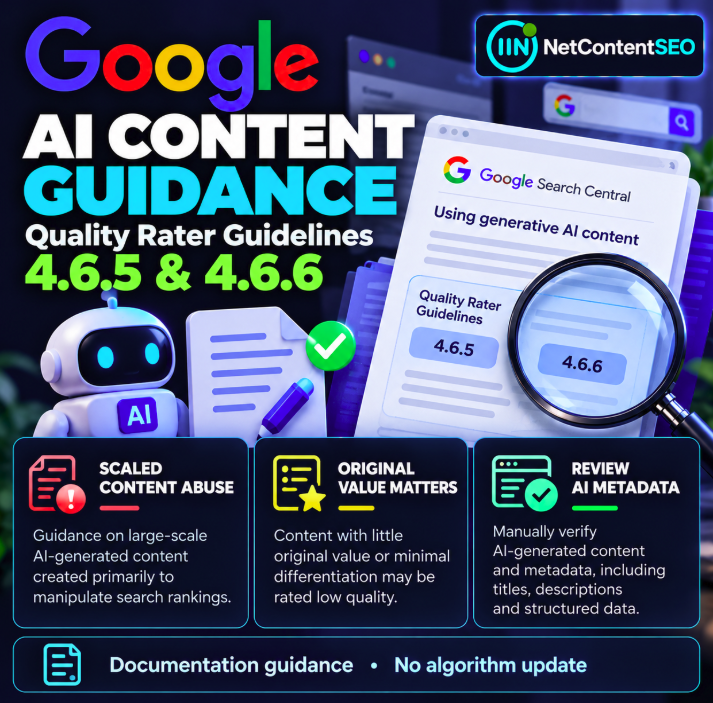

Google Search Central's guidance on generative AI content explicitly points publishers to sections 4.6.5 and 4.6.6 of the Search Quality Rater Guidelines. The sections address scaled content abuse and main content created with little effort, originality or added value. Google also stresses accuracy, quality and relevance when using AI to create content and metadata—including title elements, meta descriptions, structured data and image alt text.
Verification note: Although this topic was circulated as an October 1, 2026 documentation update, the publicly accessible guidance page reviewed for this article displays a last-updated date of December 10, 2025, and the accessible Search Central documentation changelog does not independently establish the claimed October 1 update. The guidance itself is verified; the precise October 2026 change date should not be treated as confirmed.
Primary sources: Google Search Central: Guidance on Generative AI Content and Google Search documentation updates.
What Google's official AI content guidance says
Google says generative AI can be useful for researching topics and structuring original material. But producing large numbers of pages without adding value for users may violate its spam policy on scaled content abuse. The relevant distinction is not simply whether software helped produce a page: it is whether the resulting content is useful, accurate, original and consistent with Search Essentials and spam policies.
Google points readers to the Quality Rater Guidelines for further context, specifically sections 4.6.5 and 4.6.6. The page also reminds site owners that the rater guidelines are not a formula for ranking first, and that human quality ratings do not directly influence ranking.
Section 4.6.5: scaled content abuse
Google's reference to section 4.6.5 directs attention to the problem of producing content at scale primarily to manipulate search visibility rather than help readers. Automation and AI can make mass publication inexpensive, but scale alone is not a substitute for unique expertise, trustworthy sourcing or practical value.
The official spam policy applies to scaled content abuse regardless of whether the pages were created by generative AI, traditional automation or human writers. Publishers should examine the purpose and usefulness of their content, not assume a particular production tool makes it safe or unsafe.
Section 4.6.6: little effort, originality or added value
Section 4.6.6 is cited in Google's guidance in connection with main content that shows little to no effort, little to no originality and little to no added value. The issue can arise when an article merely rephrases existing information without new reporting, analysis, explanation or practical help.
For editorial teams, this is a reminder to assess whether a page offers something worth reading: original observations, firsthand expertise, reliable synthesis, clear instructions, relevant comparisons or other genuine benefits to users.
Quality raters are not the ranking algorithm
Google explicitly distinguishes the Search Quality Rater Guidelines from the systems that determine rankings. Human raters help evaluate the performance of search ranking systems, but their individual ratings do not directly determine where a specific page ranks.
Therefore, references to sections 4.6.5 and 4.6.6 should not be misrepresented as the announcement of a new algorithm, a new numerical ranking score or an automatic penalty for AI-written text.
Google also calls out AI-generated metadata
Google's documentation specifically mentions <title> elements, meta description elements, structured data and image alt text. These fields can be produced automatically, but they still need to describe the actual page accurately.
An AI-generated title that promises information missing from the article, a meta description that misstates the facts, or structured data that describes content or entities not present on the page can mislead users and create compliance problems. Automated generation does not remove the publisher's responsibility to verify accuracy.
Structured data needs independent validation
Google advises compliance with general structured-data guidelines and the policies of individual search features, as well as validating markup. Publishers should confirm that each property reflects visible and supported page content and that the selected schema type is appropriate.
Passing a syntax validator is not proof that a page qualifies for a rich result. Eligibility also depends on feature-specific policies and other conditions.
Image alt text deserves editorial review
AI tools can draft image descriptions quickly, but alt text should accurately describe the image in its page context. Invented objects, misleading location names or irrelevant keyword stuffing can reduce usefulness. For publishers creating images with AI, checking the final image rather than trusting a prompt-generated description is especially important.
Does Google ban AI-generated content?
No blanket ban is described in the official guidance. Google recognizes useful applications of generative AI while warning that generating many low-value pages may violate its spam policies. The relevant editorial standard is whether the content provides accurate, relevant and meaningful value.
This is not a promise that every AI-assisted page will rank or be indexed. Quality, technical accessibility, relevance and competition remain important, and no publication method guarantees search performance.
Practical checklist for AI-assisted publishers
- Verify factual claims: Check dates, quotations, figures and source URLs against primary material.
- Add original value: Include expert interpretation, firsthand details, unique data or useful synthesis where possible.
- Review titles and descriptions: Ensure metadata matches the actual article and avoids exaggerated promises.
- Validate structured data: Confirm schema types, required fields and policy compliance.
- Inspect image alt text: Describe the final image accurately rather than repeating keywords.
- Audit repetitive pages: Identify templated articles that add little beyond existing sources.
- Maintain editorial accountability: Assign responsibility for review, correction and updates.
- Distinguish guidance from algorithm announcements: Do not infer a ranking-system change from a documentation reference.
How to assess an AI-assisted content workflow
A useful audit begins with a sample of recently published pages. Check whether each answers a real user question, supports its claims, adds value beyond source material and presents truthful metadata. Then review patterns across the site: duplicated introductions, shallow location variants, fabricated citations, irrelevant schema or images whose descriptions do not match.
The goal is not to prove that a human typed every sentence. It is to ensure that the published result meets the site's editorial standards and serves readers.
FAQ
What do Quality Rater sections 4.6.5 and 4.6.6 cover?
Google references section 4.6.5 for scaled content abuse and section 4.6.6 for content with little effort, originality or added value.
Are AI-generated articles automatically spam?
No. Google focuses on compliance with spam policies and whether content offers value to users.
Do quality raters directly change page rankings?
No. Google states that rater evaluations help assess ranking systems but do not directly influence rankings.
Should AI-generated meta descriptions be checked?
Yes. Google explicitly calls for accuracy, quality and relevance in generated metadata, including titles, descriptions, structured data and alt text.
Was a new Google ranking algorithm announced on October 1, 2026?
No algorithm change is established by the cited guidance. The claimed October 1 documentation date also could not be independently verified from the accessible official pages.
NetContentSEO analysis
Google's documented position is a quality-and-value standard, not a prohibition on AI-assisted publishing. The references to sections 4.6.5 and 4.6.6 underscore two risks: mass production without user benefit and pages lacking original contribution. Publishers should respond with stronger fact-checking, meaningful editorial input and accurate metadata, rather than treating this guidance as evidence of a new algorithm or an AI-text penalty.
Official references: Generative AI content guidance; Google Search documentation updates.