

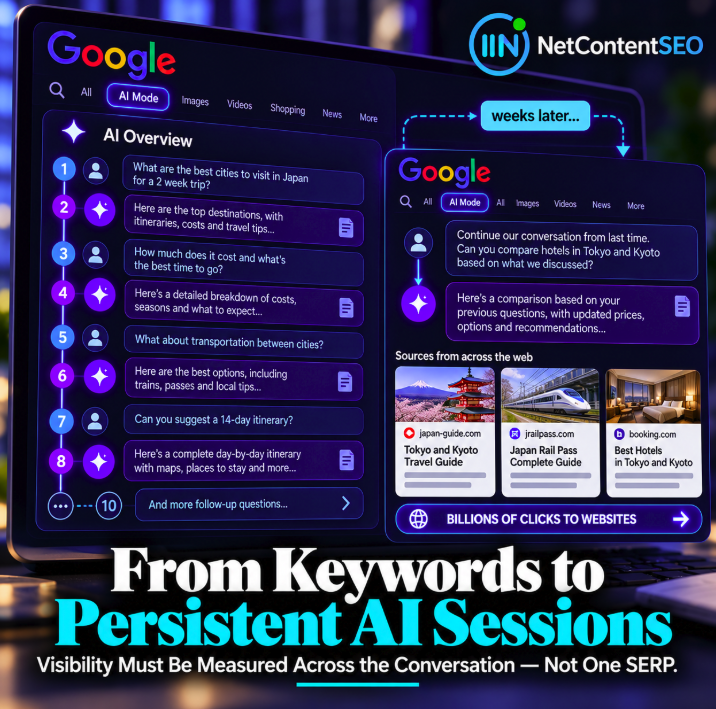

The unit of search visibility is beginning to expand from a single query to an entire conversation.
Google Search chief Nick Fox says users of Google's AI experiences are asking substantially longer questions, going five or ten follow-up questions deep and, in some cases, returning weeks later to continue the same dialogue.
The comments, made in a September 25, 2026 interview with Popular Economics, describe a Search behavior that looks increasingly different from the classic keyword → SERP → click model.
Google says queries are getting much longer
Fox said Google's queries are now much longer than they used to be and can span multiple sentences.
He described this as an internal metric Google actively watches because it shows whether users are changing the mental model they have developed over years of traditional Search.
Instead of compressing a problem into something like “car grinding noise,” a user can describe the vehicle, when the noise occurs, which warning light appeared and what makes the symptom worse.
The query begins to resemble the detailed explanation someone would give a human expert.
The second behavioral change is follow-up search
Fox identified follow-up questions as another major change.
Google has long wanted Search to support a sequence in which users ask one question, receive an answer and naturally continue with another.
AI Overviews and AI Mode now make that interaction possible.
According to Fox, users can go five questions or ten questions deep in these conversations.
A search session can continue three weeks later
The conversation does not necessarily end when the browser session ends.
Fox said users may finish a set of questions and then return as much as three weeks later to continue the dialogue.
His example involved a health-related question: a user could initially ask AI Mode several questions, visit a doctor a week later, then return to Search with the doctor's new information and ask how to interpret it.
That transforms Search from a point-in-time retrieval interface into something closer to a persistent research workspace.
Google increasingly describes searches as long-running tasks
Fox's examples extend well beyond health.
Planning a vacation or deciding which graduate school to attend are not single questions. They are projects involving research, comparison, refinement and decisions over time.
Google wants Search to retain enough conversational context to support those evolving tasks.
This aligns with Fox's broader description of query volume as a key internal success metric: more queries mean users are entrusting more tasks and problems to Google.
The SEO unit of measurement may need to change
Traditional rank tracking assumes a relatively atomic event.
A user enters a keyword. Google returns a SERP. A domain occupies a position.
Conversational Search creates a different visibility problem.
A brand can appear in question one, disappear in questions two through four, return as a cited source in question five and become a recommendation only after the user introduces new constraints in question eight.
One screenshot or one prompt run cannot describe that journey.
Visibility can change inside the same conversation
Follow-up questions progressively narrow intent.
A travel conversation might begin with “Where should I go in Japan?” and move through weather, budget, rail transport, hotels and neighborhood comparisons.
Different sources and brands can become relevant at every stage.
That means AI visibility increasingly has a sequence dimension: not simply whether a brand appears, but when it enters the conversation, how long it persists and whether it survives deeper questioning.
Persistent sessions introduce a time dimension too
If users can return weeks later, the measurement challenge becomes even harder.
The source environment may have changed. Prices can change. New pages may have been indexed. The AI system itself may have changed.
A brand that appeared during the first research phase may not be visible when the user resumes the task closer to purchase.
Conversational visibility therefore needs to be evaluated across both turn depth and time.
A new class of AI visibility metrics
This behavior suggests several useful metrics beyond classic keyword rank.
Teams can measure first-turn presence, citation persistence across follow-ups, brand mention persistence, recommendation depth, competitor replacement and conversion-oriented visibility near the end of a task.
A prompt may also be evaluated as a journey rather than independently: discovery → comparison → validation → decision.
The important point is not that every SEO platform needs exactly these metrics. It is that a single-query visibility percentage increasingly describes only one frame of a longer interaction.
Prompt tracking needs conversation tracking
Most current AI visibility monitoring starts with sets of standalone prompts.
That is valuable for measuring whether a brand appears for representative user questions.
But Fox's description of real Search behavior suggests the next measurement layer: multi-turn prompt sequences.
The second prompt should inherit the first answer's context. The fifth prompt should reflect decisions made earlier in the conversation. A resumed session should test whether visibility persists when the task evolves.
That is materially different from running ten unrelated prompts.
Google says AI Search still sends billions of clicks
Fox also pushed back against the idea that conversational answers eliminate website traffic.
In the September interview, he said people still click through to websites frequently, particularly for deeper tasks where they want first-hand reporting, analysis, restaurant reviews, menus or other source material.
He said Google sends billions of clicks to the web through its AI experiences in Search.
Fox has separately stated that Google's AI Search features send billions of clicks to websites every week, while Search overall sends billions daily.
The “billions of clicks” claim remains difficult to audit
Google has not published the underlying denominator, baseline or detailed methodology necessary for publishers to independently validate the aggregate AI-click figure.
Search Engine Journal noted this limitation when Fox made the claim publicly in July: the scale sounds large, but Google did not provide the supporting dataset needed to evaluate it.
The appropriate interpretation is therefore precise: Google says its AI experiences send billions of clicks. The figure is a proprietary platform claim, not an independently auditable publisher metric.
Clicks may happen later in the conversation
The multi-turn behavior described by Fox also complicates zero-click analysis.
A user may not click during the first AI answer but could visit a source several questions later when the task becomes more specific.
Alternatively, the user may complete the entire task inside Search without visiting a publisher.
Aggregating those two journeys into one binary “clicked / did not click” measurement can hide when and why external sources become valuable.
Content needs to survive deeper questioning
For publishers and brands, conversational Search creates a tougher test than simply matching an initial query.
Content needs enough depth and evidence to remain useful when the user asks the obvious next question.
A superficial “best products” page may surface during discovery but disappear once the conversation asks about technical constraints, pricing, real-world testing or specific use cases.
Original data, first-hand expertise, transparent comparisons and detailed factual coverage can support more stages of that journey.
Search intent is becoming a state, not a label
Classic SEO often assigns one intent category to a query: informational, navigational, commercial or transactional.
In a ten-turn conversation, intent can evolve.
A user may begin informationally, enter comparison mode, validate a recommendation and finish with a purchase-oriented question.
The same persistent session can therefore traverse several traditional intent categories.
That makes journey modeling increasingly relevant to AI Search optimization.
NetContentSEO take
Google's five-to-ten-question behavior is more important than another headline about longer queries.
It suggests that Search is moving from isolated retrieval events toward persistent task sessions that can span multiple questions and multiple weeks.
For SEO and AI visibility, the implication is straightforward: measuring whether a brand appears for one prompt will not be enough.
The next generation of visibility measurement needs to ask whether the brand remains useful as the conversation deepens, whether competitors replace it, whether citations persist and whether the brand is present when the user's intent moves closer to a decision.
The keyword is becoming a conversation. The SERP is becoming a session.