
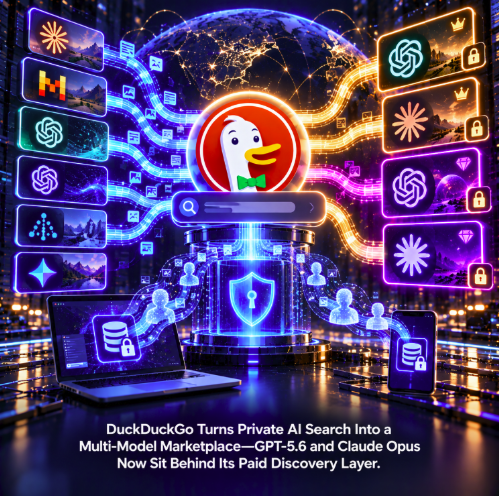
DuckDuckGo has quietly turned Duck.ai into a tiered multi-model gateway where the privacy layer stays consistent but the reasoning engine increasingly depends on what the user pays for. Its current official documentation lists six models available for free, while Plus subscribers gain GPT-5.6 Terra and Claude Sonnet 4.6 and Pro subscribers additionally receive GPT-5.6 Sol and Claude Opus 4.8, higher reasoning effort and twice the usage limits of Plus.
The configuration was visible in DuckDuckGo’s official help documentation when checked on September 27, 2026 at 13:32 CEST. DuckDuckGo does not provide a publication date for the specific model-list change on the help page, so the defensible date is the observation date rather than an asserted launch date. The current Duck.ai documentation confirms the model lineup and describes the service as a way to hold private conversations with third-party AI models through DuckDuckGo’s anonymization layer.
For AI discovery, the change is strategically interesting because Duck.ai is no longer merely a privacy wrapper around a small set of interchangeable chatbots. It is becoming a marketplace-like interface in which the same DuckDuckGo environment can route a question to models from OpenAI, Anthropic, Mistral and independently hosted open-weight systems, with frontier models increasingly reserved for subscription tiers.
The free tier now spans six models from several AI ecosystems
DuckDuckGo’s current model documentation lists Claude 4.5 Haiku, Mistral Small 4, GPT-5.4 nano, GPT-5.4 mini, gpt-oss-120b and Gemma 4 31B as free Duck.ai options. The latter two are hosted by Tinfoil.sh, while the commercial models are supplied through their respective provider infrastructure or DuckDuckGo’s documented backup arrangements.
This creates an unusually broad free comparison surface. A user can switch between models built by different organizations without opening separate accounts with each provider, and DuckDuckGo says the default model can be changed from the model selector in Duck.ai.
The importance for publishers is that “visibility in Duck.ai” cannot be treated as visibility in one model. Each model has different training, reasoning and retrieval behavior, and DuckDuckGo itself warns that models rely on different algorithms and datasets and can answer the same prompt differently.
Plus introduces GPT-5.6 Terra and Claude Sonnet 4.6
DuckDuckGo’s Plus plan adds two advanced models to the free catalog: OpenAI’s GPT-5.6 Terra and Anthropic’s Claude Sonnet 4.6. Plus also provides higher usage limits than the free service and access to a weekly allowance that can extend a conversation after the daily limit is exhausted.
DuckDuckGo currently prices Plus at $9.99 per month or $99.99 per year in the United States, with equivalent localized pricing documented for supported markets. The subscription is broader than Duck.ai and also bundles DuckDuckGo’s VPN, Personal Information Removal where available and Identity Theft Restoration.
That bundling matters commercially. DuckDuckGo is not selling model access as a standalone conventional AI subscription; it is positioning premium AI as one component of a privacy subscription.
Pro puts GPT-5.6 Sol and Claude Opus 4.8 behind the highest tier
Pro adds GPT-5.6 Sol and Claude Opus 4.8 on top of the Plus model set. DuckDuckGo also says Pro provides higher reasoning effort on models that support it and usage limits twice as high as Plus.
The Pro plan currently costs $19.99 per month or $199.99 annually in the United States. DuckDuckGo’s plan-comparison documentation specifically describes Pro as intended for more demanding AI work or heavier usage.
The tiering creates a meaningful distinction for AI visibility testing. A result observed through the free Duck.ai interface may not represent what a Pro subscriber sees when asking the same question through GPT-5.6 Sol or Claude Opus 4.8. The product name remains Duck.ai, but the underlying answer engine can be materially different.
Duck.ai sits between traditional search and model-specific chat
Duck.ai is also integrated into the broader DuckDuckGo discovery journey. DuckDuckGo says users can navigate directly to the AI interface or move from traditional search results into Duck.ai to ask follow-up questions.
That makes the service more relevant to search marketers than a generic model playground. A user can begin with private web search, encounter conventional results and then continue the information need through a chosen AI model without leaving DuckDuckGo’s environment.
The transition changes the retrieval problem. The conventional Search result set is governed by DuckDuckGo’s search stack, while the subsequent conversational answer can depend on the selected model and whatever search or grounding mechanisms are available in that Duck.ai workflow.
One interface does not imply one source-selection system
This is the core GEO complication. If Duck.ai exposes multiple models, marketers should not assume that optimizing for the interface means optimizing for one stable citation graph.
OpenAI, Anthropic, Mistral and the open-weight models can differ in what they know, how they reason, whether and how they use fresh web information, and which evidence they emphasize. Even when DuckDuckGo provides a common privacy and user-interface layer, it does not erase those underlying differences.
NetContentSEO has documented the broader measurement problem in research showing that AI interfaces and APIs can expose sharply different source sets. Duck.ai adds another dimension: multiple model families can coexist behind the same consumer-facing discovery product.
The privacy promise is implemented through DuckDuckGo as an intermediary
DuckDuckGo says Duck.ai chats are anonymized before being sent to model providers. Its privacy documentation describes contractual requirements designed to prevent providers from using Duck.ai conversations for model training and, under its Zero Data Retention framework, to require prompt and response deletion after the response is generated, subject to documented exceptions.
The current privacy table lists OpenAI’s GPT-5.6 Sol, GPT-5.6 Terra, GPT-5.4 nano and GPT-5.4 mini under OpenAI; Claude Opus 4.8, Claude Sonnet 4.6 and Claude Haiku 4.5 under Anthropic; Mistral Small 4 under Mistral; and gpt-oss-120b plus Gemma 4 31B under Tinfoil.
DuckDuckGo also documents backup hosting through Azure for OpenAI and Anthropic models. That infrastructure detail is useful because the privacy proposition is not that no external model provider participates; it is that DuckDuckGo mediates the interaction and imposes privacy conditions on the providers involved.
Zero Data Retention has documented exceptions
The privacy story is strong but should not be simplified into an absolute claim that nothing is ever temporarily retained anywhere. DuckDuckGo’s current documentation says OpenAI and Anthropic may use prompt caching in short-term memory for up to one hour to reduce token costs and improve response speed, without writing that cache to disk.
For Anthropic, DuckDuckGo also documents potential retention where legally required or necessary to combat malicious use. Uploaded files and images are additionally subject to child-safety scanning and can be retained if flagged for legally required reporting.
These caveats do not negate DuckDuckGo’s privacy architecture; they define it more accurately. The product’s claim is based on anonymization, provider restrictions and documented retention controls rather than a promise that no transient processing ever occurs.
Tinfoil adds a stronger technical privacy property for two free models
DuckDuckGo highlights a different architecture for gpt-oss-120b and Gemma 4 31B. Both are hosted by Tinfoil inside a Trusted Execution Environment.
According to DuckDuckGo, that environment gives the service a technical mechanism to ensure Tinfoil cannot read, retain, share or train on prompts, responses or uploads. DuckDuckGo describes these as zero-provider-visibility models because the host itself cannot see the conversation content.
That creates another form of differentiation inside the model selector. Users are not only choosing capability; they can also be choosing among different privacy implementations.
Recent chat history is designed to remain local
DuckDuckGo’s privacy model also separates provider-side processing from user-side convenience. Recent Duck.ai conversations can be stored locally on the user’s device so that the interface can preserve history without requiring DuckDuckGo to build a conventional cloud conversation profile tied to the person.
This local-first approach fits DuckDuckGo’s broader product identity. The company is trying to offer the continuity users expect from modern AI chat while minimizing the centralized accumulation of conversational data.
For users moving across devices, that design has different trade-offs from account-centric assistants whose histories are primarily synchronized through provider infrastructure.
Usage limits are part of the model marketplace
The subscription tiers do not differentiate only by model names. DuckDuckGo imposes daily usage limits on the free service, while subscribers receive daily and weekly allowances.
When a subscriber reaches the daily threshold, DuckDuckGo says the user can choose to continue against the weekly allowance until that pool is exhausted. Pro receives twice the usage limits of Plus.
That makes access depth part of the paid proposition. A Pro subscriber can use stronger models, request higher reasoning effort where supported and sustain more usage before hitting the product’s limits.
Model choice can change brand and source visibility without DuckDuckGo changing its interface
For GEO measurement, this is perhaps the most important consequence. DuckDuckGo can update which models are available behind Duck.ai without redesigning the surrounding product.
A brand monitoring only “Duck.ai citations” could therefore mistake a model-mix change for a visibility change. If users shift from a free model toward GPT-5.6 Terra, GPT-5.6 Sol or Claude Opus 4.8, the distribution of answers can change even if the prompt population stays constant.
This resembles a problem NetContentSEO has already observed across the wider AI ecosystem, where AI engines changed their social citation mix repeatedly without public announcements. Duck.ai makes the model layer itself visibly selectable, which at least gives researchers a clearer variable to record.
DuckDuckGo has created a natural laboratory for cross-model visibility testing
The multi-model interface can also be useful to researchers. Instead of comparing brand reconstruction across entirely different products with different account systems and interfaces, Duck.ai provides a common front end through which several models can be queried.
That does not make the comparison scientifically controlled. Models may have different web capabilities, system instructions, context windows and provider configurations. DuckDuckGo may also apply shared product-level behavior around privacy and interface handling.
But the product makes one reality impossible to ignore: an AI discovery platform can contain several answer engines rather than one canonical intelligence.
NetContentSEO’s earlier cross-model experiment asking six AI systems about the same small web entity showed how dramatically model choice can change recognition and reconstruction. Duck.ai packages that variability into a consumer product.
Paid AI discovery is becoming a distribution layer for frontier models
The arrival of GPT-5.6 and Claude Opus inside Duck.ai also illustrates a wider distribution shift. Users increasingly do not need to interact with a model through the model maker’s own application.
A third-party search and privacy company can become the customer-facing layer, bundle several providers and decide which capabilities belong in free, Plus and Pro tiers. For OpenAI and Anthropic, that creates distribution through an intermediary; for DuckDuckGo, it creates a differentiated subscription without having to build every foundation model itself.
For publishers, the implication is that “which AI engine cited us?” can become an incomplete question. The visible product may be Duck.ai while the underlying model responsible for the answer is GPT, Claude, Mistral, Gemma or gpt-oss.
The model selector is becoming part of the search market
DuckDuckGo’s current configuration shows a different vision of AI search from the single-model assistant. The free tier offers a broad model menu, while the paid layers monetize access to stronger OpenAI and Anthropic systems, more reasoning and higher limits.
The privacy layer remains DuckDuckGo’s differentiator: conversations are anonymized, providers are contractually restricted from training on them, and recent history can remain on the user’s device. At the same time, the answer itself increasingly depends on a model marketplace behind that privacy layer.
For GEO teams, this means Duck.ai should not be measured as one monolithic answer engine. It is a distribution surface whose source behavior can change with the user’s model choice and subscription tier.
The interface says DuckDuckGo. The discovery layer underneath it can now be GPT-5.6 Sol, GPT-5.6 Terra, Claude Opus 4.8, Claude Sonnet 4.6 or one of six free alternatives—and that distinction can determine which version of the web the user ultimately sees.