

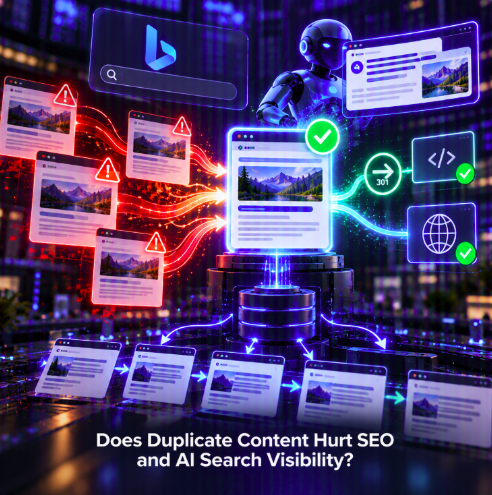

Duplicate content does not automatically trigger a search penalty, but Microsoft Bing says it can still reduce a site’s visibility in both conventional search and AI-powered discovery. In an official Bing Webmaster Blog article published December 19, 2025, Microsoft describes duplication as a signal-clarity problem: when several URLs contain the same or nearly the same information, authority can become divided, crawlers can spend resources on redundant pages, and search or AI systems can select a version the publisher did not intend. Bing’s original guidance on duplicate content is unusually explicit about extending this familiar technical SEO issue into AI search.
The distinction between a penalty and a visibility problem is essential. Bing states that duplicate and near-duplicate URLs do not harm a site simply because they exist. The problem is that they can blur the information search engines use to understand relevance and choose the right representative URL. In other words, the risk is not a mysterious punishment for duplication; it is uncertainty, fragmentation and inefficient retrieval.
Duplicate content can make a site compete against itself
When several URLs contain substantially the same material, Bing says signals such as links, clicks, impressions and engagement can become divided instead of accumulating around one preferred page. Multiple pages can also attempt to satisfy the same topic or intent, leaving the search engine to decide which version should appear. If the publisher’s canonicalization and internal signals are inconsistent, Bing may surface an outdated or unintended URL—or visibility can be weakened across the competing versions.
This is why duplicate-content cleanup is fundamentally about consolidation. The objective is to make it easy for a retrieval system to identify one authoritative representation of an idea where only one is necessary, while preserving separate URLs when they genuinely serve different audiences or intents.
AI search adds an intent-selection problem
Bing’s most consequential point is that the same ambiguity can propagate into AI experiences. Microsoft says many LLM experiences rely on information grounded in Bing or other search indexes, and that AI systems evaluate not only whether content is indexed but how clearly a page satisfies the intent behind a query. When several pages repeat the same information with similar wording, structure and metadata, determining which page should serve as the grounding source becomes harder.
This connects technical SEO directly to generative visibility. A publisher can have several crawlable, indexed pages about the same subject and still create a poor retrieval environment for an AI system. The problem is not that the model cannot find any information. It is that the model has too many weakly differentiated candidates and must choose a representative.
Bing says AI systems can cluster near-duplicate URLs
Microsoft goes further by describing a clustering behavior: near-duplicate URLs can be grouped and one page selected to represent the set. If the differences are minimal, Bing warns that the chosen page can be outdated or simply not the version the publisher wanted to highlight.
That makes canonical clarity particularly important for GEO. The relevant optimization question is no longer only whether the preferred URL ranks above a duplicate. It is whether retrieval and grounding systems can confidently recognize which version represents the current, authoritative information.
This is also why AI citation monitoring should not stop at counting mentions. NetContentSEO has previously examined how a page can appear as a citation without necessarily being the source that meaningfully shaped an AI answer. Duplicate clusters add another complication: the wrong member of a publisher’s own URL set can become the representative source.
Similarity is acceptable when the intent is genuinely different
Bing does not argue that every similar page must be merged. Campaign variants, localized pages and audience-specific experiences can legitimately coexist when they satisfy distinct needs. The problem arises when their differences are too superficial to communicate a different intent.
A seasonal offer, localized price or comparison-focused landing page can justify a separate URL. Several campaign pages that differ only in a headline, hero image or minor messaging may not. For AI retrieval, meaningful differentiation gives the system a reason to select one page for one need and another page for a different need.
Syndication can blur source attribution across domains
Duplicate content is not confined to one website. Bing specifically calls out syndicated articles: when the same article is republished elsewhere, identical copies can exist across domains, making it harder for search and AI systems to identify the original source. Microsoft recommends asking syndication partners to use a canonical pointing to the original URL when agreements permit, or syndicating an excerpt with a clear source link instead of republishing the complete article.
For publishers pursuing AI citations, this matters because distribution and attribution can work against each other. Wider syndication can increase reach, but uncontrolled full-text replication can create additional candidates for retrieval. The authoritative source needs technical and editorial signals strong enough to remain identifiable.
Localization needs substantive local value
Bing also identifies localization as a common source of duplication. Regional or language pages become problematic when they remain nearly identical and provide no meaningful distinction for users in each market. Microsoft recommends real localization through terminology, examples, regulations or product details, alongside hreflang for language and regional targeting.
The AI Search implication is straightforward. Changing a country name while preserving an otherwise identical page gives a retrieval system little evidence that the two URLs answer genuinely different needs. Local context, regulations, availability, currency, examples and market-specific facts create semantic distinctions that an AI system can use.
Technical URL duplication still matters
Not all duplication is editorial. Bing lists URL parameters, HTTP and HTTPS versions, uppercase and lowercase variants, trailing slashes, printer-friendly pages and publicly accessible staging or archive URLs among common technical causes.
These variants are particularly wasteful because they can create multiple representations without adding user value. Microsoft recommends 301 redirects when variants can be consolidated, canonical tags when several versions must remain accessible, consistent URL structures and preventing staging or archive URLs from being crawled or indexed when they should not appear in search.
Canonical tags are a clarity mechanism, not a content-quality substitute
A canonical tag tells search systems which URL a publisher prefers when several pages need to remain accessible. That can consolidate signals and reduce ambiguity, but it does not turn weak content into strong content or create meaningful differentiation where none exists.
The better architectural question is whether the duplicate should exist at all. If two URLs serve the same purpose and one is obsolete, a redirect may be cleaner. If both need to remain available for users, canonicalization can communicate the preferred representative. If the pages genuinely serve different markets or intents, the content itself should demonstrate those differences.
IndexNow accelerates cleanup after consolidation
Canonicalization and redirects describe the desired state, but search systems still need to discover the changes. Bing positions IndexNow as the acceleration layer: participating search engines can be notified when URLs are added, updated or deleted. After duplicate pages are consolidated or canonical signals change, IndexNow can help the preferred page be discovered faster and outdated duplicates leave the index sooner.
Microsoft also explicitly connects this faster propagation with AI accuracy. Its guidance says IndexNow can improve how quickly content changes reach the systems supporting AI answers while reducing unnecessary crawler activity on stale or duplicate versions.
That does not mean an IndexNow ping forces immediate canonical selection or guarantees an AI citation. It is a change-notification mechanism. Its value is reducing the delay between a publisher correcting the site and participating search engines discovering that correction.
Duplicate URLs can slow freshness in AI answers
This freshness dimension is easy to overlook. Bing says crawlers may spend time revisiting duplicate or low-value URLs rather than discovering updated content. If newer information takes longer to reach the indexes that ground AI summaries and comparisons, the generative layer can remain stale for longer.
For fast-changing subjects, this makes URL hygiene part of AI freshness strategy. A publisher updating one canonical article should not have to compete with several crawlable historical variants containing older facts.
NetContentSEO’s broader retrieval-first framework reaches a similar operational conclusion: before optimizing citations, verify that AI retrieval systems can actually find the current version of the content. Duplicate cleanup helps make that test less ambiguous.
Content audits should look for intent duplication, not only identical text
A duplicate-content audit should therefore go beyond finding exact copies. Bing recommends identifying overlapping and outdated pages, checking whether several URLs unintentionally compete for the same intent, and consolidating them so one stronger page can carry links, engagement and relevance signals.
Technical signals should be audited at the same time. Metadata, internal links, redirects, canonicals and hreflang relationships can drift as a site evolves. A page may declare one canonical while internal navigation consistently points somewhere else, or an old campaign URL may remain linked long after its replacement launches.
Bing Webmaster Tools can assist with part of this work. Microsoft says the Recommendations area can surface potential duplication signals such as excessive numbers of pages with identical titles, with affected URLs exportable for further analysis.
The goal is one clear representative for each intent
The strongest takeaway from Bing’s guidance is not that duplicate content has suddenly become a new AI penalty. Microsoft says the opposite: duplication does not trigger a search penalty on its own. The problem is the uncertainty it creates around authority, intent, crawling, freshness and source selection.
For conventional SEO, cleaner consolidation can help the intended URL accumulate signals and appear consistently. For AI Search, the same cleanup can make it easier for grounding systems to identify the right representative, distinguish genuinely different intents and retrieve updated information.
Canonical tags, redirects, hreflang, noindex and IndexNow are tools for expressing and propagating that clarity. The underlying strategy is simpler: do not make search engines and AI systems choose among unnecessary copies of your own information. Give each useful page a distinct purpose, consolidate what does not need to be separate, and make the authoritative version unmistakable.