
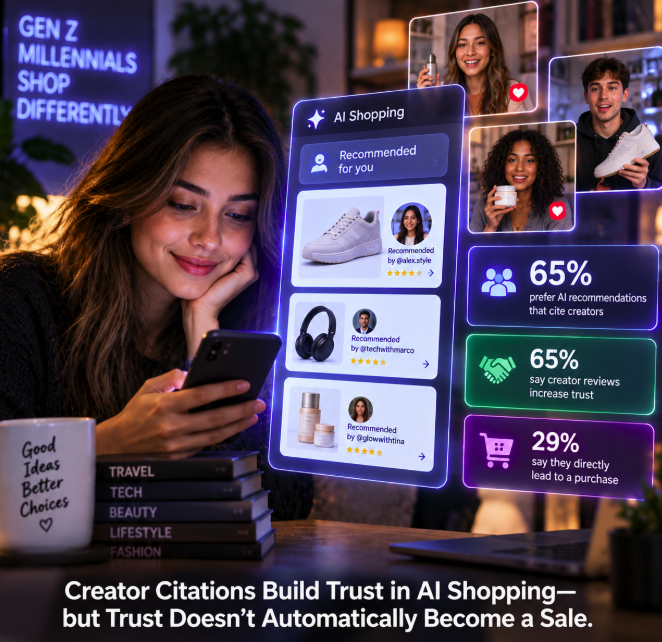
Creator content may be becoming an important trust layer inside AI shopping, but trust is not the same thing as conversion. New IAB research reported on September 18 finds that younger consumers often want generative shopping assistants to show where recommendations come from, with creator voices carrying particular weight. Yet the same data suggests that citing a creator does not automatically turn an AI recommendation into a purchase.
According to Marketing Dive’s report on the IAB study, the research surveyed 2,200 people who use AI for shopping across five countries. Among Gen Z and millennial respondents, 65% said they prefer AI recommendations that cite creators. The same share said credible creator reviews increase their trust, while only 29% said creator content directly makes them more likely to buy.
That gap is the most useful finding for marketers. Creator citations appear capable of making an AI recommendation feel more grounded and believable, but the path from credibility to checkout remains much more complicated. Brands therefore need to distinguish between content that helps an AI system justify a recommendation and content that actually changes purchasing behavior.
Creator citations give AI recommendations a human source
Generative shopping systems face a credibility problem that conventional ecommerce pages do not encounter in quite the same way. An AI assistant can confidently recommend a product, summarize its strengths and compare alternatives, but users may still wonder why the system reached that conclusion and whose experience sits behind the answer.
Creator citations can provide a recognizable layer of human evidence. A review from someone who has demonstrated the product, discussed tradeoffs and built expertise with a particular audience can make an otherwise synthetic recommendation feel more traceable. Instead of receiving only an AI-generated assertion that a shoe, camera or skincare product is suitable, the shopper can see that the recommendation is connected to an identifiable source with firsthand or specialist context.
The IAB figures suggest that this provenance matters particularly to younger consumers. A 65% preference for creator-cited AI recommendations indicates that source visibility can be part of the product experience itself, not merely a footnote added after the recommendation has already been generated.
The same 65% figure appears in trust—but purchase influence falls to 29%
The most important comparison in the study is between credibility and action. Sixty-five percent of respondents in the relevant group said credible creator reviews increase trust, yet only 29% said creator content directly increases their likelihood of purchasing. Those numbers describe different questions, so they should not be treated as a conversion funnel with a mathematically measured drop-off. They do, however, show that consumers can value creator evidence without allowing it to determine the final transaction.
That is consistent with how shopping decisions normally work. A creator can reduce uncertainty about quality, demonstrate real-world use or help a shopper understand whether a product fits a particular need. Price, availability, shipping, returns, brand familiarity, competing reviews and the shopper’s own preferences can still decide whether the recommendation becomes a sale.
For marketers, the implication is that creator content should not be evaluated only by last-click purchase influence. Inside AI shopping, its role may increasingly be to provide evidence that helps a model formulate or support a recommendation while giving the consumer a reason to trust the answer.
AI shopping may change what creator SEO looks like
Traditional creator marketing is often optimized around reach, engagement and direct response. Generative commerce adds another audience: retrieval and recommendation systems that may discover creator pages, videos, transcripts, product comparisons and reviews when assembling an answer.
This changes the value of detailed, attributable creator content. A superficial endorsement may be easy for a human follower to understand but provide little structured evidence for an AI system comparing several products. A specific review that explains use cases, limitations, alternatives and firsthand observations can be more useful both to the consumer and to a retrieval system trying to answer a precise shopping question.
The opportunity is not simply to mention brands more often. It is to produce source material that can survive being separated from the original social feed and used as evidence in a generated recommendation. Clear product naming, concrete claims, explicit comparisons and transparent experience can all make creator content easier to interpret outside its original context.
Brands need visibility in the sources AI systems trust
The IAB findings also reinforce a broader shift in generative engine optimization. A brand’s own product page is only one possible source an AI shopping assistant can use. Reviews, creator content, retailers, publishers, forums and comparison pages can all shape the information environment around a product.
That makes third-party reputation increasingly important. A company can optimize its own catalog perfectly while still being represented poorly if independent sources provide thin, outdated or negative information. Conversely, strong creator coverage can supply useful context that a brand would struggle to communicate credibly through its own marketing copy.
This does not mean brands should attempt to manufacture favorable creator consensus. Paid relationships, incentives and sponsorships need appropriate disclosure, and low-quality promotional content can undermine the very trust that creator citations are supposed to add. The strategic advantage comes from credible independent evidence, not from disguising advertising as organic opinion.
AI shopping measurement needs more than a sales metric
If creator citations primarily affect confidence rather than directly causing a purchase, marketers need a broader measurement model. Useful questions include whether creator sources appear in AI recommendations, which creators are cited, what claims the AI extracts from their content, whether the brand is compared favorably or unfavorably, and whether those citations persist across repeated prompts.
Direct sales still matter, but attribution becomes difficult when the consumer journey includes an AI assistant. A shopper might see a creator cited by an AI system, continue researching elsewhere, visit a retailer later and purchase without ever clicking the original creator source. The creator may have contributed to trust without owning the measurable final interaction.
This is one reason AI visibility cannot be reduced to citation counts alone. A citation can create credibility, support a product claim or influence which options enter a recommendation set, but those effects are different from sending traffic or generating an immediately attributable transaction.
Creators may become part of the evidence layer of commerce
The deeper change suggested by the IAB research is that creators are no longer relevant only as distribution channels. In AI-mediated shopping, their content can become part of the evidence layer from which recommendation systems construct answers.
That role favors creators who provide useful product knowledge rather than simply exposure. Detailed testing, long-term experience, comparisons, caveats and clear explanations can give AI systems more substantive material to retrieve while also helping consumers assess whether a recommendation deserves trust.
For brands, this makes creator strategy less separable from search and commerce strategy. A review published today may reach its immediate social audience, appear in search, be quoted by other publishers and later become a source in an AI-generated buying recommendation. The content can influence several discovery layers long after the original post leaves the feed.
Trust is valuable even when it is not the final conversion trigger
The temptation with the IAB figures is to focus on the apparent contrast between 65% trust and 29% purchase influence. The more useful interpretation is that creator evidence may perform an earlier job in the decision process. It can make an AI answer feel more credible without removing the shopper’s need to evaluate price, fit, risk and alternatives.
That is not a weakness of creator content. It is a reminder that credibility and conversion are different outcomes. In an AI shopping environment, the source that helps a recommendation earn trust may not be the source that receives the click, owns the checkout or receives attribution for the sale.
As shopping assistants become more influential, marketers will need to understand that distinction. Creator citations can make AI recommendations more persuasive because they connect machine-generated advice to recognizable human experience. But the IAB data suggests that brands should resist treating that trust as guaranteed revenue. The creator may help the AI win the shopper’s confidence; the product still has to win the purchase.